

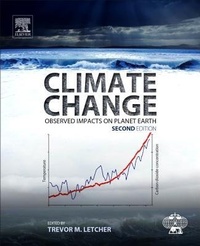
Climate Change
Observed Impacts on Planet Earth
2nd Edition
Published on 14. October 2015
Book
Paperback/Softback
632 pages
978-0-444-63524-2 (ISBN)
Description
Earth's climate is always changing. As the debate over the Earth's climate has grown, the term "climate change" has come to refer primarily to changes we've seen over recent years and those that are predicted to be coming, mainly as a result of human behavior. Climate Change: Observed Impacts on Planet Earth, Second Edition, serves as a broad, accessible guide to the science behind this often political and heated debate by providing scientific detail and evidence in language that is clear to both the climatologist and the non-specialist.
The book contains 35 chapters on all scientific aspects of climate change, written by the world's authority of each particular subject. It collects the latest information on all of these topics in one volume. In this way, readers can make connections between the various topics covered in the book, leading to new ways of solving problems and looking at related issues. The book also contains major references and details for further research and understanding on all issues related to climate change, giving a clear indication of a looming crisis in global warming and climate change.
The book contains 35 chapters on all scientific aspects of climate change, written by the world's authority of each particular subject. It collects the latest information on all of these topics in one volume. In this way, readers can make connections between the various topics covered in the book, leading to new ways of solving problems and looking at related issues. The book also contains major references and details for further research and understanding on all issues related to climate change, giving a clear indication of a looming crisis in global warming and climate change.
More details
Edition
2nd edition
Language
English
Place of publication
Oxford
United Kingdom
Publishing group
Elsevier Science & Technology
Target group
Professional and scholarly
Product notice
Paperback (trade)
Unsewn / adhesive bound
Illustrations
Approx. 200 illustrations (200 in full color)
Dimensions
Height: 235 mm
Width: 192 mm
Thickness: 35 mm
Weight
1282 gr
ISBN-13
978-0-444-63524-2 (9780444635242)
Copyright in bibliographic data and cover images is held by Nielsen Book Services Limited or by the publishers or by their respective licensors: all rights reserved.
Schweitzer Classification
Other editions
New editions
Book
02/2021
3rd Edition
Elsevier
€142.50
Shipment within 15-20 days
Additional editions
E-Book
09/2015
2nd Edition
Elsevier
€71.95
Available for download
Previous edition
Book
05/2009
Elsevier
€92.00
Shipment within 15-20 days
Person
Professor Trevor Letcher is an Emeritus Professor at the University of KwaZulu-Natal, South Africa, and living in the United Kingdom. He was previously Professor of Chemistry, and Head of Department, at the University of the Witwatersrand, Rhodes University, and Natal, in South Africa (1969-2004). He has published over 300 papers on areas such as chemical thermodynamic and waste from landfill in peer reviewed journals, and 100 papers in popular science and education journals. Prof. Letcher has edited and/or written 32 major books, of which 22 were published by Elsevier, on topics ranging from future energy, climate change, storing energy, waste, tyre waste and recycling, wind energy, solar energy, managing global warming, plastic waste, renewable energy, and environmental disasters. He has been awarded gold medals by the South African Institute of Chemistry and the South African Association for the Advancement of Science, and the Journal of Chemical Thermodynamics honoured him with a Festschrift in 2018. He is a life member of both the Royal Society of Chemistry (London) and the South African Institute of Chemistry. He is on the editorial board of the Journal of Chemical Thermodynamics, and is a Director of the Board of the International Association of Chemical Thermodynamics since 2002.
Content
PART 1: A GEOLOGICAL HISTORY OF CLIMATE CHANGE
1. A Geological History of Climate Change
PART 2: INDICATORS OF CLIMATE CHANGE
2. Global Surface Temperature- including Sea Temperature
3. Arctic Sea Ice
4. Antarctic Sea ice
5. Land Ice
6. Atmospheric Circulation
7. Weather Patterns
8. Bird Ecology
9. Mammal Ecology
10. Insect Communities
11. Sea Life (Pelagic and Planktonic)
12. Coral Reefs
13. Marine Biodiversity
14. Intertidal Indicators
15. Plant Ecology
16. Rising Sea levels
17. Ocean Currents
18. Ocean Acidification
19. Lichens
20. Coastline Degradation
21. Plant Pathogens
PART 3: MODELLING CLIMATE CHANGE
22. Statistical modelling of climate change
23. A modelling perspective of Future Climate
PART 4: POSSIBLE ROLES IN CAUSING CLIMATE CHANGE
24. The Role of Atmospheric Gases in Global Warming
25. The Variation of the Earth's Movements (orbital, tilt and precession
26. Volcanic Activity
27. Aerosols and Carbon Black particles in the Atmosphere
28. Agricultural Practices
29. Changes in the Sun's radiation
30. Space Weather and Cosmic Ray effects
PART 5: ENGINEERING AND SOCIETAL ASPECTS OF GLOBAL CHANGE OR DEALING WITH CLIMATE CHANGE
31. Engineering Aspects of Global Change
32. How Forest Managers Are Adapting to Climate Change: Science, Policy and Practice
33. Societal Adaptation to Climate Change
1. A Geological History of Climate Change
PART 2: INDICATORS OF CLIMATE CHANGE
2. Global Surface Temperature- including Sea Temperature
3. Arctic Sea Ice
4. Antarctic Sea ice
5. Land Ice
6. Atmospheric Circulation
7. Weather Patterns
8. Bird Ecology
9. Mammal Ecology
10. Insect Communities
11. Sea Life (Pelagic and Planktonic)
12. Coral Reefs
13. Marine Biodiversity
14. Intertidal Indicators
15. Plant Ecology
16. Rising Sea levels
17. Ocean Currents
18. Ocean Acidification
19. Lichens
20. Coastline Degradation
21. Plant Pathogens
PART 3: MODELLING CLIMATE CHANGE
22. Statistical modelling of climate change
23. A modelling perspective of Future Climate
PART 4: POSSIBLE ROLES IN CAUSING CLIMATE CHANGE
24. The Role of Atmospheric Gases in Global Warming
25. The Variation of the Earth's Movements (orbital, tilt and precession
26. Volcanic Activity
27. Aerosols and Carbon Black particles in the Atmosphere
28. Agricultural Practices
29. Changes in the Sun's radiation
30. Space Weather and Cosmic Ray effects
PART 5: ENGINEERING AND SOCIETAL ASPECTS OF GLOBAL CHANGE OR DEALING WITH CLIMATE CHANGE
31. Engineering Aspects of Global Change
32. How Forest Managers Are Adapting to Climate Change: Science, Policy and Practice
33. Societal Adaptation to Climate Change