

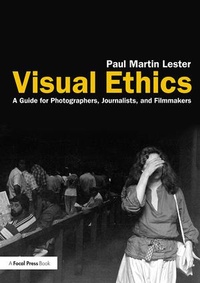
Visual Ethics
A Guide for Photographers, Journalists, and Filmmakers
1st Edition
Published on 25. January 2018
Book
Paperback/Softback
180 pages
978-1-138-21050-9 (ISBN)
Description
Visual Ethics addresses the need for critical thinking and ethical behavior among professionals responsible for visual messages in photography and photojournalism, film, and digital media. From the author of Photojournalism: An Ethical Approach, published more than 20 years ago, this book goes beyond photojournalism ethics. It discusses crucial contemporary concerns, including persuasion, stereotyping, global perspectives, graphic design decisions, multimedia production, social media, and more. Written for an ever-growing discipline, author Paul Martin Lester gives serious ethical consideration to the complex field of visual communication.
More details
Language
English
Place of publication
London
United Kingdom
Publishing group
Taylor & Francis Ltd
Target group
College/higher education
Illustrations
100 b/w images
Dimensions
Height: 254 mm
Width: 178 mm
Weight
362 gr
ISBN-13
978-1-138-21050-9 (9781138210509)
Copyright in bibliographic data and cover images is held by Nielsen Book Services Limited or by the publishers or by their respective licensors: all rights reserved.
Schweitzer Classification
Other editions
New editions
Paul Martin Lester | Stephanie A. Martin | Martin Smith-Rodden
Visual Ethics
A Guide for Photographers, Journalists, and Media Makers
Book
04/2022
2nd Edition
Routledge
€59.70
Shipment within 10-20 days
Additional editions
Book
01/2018
1st Edition
Routledge
€178.27
Article exhausted; check for reprint
Person
Paul Martin Lester is a Clinical Professor for the School of Arts, Technology, and Emerging Communication at the University of Texas at Dallas. He is the author or editor of several books that include Visual Communication: Images with Messages, Seventh Edition (2017), Digital Innovations for Mass Communications: Engaging the User (2014), and Images that Injure: Pictorial Stereotypes in the Media, Third Edition with Susan Ross (2011).
Stephanie A. Martin is an Assistant Professor of political communication in the Division of Corporate Communication and Public Affairs at Southern Methodist University. She is editor of Columns to Characters: The Presidency and the Press Enter the Digital Age (2017). Her work has also appeared in Rhetoric & Public Affairs and Visual Communication Quarterly, as well as in book chapters in several edited volumes.
Martin Smith-Rodden is an Assistant Professor for Journalism and thecoordinator of the Photojournalism Sequence at Ball State University. He holds a PhD in Applied Psychological Science and a Master of Science in Experimental Psychology from Old Dominion University. For more than three decades he's been a photojournalist, photo editor and team leader, as well as being a cognitive psychologist.
Stephanie A. Martin is an Assistant Professor of political communication in the Division of Corporate Communication and Public Affairs at Southern Methodist University. She is editor of Columns to Characters: The Presidency and the Press Enter the Digital Age (2017). Her work has also appeared in Rhetoric & Public Affairs and Visual Communication Quarterly, as well as in book chapters in several edited volumes.
Martin Smith-Rodden is an Assistant Professor for Journalism and thecoordinator of the Photojournalism Sequence at Ball State University. He holds a PhD in Applied Psychological Science and a Master of Science in Experimental Psychology from Old Dominion University. For more than three decades he's been a photojournalist, photo editor and team leader, as well as being a cognitive psychologist.
Content
1 Ethical Issues and Analytical Procedures
2 Visual Reporting
3 Documentary and Advocacy
4 Citizen Journalism
5 Advertising and Public Relations
6 Typography and Graphic Design
7 Informational Graphics and Cartoons
8 Screened Media
9 Mixed and Virtual Reality
10 Social Media
11 Editing Challenges
Conclusion: Let Empathy Be Your Guide
Appendix A: Interviews with Professionals
Appendix B: The 10-Step Systematic Ethical Analysis
Appendix C: Case Studies Using the Ten-Step SEA
2 Visual Reporting
3 Documentary and Advocacy
4 Citizen Journalism
5 Advertising and Public Relations
6 Typography and Graphic Design
7 Informational Graphics and Cartoons
8 Screened Media
9 Mixed and Virtual Reality
10 Social Media
11 Editing Challenges
Conclusion: Let Empathy Be Your Guide
Appendix A: Interviews with Professionals
Appendix B: The 10-Step Systematic Ethical Analysis
Appendix C: Case Studies Using the Ten-Step SEA