

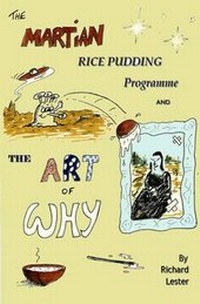
The Martian Rice Pudding Programme and the Art of Why
Published on 12. December 2009
Book
Hardback
294 pages
978-0-9564111-0-5 (ISBN)
Description
This book is suitable for anyone struggling to tell their lupins from their leptons, or their primordial soup from their Martian Rice Pudding. It is a revealing new book from an exciting new author. 'It's science explained for the creative, for the curious, for everyone', said writer Richard Lester. It is perfect for those who may be rusty on school science, fuzzy on physics, creaky on chemistry or biologically bamboozled. Do you get embarrassed by your kids asking basic questions on homework? Are you science-curious, but get bored or lost in detail? Duff teachers, maybe. Do you want to hide behind the sofa or feign bilious attack when someone shows you an equation? Or maybe you don't, and you simply like asking 'why'. Well, whether you already enjoy science or want to, you can get it all here, and smile on the way. No intimidation; no equations. Just words and pictures and passion and humour. And rice pudding, obviously. A gulf of incomprehension exists between science and the arts. This book accessibly bridges that gulf, that intimidating chasm afflicting huge numbers of people, and argues that it should never have existed in the first place.
Its market is broad; its appeal wide; its uses myriad. A good read as much as a good learn, it is a lyrical and amusing overview of science to the uninitiated whilst emphasising the importance of creativity at its beating heart. Science, it asserts, is the unrecognised art - it is the creative art of understanding beauty and truth. Few consider science post-schoolyears. Yet many people do still wonder how, what and why? A 'left-brain' bias person will read 'New Scientist', or pick up very specific, narrow-framed books maybe, or perhaps watch 'Horizon' or the Discovery channel - but what is there for the 'right-brained' person? What is there for the everyman, the everywoman, for the time-pressed, and in all a single simple, readable and entertaining volume? Nothing much - until now. Now you have a bridge across the chasm, and an invitation to explore the many wonders of the land that lies beyond. This is an inspiring overview for the everyman, bringing science back to the arts, and back to where it belongs.
Its market is broad; its appeal wide; its uses myriad. A good read as much as a good learn, it is a lyrical and amusing overview of science to the uninitiated whilst emphasising the importance of creativity at its beating heart. Science, it asserts, is the unrecognised art - it is the creative art of understanding beauty and truth. Few consider science post-schoolyears. Yet many people do still wonder how, what and why? A 'left-brain' bias person will read 'New Scientist', or pick up very specific, narrow-framed books maybe, or perhaps watch 'Horizon' or the Discovery channel - but what is there for the 'right-brained' person? What is there for the everyman, the everywoman, for the time-pressed, and in all a single simple, readable and entertaining volume? Nothing much - until now. Now you have a bridge across the chasm, and an invitation to explore the many wonders of the land that lies beyond. This is an inspiring overview for the everyman, bringing science back to the arts, and back to where it belongs.
Reviews / Votes
"An entertaining book! It also deals with some subjects about which I know depressingly little (such as biology). Well worth pursuing!" Sir Patrick Moore CBE FRS "Gloop! F-lubba lubba phlung." Martian Rice PuddingMore details
Language
English
Place of publication
Marlborough
United Kingdom
Illustrations
70 b&w / greyscale illustrations
Dimensions
Height: 235 mm
Width: 156 mm
ISBN-13
978-0-9564111-0-5 (9780956411105)
Copyright in bibliographic data and cover images is held by Nielsen Book Services Limited or by the publishers or by their respective licensors: all rights reserved.
Persons
Scientists typically explain science almost as well as local government explains planning policy: in mind-numbingly detailed jargon which bores your socks off and leaves you none the wiser (but without all the flair, exhilaration, colour and variety). Richard Lester isn't typical. Born and raised in South East Kent, Richard won the Pfizer science prize before undertaking his Physics degree at the world-renowned Imperial College. Since that time he has been, variously, a traffic penguin, medical physicist, personnel manager, programmer, analyst, actor, astronomer, writer, editor, poet, painter, project and programme manager... ...and, most importantly: Dad. He also likes cheese and cats (but not in the same sandwich) and presently lives near a jolly nice pub in darkest Wiltshire. Do pop in for a pint...
Content
Introduction 1. Biology : it moves 2. Chemistry: it smells 3. Physics : it doesn't work 4. But is it Art? 5. In the Beginning: universe formation 6. The Solar System : between a rock and a hard place 7. The Earth Today ...and probably tomorrow 8. The Whither of Weather 9. Mechanics: cause and effect 10. Gravity : it sucks 11. Time: what makes it tick? (Everything's relative.) 12. The Tingle of Electricity 13. The Animal of Magnetism 14. Shining Light on Light: a whole spectrum of possibilities 15. Thermodynamics: feeling the heat 16. Sounds and Silence 17. The Weirdness of Water 18. Quantum Mechanics and the dreams that stuff is made of 19. Summary