

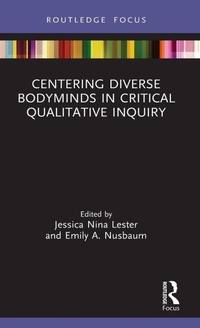
Centering Diverse Bodyminds in Critical Qualitative Inquiry
1st Edition
Published on 6. May 2021
Book
Hardback
96 pages
978-0-367-47086-9 (ISBN)
Description
Awarded the 2022 American Educational Studies Association Critics' Choice Book Award.
Centering Diverse Bodyminds in Critical Qualitative Inquiry directly responds to the call for engaging in a new critical qualitative inquiry with consideration to issues related to power, privilege, voice, identity, and agency, while examining the hegemonic power of ableism and ableist epistemologies.
The contributing authors of this edited volume advance qualitative methods and methodological discussions to a place where disability embodiment and the lived experience of disability are potential sources of method and methodological advancement. Accordingly, this book centers disability, and, in so doing, examines methodological challenges related to normative and ableist assumptions of doing qualitative research. The range of chapters included highlights how there is no singular answer to questions about qualitative method and methodology; rather, the centering of diverse bodyminds complicates the normative desire to create method/methodology that is "standard," versus thinking about method and methodology as fluid, emerging, and disruptive.
As an interdisciplinary text on critical qualitative research and disability studies with an international appeal, Centering Diverse Bodyminds in Critical Qualitative Inquiry is valuable for graduate level students and academics within a broad range of fields including critical qualitative research methodologies and methods, disability studies, cultural studies, discourse studies, education, sociology, and psychology. Disciplines that engage in the teaching of qualitative research methodologies and methods, particularly those that foreground critical qualitative research perspectives, will also find the book appealing.
Centering Diverse Bodyminds in Critical Qualitative Inquiry directly responds to the call for engaging in a new critical qualitative inquiry with consideration to issues related to power, privilege, voice, identity, and agency, while examining the hegemonic power of ableism and ableist epistemologies.
The contributing authors of this edited volume advance qualitative methods and methodological discussions to a place where disability embodiment and the lived experience of disability are potential sources of method and methodological advancement. Accordingly, this book centers disability, and, in so doing, examines methodological challenges related to normative and ableist assumptions of doing qualitative research. The range of chapters included highlights how there is no singular answer to questions about qualitative method and methodology; rather, the centering of diverse bodyminds complicates the normative desire to create method/methodology that is "standard," versus thinking about method and methodology as fluid, emerging, and disruptive.
As an interdisciplinary text on critical qualitative research and disability studies with an international appeal, Centering Diverse Bodyminds in Critical Qualitative Inquiry is valuable for graduate level students and academics within a broad range of fields including critical qualitative research methodologies and methods, disability studies, cultural studies, discourse studies, education, sociology, and psychology. Disciplines that engage in the teaching of qualitative research methodologies and methods, particularly those that foreground critical qualitative research perspectives, will also find the book appealing.
More details
Series
Language
English
Place of publication
London
United Kingdom
Publishing group
Taylor & Francis Ltd
Target group
College/higher education
Professional and scholarly
Academic, Postgraduate, Professional, and Undergraduate Advanced
Illustrations
16 s/w Abbildungen, 16 s/w Photographien bzw. Rasterbilder
16 Halftones, black and white; 16 Illustrations, black and white
Dimensions
Height: 222 mm
Width: 145 mm
Thickness: 10 mm
Weight
280 gr
ISBN-13
978-0-367-47086-9 (9780367470869)
Copyright in bibliographic data and cover images is held by Nielsen Book Services Limited or by the publishers or by their respective licensors: all rights reserved.
Schweitzer Classification
Other editions
Additional editions
Jessica Nina Lester | Emily A. Nusbaum
Centering Diverse Bodyminds in Critical Qualitative Inquiry
Book
10/2024
1st Edition
Routledge
€32.80
Shipment within 10-20 days
Jessica Nina Lester | Emily A. Nusbaum
Centering Diverse Bodyminds in Critical Qualitative Inquiry
E-Book
05/2021
1st Edition
Routledge
€27.49
Available for download
Jessica Nina Lester | Emily A. Nusbaum
Centering Diverse Bodyminds in Critical Qualitative Inquiry
E-Book
05/2021
1st Edition
Routledge
€27.49
Available for download
Persons
Jessica Nina Lester, PhD is an associate professor of inquiry methodology in the School of Education at Indiana University, Bloomington. Much of her scholarship focuses on methodological concerns at the intersection of discourse and conversation analysis and disability studies. She has most recently published in journals such as Qualitative Inquiry, Qualitative Research in Psychology, and Discourse Studies. Most recently, she co-authored a book with Sage publications titled Doing Qualitative Research in a Digital World.
Emily A. Nusbaum, PhD currently teaches at Mills College and University of San Diego. She has worked in teacher education and special education departments, has taught undergraduate and graduate level courses in disability studies in education and interdisciplinary disability studies, as well as qualitative research methods. Her research focuses on the advancement of critical, qualitative research through the centering of disability and disabled researchers, the ideology of inclusive education, and the experiences of post-secondary students who identify as disabled. Emily is invested in supporting individuals and families in accessing general education and higher education environments, which they have historically been denied access to.
Emily A. Nusbaum, PhD currently teaches at Mills College and University of San Diego. She has worked in teacher education and special education departments, has taught undergraduate and graduate level courses in disability studies in education and interdisciplinary disability studies, as well as qualitative research methods. Her research focuses on the advancement of critical, qualitative research through the centering of disability and disabled researchers, the ideology of inclusive education, and the experiences of post-secondary students who identify as disabled. Emily is invested in supporting individuals and families in accessing general education and higher education environments, which they have historically been denied access to.
Content
Introduction 1 (Re)framing Qualitative Research as a Prickly Artichoke: Peeling Back the Layers of Structural Ableism within the Institutional Research Process, Brianna Dickens and Holly Pearson 2 Bodymind Legibility and the Possibilities of Qualitative Research, Emily Nusbaum and Jessica Nina Lester 3 Sign Language Transcription and Qualitative Research Methodologies, Stephanie Kerschbaum 4 When Participatory Approaches are Inaccessible: Creating Space for Both Individual and Group Engagement, Kathleen Sitter 6 Alice Wong, Disability Visibility: Qualitative Methods, Online Archives, and Advocacy