

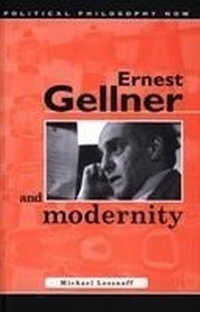
Ernest Gellner and Modernity
Published on 21. February 2002
Book
Paperback/Softback
224 pages
978-0-7083-1684-9 (ISBN)
Description
Ernest Gellner (1925 - 1995) was one of the major thinkers of the twentieth century. He held major chairs in philosophy, sociology and social anthropology during his distinguished career and contributed to a wide range of political and philosophical debates, most notably in linguistic philosophy, the theory of political nationalism and the theory of history. Gellner was also an outspoken defender of the Enlightenment tradition and social democracy. In Ernest Gellner and Modernity, Michael Lessnoff presents a lucid and coherent exposition of Gellner's thought, both in terms of the specific areas in which he worked and the underlying consistency of his theoretical principles. Lessnoff provides a context within which to evaluate Gellner's contribution to social and political thought and, in keeping with the aims of the series, demonstrates the importance of Gellner's work for contemporary political philosophy.
Reviews / Votes
'Gellner mastered an enviable range of topics and only a commentator of the quality of Michael Lessnoff would be able to draw them together in this way' 'Lessnof brings to Gellner's work the synthesis it requires' 'Gellner's work is extraordinarily challenging and only very few people could make it accessible in the way Lessnoff proposes' 'This is the first book-length treatment of the work of Ernest Gellner. It is beautifully written, essentially accurate, covers the full range of the great polymath's thought, and offers very interesting judgements of its own.' (Political Studies Review Vol. 1 No. 1 Jan. 2003)More details
Series
Language
English
Place of publication
Wales
United Kingdom
Target group
College/higher education
Professional and scholarly
Product notice
Paperback (trade)
Illustrations
Not illustrated
Dimensions
Height: 214 mm
Width: 141 mm
Thickness: 10 mm
Weight
268 gr
ISBN-13
978-0-7083-1684-9 (9780708316849)
Copyright in bibliographic data and cover images is held by Nielsen Book Services Limited or by the publishers or by their respective licensors: all rights reserved.
Schweitzer Classification
Person
Michael Lessnoff is Reader in Politics at the University of Glasgow.
Content
I Introduction II Theory of History - Human Society: structure and history, the path to modernity and other theories of modernity III Nationalism - The modernity of nationalism, the history of nationalism in Europe, Gellner's explanation of nationalism, other theories of nationalism and nationalism, the Enlightenment and democracy IV Politics in modern society - Civil society, political theory and modernity, Marxism-Leninism, democracy and the Open Society, the market economy and the role of the state, Gellner and Rawls, the future of civil society, consumerist capitalism and the threat of self-destruction V Islam - High Islam and Folk Islam, Islam and modernity, Orthodox Islam: a critique of Gellner's thesis and the Iranian Revolution VI Wittgenstein and Linguistic Philosophy - Wittgenstein's philosophy, Gellner's critique of linguistic philosophy, Wittgensteinian philosophy and social anthropology: Peter Winch, some related views in social anthropology and philosophy and postscript VII Freud and Psychoanalysis - The key doctrines of psychoanalysis, psychoanalysis and modernity, the unfalsifiability of psychoanalytic theory and the report of the Research Committee of the International Psychoanalytic Association VIII Relativism, Cognitive Ethics and the Philosophy of Science - The problem of relativism, an intellectual history of Western man, relativism and the theory of progress, modern science, science as an ethic of cognition, mechanism and empiricism and the political philosophy of science IX Ernest Gellner's Achievement in Perspective