

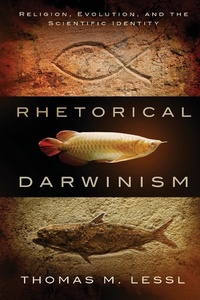
Rhetorical Darwinism
Religion, Evolution, and the Scientific Identity
Published on 18. March 2019
Book
Paperback/Softback
348 pages
978-1-60258-404-4 (ISBN)
Description
Everything evolves, science tells us, including the public language used by scientists to sustain and perpetuate their work. Harkening back to the Protestant Reformation--a time when the promise of scientific inquiry was intimately connected with a deep faith in divine Providence--Thomas Lessl traces the evolving role and public identity of science in the West.
As the Reformation gave way to the Enlightenment, notions of Providence evolved into progress. History's divine plan could now be found in nature, and scientists became history's new prophets. With Darwin and the emergence of evolutionary science, progress and evolution collapsed together into what Lessl calls ""evolutionism,"" and the grand scientific identity was used to advance science's power into the world.
In this masterful treatment, Lessl analyzes the descent of these patterns of scientific advocacy from the world of Francis Bacon into the world of Thomas Huxley and his successors. In the end, Rhetorical Darwinism proposes that Darwin's power to fuel the establishment of science within the Western social milieu often turns from its scientific course.
Rhetorical Darwinism: Religion, Evolution, and the Scientific Identity received the Religious Communication Associatons ""Book of the Year"" award in 2012.
As the Reformation gave way to the Enlightenment, notions of Providence evolved into progress. History's divine plan could now be found in nature, and scientists became history's new prophets. With Darwin and the emergence of evolutionary science, progress and evolution collapsed together into what Lessl calls ""evolutionism,"" and the grand scientific identity was used to advance science's power into the world.
In this masterful treatment, Lessl analyzes the descent of these patterns of scientific advocacy from the world of Francis Bacon into the world of Thomas Huxley and his successors. In the end, Rhetorical Darwinism proposes that Darwin's power to fuel the establishment of science within the Western social milieu often turns from its scientific course.
Rhetorical Darwinism: Religion, Evolution, and the Scientific Identity received the Religious Communication Associatons ""Book of the Year"" award in 2012.
Reviews / Votes
From the beginnings of the scientific revolution, demarcating the boundaries of science has been a problem for the scientific community. Thomas Lessl, comparing 'evolution' with what he calls 'rhetorical Darwinism,' argues persuasively that the scientific establishment has never guarded those borders carefully. -- Christianity Today This is a superb piece of scholarship that ranges widely across disciplinary boundaries, shedding light on the underlying humanity of scientific inquiry and, ultimately, on its politics and sociology as well. Lessl asks novel questions about axiology and ontology and, in so doing, he becomes Charles Darwin's amaneusis for a new age. -- Roderick P. Hart, Dean, Shivers/Cronkite Chair in Communication, University of TexasMore details
Series
Language
English
Place of publication
Waco
United States
Target group
Professional and scholarly
Product notice
Paperback (trade)
Dimensions
Height: 229 mm
Width: 152 mm
Thickness: 20 mm
Weight
538 gr
ISBN-13
978-1-60258-404-4 (9781602584044)
Copyright in bibliographic data and cover images is held by Nielsen Book Services Limited or by the publishers or by their respective licensors: all rights reserved.
Schweitzer Classification
Person
Thomas M. Lessl is a Professor in the Department of Communication Studies at the University of Georgia. A frequent contributor to the Journal of Communication and Religion and the Quarterly Journal of Speech, Lessl received the 2010 Religious Communication Association's Article Award for ""The Innate Religiosity of Political Rhetoric."" He lives in Athens, Georgia.
Content
1. The Social Meaning of Evolutionary Rhetoric
2. Francis Bacon and the Scientific Identity
3. Science in God's Bosom
4. From Two Books to One
5. The New Christianity
6. Positivism in the World of Thomas Huxley
7. Scientism Scientized
8. The Continuing Education of Evolutionism and Science's Battle for the Public Mind
2. Francis Bacon and the Scientific Identity
3. Science in God's Bosom
4. From Two Books to One
5. The New Christianity
6. Positivism in the World of Thomas Huxley
7. Scientism Scientized
8. The Continuing Education of Evolutionism and Science's Battle for the Public Mind