

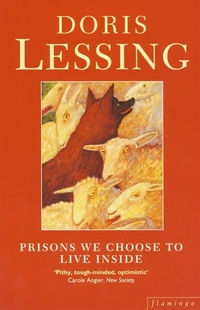
Prisons We Choose to Live Inside
Published on 23. May 1994
Book
Paperback/Softback
96 pages
978-0-00-654628-3 (ISBN)
Description
The companion to a series of lectures given by Lessing, winner of the Nobel Prize for Literature, in which she addresses some of the most important questions facing us today.
'This is a time when it is frightening to be alive, when it is hard to think of human beings as rational creatures. Everywhere we look we see brutality, stupidity, until it seems that there is nothing else to be seen but that - a descent into barbarism, everywhere, which we are unable to check. But I think that while it is true there is a general worsening, it is precisely because things are so frightening we become hypnotized, and do not notice - or if we notice, belittle - equally strong forces on the other side, the forces, in short, of reason, sanity and civilization ...'
In this published version of a series of perceptive and thought-provoking lectures, Lessing stresses the importance of independent thought, of questioning received opinion and fighting the lure of apathy. She argues that only if we are free to interrogate authority and disagree that despotism and ignorance can be defeated. We must examine 'ideas, from whatever source they come, to see how they may usefully contribute to our lives and to the societies we live in'.
'This is a time when it is frightening to be alive, when it is hard to think of human beings as rational creatures. Everywhere we look we see brutality, stupidity, until it seems that there is nothing else to be seen but that - a descent into barbarism, everywhere, which we are unable to check. But I think that while it is true there is a general worsening, it is precisely because things are so frightening we become hypnotized, and do not notice - or if we notice, belittle - equally strong forces on the other side, the forces, in short, of reason, sanity and civilization ...'
In this published version of a series of perceptive and thought-provoking lectures, Lessing stresses the importance of independent thought, of questioning received opinion and fighting the lure of apathy. She argues that only if we are free to interrogate authority and disagree that despotism and ignorance can be defeated. We must examine 'ideas, from whatever source they come, to see how they may usefully contribute to our lives and to the societies we live in'.
More details
Language
English
Place of publication
London
United Kingdom
Publishing group
HarperCollins Publishers
Target group
College/higher education
Product notice
Unsewn / adhesive bound
Paperback (UK-B)
Dimensions
Height: 203 mm
Width: 127 mm
Thickness: 7 mm
Weight
111 gr
ISBN-13
978-0-00-654628-3 (9780006546283)
Copyright in bibliographic data and cover images is held by Nielsen Book Services Limited or by the publishers or by their respective licensors: all rights reserved.
Schweitzer Classification
Other editions
Additional editions
Person
Doris Lessing was one of the most important writers of the second half of the 20th-century and was awarded the Nobel Prize for Literature 2007. Her novels include The Grass is Singing, The Golden Notebook and The Good Terrorist. In 2001, Lessing was awarded the David Cohen Prize for a lifetime's achievement in British literature. In 2008, The Times ranked her fifth on a list of "The 50 greatest British writers since 1945". She died in 2013.