

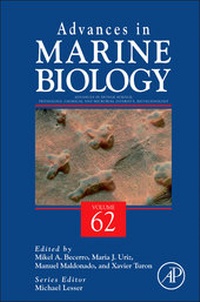
Advances in Sponge Science: Physiology, Chemical and Microbial Diversity, Biotechnology: Volume 62
Published on 26. June 2012
Book
Hardback
374 pages
978-0-12-394283-8 (ISBN)
Description
One of two special issues of Advances in Marine Biology focusing on sponge science, it features comprehensive reviews of the latest studies that are advancing our understanding of the fascinating marine phylum Porifera. The selected contributors are internationally renowned researchers in their respective fields and provide a thorough overview of the state-of-the-art of sponge science.
More details
Series
Language
English
Place of publication
San Diego
United States
Publishing group
Elsevier Science Publishing Co Inc
Target group
Professional and scholarly
Postgraduates and researchers in marine biology, fisheries science, ecology, zoology, oceanography
Dimensions
Height: 229 mm
Width: 152 mm
Weight
730 gr
ISBN-13
978-0-12-394283-8 (9780123942838)
Copyright in bibliographic data and cover images is held by Nielsen Book Services Limited or by the publishers or by their respective licensors: all rights reserved.
Schweitzer Classification
Other editions
Additional editions
Michael Lesser
Advances in Sponge Science: Physiology, Chemical and Microbial Diversity, Biotechnology
Physiology, Chemical and Microbial Diversity, Biotechnology
E-Book
06/2012
1st Edition
Academic Press
from
€148.00
Available for download
Person
Educational Background
Ph. D., University of Maine, Zoology, 1989
M.S., University of New Hampshire, Microbiology, 1985
B.A., University of New Hampshire, Microbiology, Minor: Zoology, 1983
A.S. George Washington University, Medical Laboratory Science, 1977
Courses Taught
Biological Oceanography, Physiological Ecology, Marine Biology, Marine Microbiology, General Microbiology, Immunology, Biology and Ecology of Coral Reefs
Current Research Interests
My principal focus involve understanding how taxonomically diverse marine organisms respond physiologically to changes in their environment. In particular I'm interested in how organismal physiology can influence the ecology of marine organisms. As a physiological ecologist my students and I answer these types of questions by utilizing field and laboratory experiments, as well as a wide range of techniques from molecular biology to in situ measurements. Currently my research encompasses four major areas;
1) Biochemistry and molecular genetics of oxidative stress in marine organisms associated with exposure to ultraviolet radiation, elevated temperatures, or hyperoxic conditions.
2) Physiological ecology of marine invertebrates and phytoplankton, physiological responses to changes in the environment, bacterial- and algal-invertebrate symbioses, and the trophic biology of suspension-feeding invertebrates.
3) Ecology and photobiology of mesophotic coral reefs.
4) Underwater technology, use of technical diving for scientific research.
Ph. D., University of Maine, Zoology, 1989
M.S., University of New Hampshire, Microbiology, 1985
B.A., University of New Hampshire, Microbiology, Minor: Zoology, 1983
A.S. George Washington University, Medical Laboratory Science, 1977
Courses Taught
Biological Oceanography, Physiological Ecology, Marine Biology, Marine Microbiology, General Microbiology, Immunology, Biology and Ecology of Coral Reefs
Current Research Interests
My principal focus involve understanding how taxonomically diverse marine organisms respond physiologically to changes in their environment. In particular I'm interested in how organismal physiology can influence the ecology of marine organisms. As a physiological ecologist my students and I answer these types of questions by utilizing field and laboratory experiments, as well as a wide range of techniques from molecular biology to in situ measurements. Currently my research encompasses four major areas;
1) Biochemistry and molecular genetics of oxidative stress in marine organisms associated with exposure to ultraviolet radiation, elevated temperatures, or hyperoxic conditions.
2) Physiological ecology of marine invertebrates and phytoplankton, physiological responses to changes in the environment, bacterial- and algal-invertebrate symbioses, and the trophic biology of suspension-feeding invertebrates.
3) Ecology and photobiology of mesophotic coral reefs.
4) Underwater technology, use of technical diving for scientific research.
Content
1- The physiology and molecular biology of sponge tissues
Sally P. Leys and April Hill
2- Sponge-microbe symbioses: recent advances and new directions
Robert W. Thacker and Christopher J. Freeman
3- Nutrient fluxes through sponges: biology, budgets, and ecological implications
Manuel Maldonado, Marta Ribes and Fleur C. van Duyl
4- Sponge chemical diversity: from biosynthetic pathways to ecological roles
Gregory Genta-Jouve and Olivier P. Thomas
5- Biosilica: molecular biology, biochemistry and function in demosponges as well
as its applied aspects for tissue engineering
Xiaohong Wang, Heinz C. Schroeder, Matthias Wiens, Ute Schlossmacher and Werner
E.G. Mueller
6- Cultivation of sponges, sponge cells and symbionts: achievements and future prospects
Klaske J. Schippers, Detmer Sipkema, Ronald Osinga, Hauke Smidt, Shirley A.
Pomponi, Dirk E. Martens and Rene H. Wijffels
Sally P. Leys and April Hill
2- Sponge-microbe symbioses: recent advances and new directions
Robert W. Thacker and Christopher J. Freeman
3- Nutrient fluxes through sponges: biology, budgets, and ecological implications
Manuel Maldonado, Marta Ribes and Fleur C. van Duyl
4- Sponge chemical diversity: from biosynthetic pathways to ecological roles
Gregory Genta-Jouve and Olivier P. Thomas
5- Biosilica: molecular biology, biochemistry and function in demosponges as well
as its applied aspects for tissue engineering
Xiaohong Wang, Heinz C. Schroeder, Matthias Wiens, Ute Schlossmacher and Werner
E.G. Mueller
6- Cultivation of sponges, sponge cells and symbionts: achievements and future prospects
Klaske J. Schippers, Detmer Sipkema, Ronald Osinga, Hauke Smidt, Shirley A.
Pomponi, Dirk E. Martens and Rene H. Wijffels