

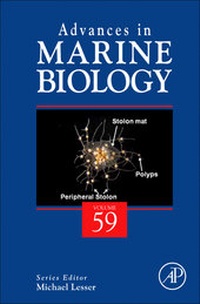
Advances in Marine Biology: Volume 59
Published on 1. July 2011
Book
Hardback
212 pages
978-0-12-385536-7 (ISBN)
Description
Advances in Marine Biology has been providing in-depth and up-to-date reviews on all aspects of marine biology since 1963 -- over 45 years of outstanding coverage! The series is well-known for both its excellence of reviews and editing. Now edited by Michael Lesser, with an internationally renowned Editorial Board, the serial publishes in-depth and up-to-date content on a wide range of topics that will appeal to postgraduates and researchers in marine biology, fisheries science, ecology, zoology, and biological oceanography.
More details
Series
Language
English
Place of publication
San Diego
United States
Publishing group
Elsevier Science Publishing Co Inc
Target group
Professional and scholarly
Postgraduates and researchers in marine biology, fisheries science, ecology, zoology, oceanography
Dimensions
Height: 229 mm
Width: 152 mm
Weight
490 gr
ISBN-13
978-0-12-385536-7 (9780123855367)
Copyright in bibliographic data and cover images is held by Nielsen Book Services Limited or by the publishers or by their respective licensors: all rights reserved.
Schweitzer Classification
Other editions
Additional editions
Michael P. Lesser
Advances in Marine Biology
E-Book
06/2011
1st Edition
Academic Press
from
€155.00
Available for download
Person
Educational Background
Ph. D., University of Maine, Zoology, 1989
M.S., University of New Hampshire, Microbiology, 1985
B.A., University of New Hampshire, Microbiology, Minor: Zoology, 1983
A.S. George Washington University, Medical Laboratory Science, 1977
Courses Taught
Biological Oceanography, Physiological Ecology, Marine Biology, Marine Microbiology, General Microbiology, Immunology, Biology and Ecology of Coral Reefs
Current Research Interests
My principal focus involve understanding how taxonomically diverse marine organisms respond physiologically to changes in their environment. In particular I'm interested in how organismal physiology can influence the ecology of marine organisms. As a physiological ecologist my students and I answer these types of questions by utilizing field and laboratory experiments, as well as a wide range of techniques from molecular biology to in situ measurements. Currently my research encompasses four major areas;
1) Biochemistry and molecular genetics of oxidative stress in marine organisms associated with exposure to ultraviolet radiation, elevated temperatures, or hyperoxic conditions.
2) Physiological ecology of marine invertebrates and phytoplankton, physiological responses to changes in the environment, bacterial- and algal-invertebrate symbioses, and the trophic biology of suspension-feeding invertebrates.
3) Ecology and photobiology of mesophotic coral reefs.
4) Underwater technology, use of technical diving for scientific research.
Ph. D., University of Maine, Zoology, 1989
M.S., University of New Hampshire, Microbiology, 1985
B.A., University of New Hampshire, Microbiology, Minor: Zoology, 1983
A.S. George Washington University, Medical Laboratory Science, 1977
Courses Taught
Biological Oceanography, Physiological Ecology, Marine Biology, Marine Microbiology, General Microbiology, Immunology, Biology and Ecology of Coral Reefs
Current Research Interests
My principal focus involve understanding how taxonomically diverse marine organisms respond physiologically to changes in their environment. In particular I'm interested in how organismal physiology can influence the ecology of marine organisms. As a physiological ecologist my students and I answer these types of questions by utilizing field and laboratory experiments, as well as a wide range of techniques from molecular biology to in situ measurements. Currently my research encompasses four major areas;
1) Biochemistry and molecular genetics of oxidative stress in marine organisms associated with exposure to ultraviolet radiation, elevated temperatures, or hyperoxic conditions.
2) Physiological ecology of marine invertebrates and phytoplankton, physiological responses to changes in the environment, bacterial- and algal-invertebrate symbioses, and the trophic biology of suspension-feeding invertebrates.
3) Ecology and photobiology of mesophotic coral reefs.
4) Underwater technology, use of technical diving for scientific research.
Content
p53 Signaling in Mollusks and Other Marine Invertebrates: Evidence for Conservation of DNA Editing and Repair, Cellular Senescence and Apoptotic Pathways.
Charles Walker
Trophic Level Dysfunction and the Resilience of Coral Reef Ecosystems
Robert Steneck
Vascular architecture and the limits of morphological plasticity in colonial cnidarians
Steven Dudgeon
Charles Walker
Trophic Level Dysfunction and the Resilience of Coral Reef Ecosystems
Robert Steneck
Vascular architecture and the limits of morphological plasticity in colonial cnidarians
Steven Dudgeon