

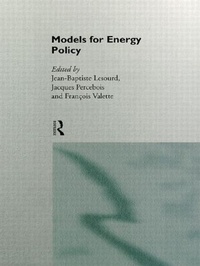
Models for Energy Policy
Published on 9. November 1995
Book
Hardback
288 pages
978-0-415-12975-6 (ISBN)
Description
Energy policy is a key area in each of the world's economies. The oil shocks of the 1970's emphasised how important energy had become. In recent years a growing awareness of environmental issues has had a major impact on perceptions of energy use as growing numbers of people express concern at the relationship between energy and the greenhouse effect, acid rain and the depletion of the ozone layer. All of this has created a demand for more, and better, models of energy use.
More details
Series
Language
English
Place of publication
London
United Kingdom
Publishing group
Taylor & Francis Ltd
Target group
College/higher education
Professional and scholarly
Postgraduate and Professional
Dimensions
Height: 234 mm
Width: 156 mm
Weight
690 gr
ISBN-13
978-0-415-12975-6 (9780415129756)
Copyright in bibliographic data and cover images is held by Nielsen Book Services Limited or by the publishers or by their respective licensors: all rights reserved.
Schweitzer Classification
Other editions
Additional editions
Jean-Baptiste Lesourd | Jacques Percebois | Francois Valette
Models for Energy Policy
E-Book
11/1995
1st Edition
Routledge
€60.49
Available for download
Jean-Baptiste Lesourd | Jacques Percebois | Francois Valette
Models for Energy Policy
E-Book
11/1995
1st Edition
Routledge
€60.49
Available for download
Persons
Jean-Baptiste Lesourd is at GREQAM, Universities of Aix-Marseille. Jacques Percebois is at the Faculte des Sciences Economiques, University of Montpellier-I, Montpellier. Francois Valette is at CNRS, Montpellier.
Content
Part I New models and new modelling methodologies 1 Methodological advances in energy modelling: 1970-90, 2 International markets and energy prices: the POLES model 3 ERASME: a short-term energy forecasting model for the European Community 4 The energy model MIDAS 5 Bi-proportional methods and inter-industrial dynamics: application to energy demand in France 6 Gas contract portfolio management: experiments with a stochastic programming approach 7 Modelling the European gas a market: a comparison of several scenarios Part II Application to particular energy policy problems 8 World energy outlooks 9 Energy shocks and the demand for energy 10 Modelling the petroleum spot market: a vector autoregressive approach 11 Fiscal harmonization on oil products within the EC: problems and prospects 12 Energy tax increases as a way to reduce CO2 Emissions 13 Energy conservation and economic performance in Japan: an econometric approach 14 Electricity futures markets