

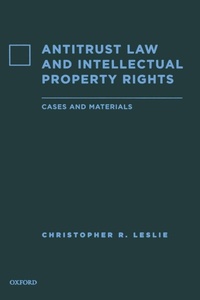
Antitrust Law and Intellectual Property Rights
Cases and Materials
Published on 23. December 2010
Book
Hardback
704 pages
978-0-19-533719-8 (ISBN)
Description
In Antitrust Law and Intellectual Property Rights: Cases and Materials, Christopher R. Leslie describes how patents, copyrights, and trademarks confer exclusionary rights on their owners, and how firms sometimes exercise this exclusionary power in ways that exceed the legitimate bounds of their intellectual property rights. Leslie explains that while substantive intellectual property law defines the scope of the exclusionary rights, antitrust law often provides the most important consequences when owners of intellectual property misuse their rights in a way that harms consumers or illegitimately excludes competitors. Antitrust law defines the limits of what intellectual property owners can do with their IP rights. In this book, Leslie explores what conduct firms can and cannot engage in while acquiring and exploiting their intellectual property rights, and surveys those aspects of antitrust law that are necessary for both antitrust practitioners and intellectual property attorneys to understand. This book is ideal for an advanced antitrust course in a JD program. In addition to building on basic antitrust concepts, it fills in a gap that is often missing in basic antitrust courses yet critical for an intellectual property lawyer: the intersection of intellectual property and antitrust law. The relationship between intellectual property and antitrust is particularly valuable as an increasing number of law schools offer specializations and LLMs in intellectual property. This book also provides meaningful material for both undergraduate and graduate business schools programs because it explains how antitrust law limits the marshalling of intellectual property rights.
More details
Language
English
Place of publication
New York
United States
Target group
Professional and scholarly
Dimensions
Height: 260 mm
Width: 183 mm
Thickness: 42 mm
Weight
1493 gr
ISBN-13
978-0-19-533719-8 (9780195337198)
Copyright in bibliographic data and cover images is held by Nielsen Book Services Limited or by the publishers or by their respective licensors: all rights reserved.
Schweitzer Classification
Person
Christopher R. Leslie is a Professor of Law at the University of California, Irvine School of Law. He has been a Visiting Professor of Law at Stanford Law School, the University of Texas School of Law, and N.Y.U. School of Law. Professor Leslie's scholarship has appeared in the University of Pennsylvania Law Review, the California Law Review, Texas Law Review, the UCLA Law Review, the Iowa Law Review, the Minnesota Law Review, and the William & Mary Law Review, among others. He is a co-author on the leading treatise on the intersection of antitrust law and intellectual property rights, IP AND ANTITRUST: AN ANALYSIS OF ANTITRUST PRINCIPLES APPLIED TO INTELLECTUAL PROPERTY (2d. ed. 2009) (co-author with Herbert Hovenkamp, Mark D. Janis & Mark A. Lemley). Professor Leslie graduated from the University of California, Berkeley School of Law, where he served as an editor on the California Law Review and was elected to the Order of the Coif.
Content
Part One:
The Foundations of the Intersection Between Antitrust Law and Intellectual Property Rights
Chapter One: A Primer on Intellectual Property Law
Chapter Two: A Primer on Antitrust Law
Chapter Three: The Tension Between Antitrust and Intellectual Property
Part Two:
The Antitrust Implications of Unilateral Conduct by Intellectual Property Owners
Chapter Four: Enforcement of Intellectual Property Rights
Chapter Five: Tying Arrangements and Intellectual Property
Chapter Six: Unilateral Refusals to License or Deal
Chapter Seven: Design Changes and Predatory Innovation
Chapter Eight: Deceptive Conduct Before Standard-Setting Organizations
Part Three:
The Antitrust Implications of Horizontal Agreements Involving Intellectual Property
Chapter Nine: Price Fixing and Intellectual Property
Chapter Ten: Market Allocation and Intellectual Property Rights
Chapter Eleven: Pharmaceutical Settlements and Reverse Payments
Chapter Twelve: Agreements to Buy and Sell Intellectual Property as an Antitrust Violation
Chapter Thirteen: Group Boycotts and Concerted Refusals to Deal or License
Part Four:
The Antitrust Implications of Vertical Agreements Involving Intellectual Property
Chapter Fourteen: Vertical Price Restraints and Intellectual Property
Chapter Fifteen: Non-Price Licensing Restrictions
Chapter Sixteen: The Antitrust Implications of Structuring Royalties
Part Five: Injury, Remedies, Jurisdiction And Procedural Issues
Chapter Seventeen: Standing and Antitrust Injury
Chapter Eighteen: Remedies
Chapter Nineteen: Jurisdiction and Procedural Issues
Appendix A: Statutory Supplement
Appendix B: Antitrust Guidelines for the Licensing of Intellectual Property
The Foundations of the Intersection Between Antitrust Law and Intellectual Property Rights
Chapter One: A Primer on Intellectual Property Law
Chapter Two: A Primer on Antitrust Law
Chapter Three: The Tension Between Antitrust and Intellectual Property
Part Two:
The Antitrust Implications of Unilateral Conduct by Intellectual Property Owners
Chapter Four: Enforcement of Intellectual Property Rights
Chapter Five: Tying Arrangements and Intellectual Property
Chapter Six: Unilateral Refusals to License or Deal
Chapter Seven: Design Changes and Predatory Innovation
Chapter Eight: Deceptive Conduct Before Standard-Setting Organizations
Part Three:
The Antitrust Implications of Horizontal Agreements Involving Intellectual Property
Chapter Nine: Price Fixing and Intellectual Property
Chapter Ten: Market Allocation and Intellectual Property Rights
Chapter Eleven: Pharmaceutical Settlements and Reverse Payments
Chapter Twelve: Agreements to Buy and Sell Intellectual Property as an Antitrust Violation
Chapter Thirteen: Group Boycotts and Concerted Refusals to Deal or License
Part Four:
The Antitrust Implications of Vertical Agreements Involving Intellectual Property
Chapter Fourteen: Vertical Price Restraints and Intellectual Property
Chapter Fifteen: Non-Price Licensing Restrictions
Chapter Sixteen: The Antitrust Implications of Structuring Royalties
Part Five: Injury, Remedies, Jurisdiction And Procedural Issues
Chapter Seventeen: Standing and Antitrust Injury
Chapter Eighteen: Remedies
Chapter Nineteen: Jurisdiction and Procedural Issues
Appendix A: Statutory Supplement
Appendix B: Antitrust Guidelines for the Licensing of Intellectual Property