

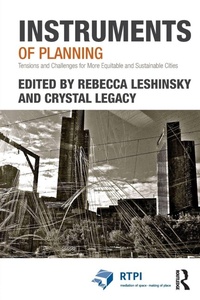
Instruments of Planning
Tensions and challenges for more equitable and sustainable cities
1st Edition
Published on 10. August 2015
Book
Paperback/Softback
276 pages
978-1-138-81205-5 (ISBN)
Description
Instruments of Planning: Tensions and Challenges for more Equitable and Sustainable Cities critically explores planning's instrumentality to deliver important social and environmental outcomes in neoliberal planning landscapes. Because each instrument is unique and may be tailored to its own jurisdictional needs, Instruments of Planning is a compendium of case studies from urban regions in Australia, Canada, the United States and Europe, providing readers with a collection that critically challenges the role and potential of planning instruments and instrumentality across a range of contexts.
Instruments of Planning captures the political, institutional, and economic challenges that confront planning. It examines planning instruments designed to assist with strategic planning and implementation, and considers the role that technology plays in unpacking and understanding complexity in planning.
Written by Rebecca Leshinsky and Crystal Legacy of RMIT University in Melbourne, Australia, this book fills the gap in planning theory about the instrumentality of planning in the neoliberal urban context. It is essential reading for students, urban researchers, policy analysts and planning practitioners.
Instruments of Planning captures the political, institutional, and economic challenges that confront planning. It examines planning instruments designed to assist with strategic planning and implementation, and considers the role that technology plays in unpacking and understanding complexity in planning.
Written by Rebecca Leshinsky and Crystal Legacy of RMIT University in Melbourne, Australia, this book fills the gap in planning theory about the instrumentality of planning in the neoliberal urban context. It is essential reading for students, urban researchers, policy analysts and planning practitioners.
Reviews / Votes
"Leshinsky and Legacy present a timely collection of state-of-the-art chapters on current problems and creative solutions regarding spatial planning, law, and property rights. This book explores the pertinent question of who owns, who plans, and who has the power to facilitate change." - Ben Davy, TU Dortmund University"This book presents a collection of case studies and synthetic analyses speaking to the challenges confronting urban centers in light of the global push for neoliberal policies that privilege markets, competitiveness, and individual advancement, sometimes at the expense of individual equity and community welfare. It provides an important and timely check on how well conventional planning systems are positioned--or not--to address these larger forces, along with insights on how to reform those planning systems to better address challenges ahead." - Richard K. Norton, University of Michigan
More details
Series
Language
English
Place of publication
London
United Kingdom
Publishing group
Taylor & Francis Ltd
Target group
College/higher education
Illustrations
23 s/w Photographien bzw. Rasterbilder, 11 s/w Zeichnungen, 13 s/w Tabellen
13 Tables, black and white; 11 Line drawings, black and white; 23 Halftones, black and white
Dimensions
Height: 234 mm
Width: 156 mm
Thickness: 15 mm
Weight
430 gr
ISBN-13
978-1-138-81205-5 (9781138812055)
Copyright in bibliographic data and cover images is held by Nielsen Book Services Limited or by the publishers or by their respective licensors: all rights reserved.
Schweitzer Classification
Other editions
Additional editions
Rebecca Leshinsky | Crystal Legacy
Instruments of Planning
Tensions and challenges for more equitable and sustainable cities
Book
08/2015
1st Edition
Routledge
€272.50
Shipment within 10-20 days
Rebecca Leshinsky | Crystal Legacy
Instruments of Planning
Tensions and challenges for more equitable and sustainable cities
E-Book
08/2015
Routledge
€77.49
Available for download
Rebecca Leshinsky | Crystal Legacy
Instruments of Planning
Tensions and challenges for more equitable and sustainable cities
E-Book
08/2015
Routledge
€77.99
Available for download
Persons
Rebecca Leshinsky is a Senior Lecturer in Property, School of Property, Construction and Project Management, RMIT University, Melbourne, Australia, and the author of a number of practitioner books in the areas of property and strata law.
Crystal Legacy is an Australian Research Council (DECRA) Fellow and a Vice Chancellor's Research Fellow in the Centre for Urban Research at RMIT University. She is co-editor of Building Inclusive Cities: Women's safety and the right to the city (Routledge).
Crystal Legacy is an Australian Research Council (DECRA) Fellow and a Vice Chancellor's Research Fellow in the Centre for Urban Research at RMIT University. She is co-editor of Building Inclusive Cities: Women's safety and the right to the city (Routledge).
Content
1. Planning instruments and the urban change process Part 1. Planning challenges in a context of discontinuous growth 2. Towards equitable intensification: Restricting developer gain and compensating planning costs 3. Freedom's prospect? Re-thinking red and green tape reform as a planning instrument 4. The problem/solution nexus and its effects on public consultation Part 2. Designing strategies for change 5. Community deliberation as a procedural planning tool: Examination of Vancouver and Melbourne 6. Targets for affordable housing: Supporting equitable and sustainable urban growth 7. Social impact assessment: Strategic litigation tool for planning law decision makers 8. A design-led approach for enabling collective imagining of sustainable urban futures Part 3. Instruments to implement change 9. Would you like a code with that? Place-based planning and mapping neighbourhood fields of care 10. Transferable development credits put growth in its place 11. Managing urban intensification through conservation covenants 12. Regenerating cities: Creating the opportunity for greyfield precinct infill development Part 4. Technology in planning: Supporting urban policy and decision-making 13. Policy and planning on the interface of socio-technical systems: Novel approaches to policy development 14. Engaging the greyfields: Community engagement and co-design in residential redevelopment of public housing 15. Technology in urban planning: Spatial hedonic house price model as an information tool 16. Instruments of planning: tensions and challenges for more equitable and sustainable cities