

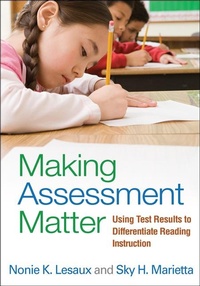
Making Assessment Matter
Using Test Results to Differentiate Reading Instruction
1st Edition
Published on 11. January 2012
Book
Paperback/Softback
143 pages
978-1-4625-0246-2 (ISBN)
Description
All too often, literacy assessments are given only for accountability purposes and fail to be seen as valuable resources for planning and differentiating instruction. This clear, concise book shows K-5 educators how to implement a comprehensive, balanced assessment battery that integrates accountability concerns with data-driven instruction. Teachers learn to use different types of test scores to understand and address students' specific learning needs. The book features an in-depth case example of a diverse elementary school that serves many struggling readers and English language learners. Reproducible planning and progress monitoring forms can be downloaded and printed in a convenient 8 1/2 x 11 size.
Reviews / Votes
This is one of the strongest and most engaging books I have ever read. It speaks directly to teachers about issues that are meaningful to them. I love the book's focus on code- and meaning-based skills, assessment, and instruction. Lesaux and Marietta provide the tools for teachers and schools to bring these ideas to their classrooms. Especially appealing are the realistic examples and the careful scaffolding of assessment practices. I work in high-poverty, low-performing schools on a routine basis, and this book needs to be in the hands of teachers and principals in these schools. It will make a difference to student learning. I would also use the book in my undergraduate course on early literacy and my graduate course on assessment.--Diane M. Barone, EdD, Foundation Professor of Literacy Studies, University of Nevada, RenoI wish this book had been available 12 years ago when I first began to work on a whole-school change process. It is an important, uniquely helpful resource that I highly recommend to literacy leaders, coaches, and administrators as a road map for effecting literacy improvement through sensible alignment of assessment and instruction. The authors have managed to capture the complex nature of reading and reading difficulties, while not making the discussion complicated! I especially appreciated the focus on providing high-quality classroom instruction (for the good of the whole class) while acknowledging the individual needs of specific students. The respectful tone and clear recommendations for more deliberate instruction will make this book a welcome addition to the library of anyone committed to improving reading for all students.--Marjorie Y. Lipson, PhD, Professor Emerita of Education, University of Vermont
Lesaux and Marietta clearly know what it is really like in schools and classrooms today. They offer a balanced perspective on assessment that acknowledges the realities of high-stakes testing while keeping students' learning needs the central focus. The book provides a systematic way for teachers and administrators to make the shift from assessment of learning to assessment for learning. The approach presented here is doable and realistic.--M. Susan Dee, MSEd, classroom teacher, Biddeford, Maine-
More details
Language
English
Place of publication
New York
United States
Publishing group
Guilford Publications
Target group
College/higher education
Professional and scholarly
Professional Practice & Development
Product notice
Paperback (trade)
Unsewn / adhesive bound
Dimensions
Height: 249 mm
Width: 175 mm
Thickness: 15 mm
Weight
295 gr
ISBN-13
978-1-4625-0246-2 (9781462502462)
Copyright in bibliographic data and cover images is held by Nielsen Book Services Limited or by the publishers or by their respective licensors: all rights reserved.
Schweitzer Classification
Other editions
Additional editions
Nonie K. Lesaux | Sky H. Marietta
Making Assessment Matter
Using Test Results to Differentiate Reading Instruction
Book
01/2012
1st Edition
Guilford Press
€85.60
Article exhausted; check different version
Nonie K. Lesaux | Sky H. Marietta
Making Assessment Matter
Using Test Results to Differentiate Reading Instruction
E-Book
12/2011
The Guilford Press
€33.99
Available for download
Persons
Nonie K. Lesaux, PhD, is the Juliana W. and William Foss Thompson Professor of Education and Society at the Harvard Graduate School of Education. Her developmental and experimental research on school-age children and youth investigates language, reading, and social-emotional development; classroom quality and academic growth; and strategies for accelerating language and reading comprehension. With Stephanie M. Jones, Dr. Lesaux is also codirector of the Saul Zaentz Early Education Initiative and coprincipal investigator of the Early Learning Study at Harvard. She is a recipient of the William T. Grant Scholars Award and the Presidential Early Career Award for Scientists and Engineers. Dr. Lesaux has served on the Institute of Medicine and National Research Council's Committee on the Science of Children Birth to Age 8. Sky H. Marietta, EdD, is the Curriculum and Instruction Specialist at Pine Mountain Settlement School, a not-for-profit organization focused on improving opportunities for children in Appalachia, and a research fellow at Berea College. Previously, she was a postdoctoral fellow and lecturer at the Harvard Graduate School of Education. Her work examines connections between language, culture, poverty, and reading achievement, with a special emphasis on rural populations and science literacy. A former elementary teacher, Dr. Marietta has worked with numerous teachers and districts on implementing efficient and informative literacy assessment systems. She is coauthor with Nonie K. Lesaux of Making Assessment Matter.
Content
I. Foundational Issues for Data-Driven Instruction 1. A New Relationship with Student Data 2. Why Many Readers Fail 3. An Assessment Battery That Works II. Assessment Considerations for Special Populations 4. Assessment to Support Struggling Readers 5. Considerations for Linguistically Diverse Students III. Action Steps for Improved Instruction 6. Identifying Instructional Priorities and Designing Effective Instruction 7. Putting Schoolwide Response to Intervention in Place 8. Leading Data-Driven Instruction