

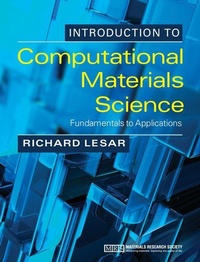
Introduction to Computational Materials Science
Fundamentals to Applications
Published on 28. March 2013
Book
Hardback
427 pages
978-0-521-84587-8 (ISBN)
Description
Emphasising essential methods and universal principles, this textbook provides everything students need to understand the basics of simulating materials behaviour. All the key topics are covered from electronic structure methods to microstructural evolution, appendices provide crucial background material, and a wealth of practical resources are available online to complete the teaching package. Modelling is examined at a broad range of scales, from the atomic to the mesoscale, providing students with a solid foundation for future study and research. Detailed, accessible explanations of the fundamental equations underpinning materials modelling are presented, including a full chapter summarising essential mathematical background. Extensive appendices, including essential background on classical and quantum mechanics, electrostatics, statistical thermodynamics and linear elasticity, provide the background necessary to fully engage with the fundamentals of computational modelling. Exercises, worked examples, computer codes and discussions of practical implementations methods are all provided online giving students the hands-on experience they need.
Reviews / Votes
"Finally, an introductory textbook on computational methods that addresses the breadth of materials science. Finally, an introductory textbook that emphasizes understanding the foundations of the subject. Kudos to Prof. Richard LeSar for producing such a beautifully pedagogical introductory text that covers the major methods of the field, relates them to their underlying science, and provides links to accessible simulation codes. "Introduction to Computational Materials Science" is the perfect companion to a first-course on this rapidly growing segment of our field." - David J Srolovitz, University of Pennsylvania "Prof. LeSar has written an elegant book on the methods that have been found to be useful for simulating materials. Unlike most texts, he has made the effort to give clear, straightforward explanations so that readers can implement the models for themselves. He has also covered a wider range of techniques and length-/time-scales than typical textbooks that ignore anything coarser than the atom. This text will be useful for a wide range of materials scientists and engineers." - Anthony Rollett, Carnegie Mellon University "Richard LeSar has successfully summarized the computational techniques that are most commonly used in Materials Science, with many examples that bring this field to life. I have been using drafts of this book in my Computational Materials course, with very positive student response. I am delighted to see the book in print-it will become a classic!" - Chris G. Van de Walle, University of California, Santa BarbaraMore details
Language
English
Place of publication
Cambridge
United Kingdom
Target group
College/higher education
Illustrations
15 Tables, black and white; 339 Line drawings, black and white
Dimensions
Height: 260 mm
Width: 208 mm
Thickness: 28 mm
Weight
1139 gr
ISBN-13
978-0-521-84587-8 (9780521845878)
Copyright in bibliographic data and cover images is held by Nielsen Book Services Limited or by the publishers or by their respective licensors: all rights reserved.
Schweitzer Classification
Other editions
Additional editions
E-Book
04/2013
Cambridge University Press
€87.49
Available for download
E-Book
03/2013
Cambridge University Press
€73.99
Available for download
Person
Richard LeSar is the Lynn Gleason Professor of Interdisciplinary Engineering in the Department of Materials Science and Engineering, Iowa State University, and the former Chair of the Materials Science and Engineering programme. He is highly experienced in teaching the modelling and simulation of materials at both undergraduate and graduate levels, and has made extensive use of these methods throughout his own research.
Content
Part I. Some Basics: 1. Materials modelling and simulation; 2. The random walk model; 3. Simulation of finite systems; Part II. Atoms and Molecules: 4. Electronic structure methods; 5. Interatomic potentials; 6. Molecular dynamics; 7. The Monte Carlo method; 8. Molecular and macromolecular systems; Part III. Mesoscopic Methods: 9. Kinetic Monte Carlo; 10. Monte Carlo methods at the mesoscale; 11. Cellular automata; 12. Phase-field methods; 13. Mesoscale dynamics; Part IV. Some Final Words: 14. Materials selection and design; Part V. Appendices: A. Energy units; B. Introduction to materials; C. Mathematical background; D. Classical mechanics; E. Electrostatics; F. Quantum mechanics; G. Statistical thermodynamics and kinetics; H. Linear elasticity; I. Introduction to computation.