

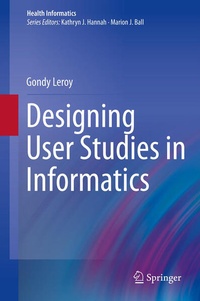
Designing User Studies in Informatics
Published on 27. November 2013
Book
Paperback/Softback
XX, 260 pages
978-1-4471-2696-6 (ISBN)
Description
This book provides a practical, hands-on guide to conducting user studies in informatics. Its purpose is to explain the foundations of different experimental designs together with the appropriate statistical analyses for studies most often conducted in computing. Common mistakes are highlighted together with guidelines on how they should be avoided. The book is intended for advanced undergraduate students, beginning graduate students and as a refresher for any researcher evaluating the usefulness of informatics for people by doing user studies. With clear, non-technical language, fundamental concepts are explained and illustrated using diverse examples. In addition to the foundations, practical tips to starting, acquiring permission, recruiting participants, conducting and publishing studies are included. A how-to guide, in the form of a cookbook, is also included. The cookbook recipes can be followed step-by-step or adjusted as necessary for different studies. Each recipe contains step-by-step instructions and concrete advice.
More details
Series
Edition
2011 ed.
Language
English
Place of publication
London
United Kingdom
Target group
Professional and scholarly
Professional/practitioner
Illustrations
XX, 260 p.
Dimensions
Height: 235 mm
Width: 155 mm
Thickness: 16 mm
Weight
429 gr
ISBN-13
978-1-4471-2696-6 (9781447126966)
DOI
10.1007/978-0-85729-622-1
Schweitzer Classification
Other editions
Additional editions
Gondy Leroy
Designing User Studies in Informatics
Book
08/2011
1st Edition
Springer
€53.49
Shipment within 15-20 days
Gondy Leroy
Designing User Studies in Informatics
E-Book
08/2011
1st Edition
Springer
€53.49
Available for download
Content
SECTION 1 - DESIGNING THE USER STUDY.- Chapter 1: Overview.- Chapter 2: Variables.- Chapter 3: Design Equation and Statistics.- Chapter 4: Between-Subjects Design.- Chapter 5: Within-Subject Designs.- Chapter 6: Advanced Designs.- SECTION 2 - PRACTICAL TIPS
Chapter 7: Understanding Main and Interaction Effects.- Chapter 8: Conducting Multiple Comparisons.- Chapter 9: Gold Standard and User Evaluations.- Chapter 10: Recruiting and Motivating Study Participants.- Chapter 11: Institutional Review Board (IRB) Approval.- Chapter 12: Resources.- SECTION 3 - COMMON MISTAKES TO AVOID
Chapter 13: Avoid Bias.- Chapter 14: Avoid Missing the Effect.- Chapter 15: Avoid Missing Variables or Conditions.- Chapter 16: Other Errors to Avoid.- SECTION 4 - Appendix: COOKBOOK for Designing User Studies in Informatics.- Recipe1: Evaluating Standalone Algorithms using Artifacts.- Recipe 2: Evaluating Standalone Algorithms using Subjects.- Recipe 3: Comparing Algorithms Using Artifacts.- Recipe 4: Comparing Algorithms using Subjects.- Recipe 5: Evaluating Standalone Systems using Subjects.- Recipe 6: Comparing Systems Using Subjects.
Chapter 7: Understanding Main and Interaction Effects.- Chapter 8: Conducting Multiple Comparisons.- Chapter 9: Gold Standard and User Evaluations.- Chapter 10: Recruiting and Motivating Study Participants.- Chapter 11: Institutional Review Board (IRB) Approval.- Chapter 12: Resources.- SECTION 3 - COMMON MISTAKES TO AVOID
Chapter 13: Avoid Bias.- Chapter 14: Avoid Missing the Effect.- Chapter 15: Avoid Missing Variables or Conditions.- Chapter 16: Other Errors to Avoid.- SECTION 4 - Appendix: COOKBOOK for Designing User Studies in Informatics.- Recipe1: Evaluating Standalone Algorithms using Artifacts.- Recipe 2: Evaluating Standalone Algorithms using Subjects.- Recipe 3: Comparing Algorithms Using Artifacts.- Recipe 4: Comparing Algorithms using Subjects.- Recipe 5: Evaluating Standalone Systems using Subjects.- Recipe 6: Comparing Systems Using Subjects.