

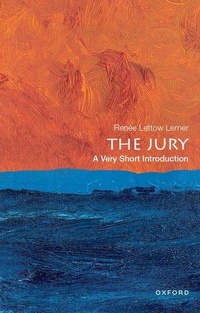
The Jury
A Very Short Introduction
Published on 23. March 2023
Book
Paperback/Softback
176 pages
978-0-19-092391-4 (ISBN)
Description
From ancient Athens to modern Asia, cultures have wanted ordinary people involved in making legal decisions. This Very Short Introduction charts juries from antiquity through the English-speaking world and beyond to Europe, Latin America, Africa, and Asia. Today, juries have become a symbol of democracy and popular legitimacy.
But in English-speaking countries, jury trials are declining. Civil juries have been virtually abolished everywhere except the United States, and plea bargaining is taking the place of criminal jury trials. In this book, Renee Lettow Lerner describes the benefits and challenges of using juries, including jury nullification. She considers how innovations from non-English-speaking countries may be key to the survival of citizen participation in the legal system.
Along the way, the book tells how a small German state invented a way of using jurors that is now found around the world. And it reveals why some defendants preferred to be crushed to death by weights rather than convicted by a jury.
But in English-speaking countries, jury trials are declining. Civil juries have been virtually abolished everywhere except the United States, and plea bargaining is taking the place of criminal jury trials. In this book, Renee Lettow Lerner describes the benefits and challenges of using juries, including jury nullification. She considers how innovations from non-English-speaking countries may be key to the survival of citizen participation in the legal system.
Along the way, the book tells how a small German state invented a way of using jurors that is now found around the world. And it reveals why some defendants preferred to be crushed to death by weights rather than convicted by a jury.
Reviews / Votes
This is a fascinating short book written with an international emphasis by an American academic who, like many of her US colleagues, values English common law perhaps more than we do. The book introduces the subject with consideration of two films made in the same period. They are To Kill a Mockingbird and 12 Angry Men (pictured), both of which have very different outcomes but deal with jury trial. * David Pickup, The Gazette * An excellent and fascinating short book written with an international emphasis. * Best Law Books of the Year 2023, The Law Gazzette *More details
Series
Language
English
Place of publication
New York
United States
Target group
Professional and scholarly
Illustrations
10 b/w halftones
Dimensions
Height: 174 mm
Width: 114 mm
Thickness: 20 mm
Weight
140 gr
ISBN-13
978-0-19-092391-4 (9780190923914)
Copyright in bibliographic data and cover images is held by Nielsen Book Services Limited or by the publishers or by their respective licensors: all rights reserved.
Schweitzer Classification
Other editions
Person
Renee Lettow Lerner is the Donald Phillip Rothschild Research Professor of Law at George Washington University Law School. After graduating from Yale Law School, she was a law clerk to Justice Anthony M. Kennedy of the U.S. Supreme Court and to Judge Stephen F. Williams of the U.S. Court of Appeals for the District of Columbia Circuit. From 2003 to 2005, she served as Deputy Assistant Attorney General in the Office of Legal Counsel at the U.S. Department of Justice. She was a witness in a murder case in Paris, France, before a mixed panel of professional judges and lay jurors. Lerner is the author of History of the Common Law: The Development of Anglo-American Legal Institutions (2009).
Content
List of illustrations
Introduction
1. Why use lay jurors? The ancient and medieval world
2. Reasons for lay jurors in early modern and modern societies
3. Jury nullification
4. Who serves as a juror?
5. The scope and structure of the jury
6. The limitations of lay jurors
7. Jury control and avoidance
8. The Future of the Jury
References
Further reading
Index
Introduction
1. Why use lay jurors? The ancient and medieval world
2. Reasons for lay jurors in early modern and modern societies
3. Jury nullification
4. Who serves as a juror?
5. The scope and structure of the jury
6. The limitations of lay jurors
7. Jury control and avoidance
8. The Future of the Jury
References
Further reading
Index