

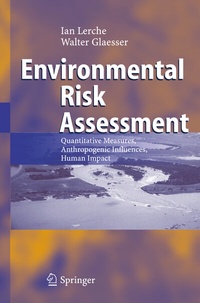
Environmental Risk Assessment
Quantitative Measures, Anthropogenic Influences, Human Impact
Published on 25. January 2006
Book
Hardback
XII, 343 pages
978-3-540-26249-7 (ISBN)
Description
The world is a dirty place and getting dirtier all the time. The reasons for this ever-increasing lack of cleanliness are not hard to find, being basically caused by the actions of the six billion people who inhabit the planet. The needs of the people for air, water, food, housing, clothing, heating, materials, oil, gas, minerals, metals, chemicals, and so forth have, over the centuries, given rise to a variety of environmental problems that have been exacerbated or been newly created by the industrialization of the world, the increase in population, and the increase in longevity of the population. The costs of cleaning even fractions of the known environmental problems are truly enormous, as detailed in the volume Environmental Risk Analysis (I. Lerche and E. Paleologos, 2001, McGraw-Hill). The chances of causing new environmental problems, and their associated costs of clean up, are equally challenging in terms of anthropogenic influences and also of the natural environmental problems that can be triggered by humanity. This volume discusses many examples of environmental problems that have occurred and that are still ongoing. The volume also considers the effects in terms of sickness and death of fractions of the population of the planet caused by such environmental problems.
Reviews / Votes
From the reviews:
"This book deals with environment and human risk problems caused by contamination that have occurred and that are still ongoing. . For professionals in the field, seriously involved in remediation efforts, this volume provides a detailed set of procedures to analyse the scientific consequences of environmental problems. The volume should be of use to decision-makers in both government and private industry who are actively involved in balancing the social, economic, political, scientific, and health issues for the best benefits of the population." (International Journal of Environmental and Analytical Chemistry, Vol. 86, 2006)
More details
Edition
2006 ed.
Language
English
Place of publication
Berlin
Germany
Publishing group
Springer Berlin
Target group
Professional and scholarly
Research
Illustrations
125 s/w Abbildungen
XII, 343 p. 125 illus.
Dimensions
Height: 303 mm
Width: 215 mm
Thickness: 25 mm
Weight
1204 gr
ISBN-13
978-3-540-26249-7 (9783540262497)
DOI
10.1007/3-540-29709-X
Schweitzer Classification
Other editions
Additional editions
Ian Lerche | Walter Glaesser
Environmental Risk Assessment
Quantitative Measures, Anthropogenic Influences, Human Impact
Book
10/2010
Springer
€160.49
Shipment within 7-9 days
Ian Lerche | Walter Glaesser
Environmental Risk Assessment
Quantitative Measures, Anthropogenic Influences, Human Impact
E-Book
04/2007
1st Edition
Springer
€149.79
Available for download
Content
Natural and Anthropogenic Environmental Problems.- Restoration of lignite mining sites in the former GDR: lessons to be learnt from Zwenkau.- Carbon Dioxide Development and the Influence of Rising Groundwater in the Cospuden/Zwenkau Dump: Observations and Inferences.- Carbon Dioxide Development and the Influence of Rising Groundwater in the Cospuden/Zwenkau Dump: Quantitative Models.- Environmental and Economic Risks from Sinkholes in West-Central Florida.- Risks of Damage from Flooding Rivers: Correlation of Weakened Dyke Structures?.- Biological Remediation of Environmentally Contaminated Water.- Heavy Metal Contamination Removal by Bacterial Activity in Seeping Depositories.- Quantitative Risks of Death and Sickness from Toxic Contamination: General Population.- Quantitative Risks of Death and Sickness from Toxic Contamination: Age-Dependent Toxic Sickness/Death Exposure Limits.- Methods for Estimating Associated Risks of Sinkhole Occurrences with data from the Ruhr Valley Region of Germany.- Environmental Concerns: Catastrophic Events and Insurance.- Integrated Scientific and Economic Uncertainties in Environmental Hazard Assessments: Social and Political Consequences.