

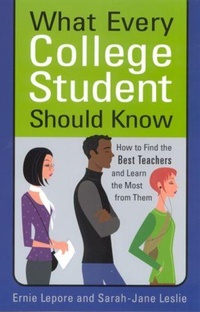
What Every College Student Should Know
How to Find the Best Teachers and Learn the Most from Them
Will be published approx. on 1. February 2002
Book
Paperback/Softback
140 pages
978-0-8135-3066-6 (ISBN)
Description
Students do months of research before choosing just the right college, but once theyre on campus, how many of them actually research the professors who are teaching their classes? To optimize your college education you need to find your schools best teachers but how?
What Every College Student Should Know is a guide to discovering the best teachers at your school and learning everything you can from them. Here, the unique writing combination of a professor and a student provides you with perspectives from both sides of the equation. You'll learn:
What questions to ask in selecting an instructor
How to evaluate professors based on the first class sessions
What to look for in a syllabus and grading policies
How to identify a professors teaching style and how to adapt to it
Even the most outgoing students can expect only limited contact with their professors in the classroom, so the authors also provide tactics to take full advantage of meetings outside regular class time, such as:
Advice on how to review your exam or paper with your professor
Ways to build a relationship with a teacher and get invaluable feedback on your work
Tips on how to get the best recommendations from proffessors
What Every College Student Should Know is a guide to discovering the best teachers at your school and learning everything you can from them. Here, the unique writing combination of a professor and a student provides you with perspectives from both sides of the equation. You'll learn:
What questions to ask in selecting an instructor
How to evaluate professors based on the first class sessions
What to look for in a syllabus and grading policies
How to identify a professors teaching style and how to adapt to it
Even the most outgoing students can expect only limited contact with their professors in the classroom, so the authors also provide tactics to take full advantage of meetings outside regular class time, such as:
Advice on how to review your exam or paper with your professor
Ways to build a relationship with a teacher and get invaluable feedback on your work
Tips on how to get the best recommendations from proffessors
More details
Language
English
Place of publication
New Brunswick NJ
United States
Target group
College/higher education
Product notice
Paperback (trade)
Unsewn / adhesive bound
Illustrations
Illustrations
Dimensions
Height: 215 mm
Width: 141 mm
Thickness: 11 mm
Weight
213 gr
ISBN-13
978-0-8135-3066-6 (9780813530666)
Copyright in bibliographic data and cover images is held by Nielsen Book Services Limited or by the publishers or by their respective licensors: all rights reserved.
Schweitzer Classification
Persons
Ernie Lepore is the director of the Center for Cognitive Science at Rutgers University as well as a professor in the philosophy department.
Sarah-Jane Leslie, a student in the Rutgers University Honors Program, is a National Merit Scholar and has been elected to Phi Beta Kappa.
Sarah-Jane Leslie, a student in the Rutgers University Honors Program, is a National Merit Scholar and has been elected to Phi Beta Kappa.
Content
Acknowledgments
Introduction: Why Students Need This Book
1. Before Classes Begin: Finding Good Teachers
2. In the Classroom: Getting the Most our of Good Teachers
3. Outside the Classroom: Cultivating Relationships with Good Teachers
4. After Class: Building on Relationships with Good Teachers
5. The Ins and Outs of Recommendations
Afterword: Why Bad Teaching Persists
A Guide to Academic Vocabulary
Introduction: Why Students Need This Book
1. Before Classes Begin: Finding Good Teachers
2. In the Classroom: Getting the Most our of Good Teachers
3. Outside the Classroom: Cultivating Relationships with Good Teachers
4. After Class: Building on Relationships with Good Teachers
5. The Ins and Outs of Recommendations
Afterword: Why Bad Teaching Persists
A Guide to Academic Vocabulary