

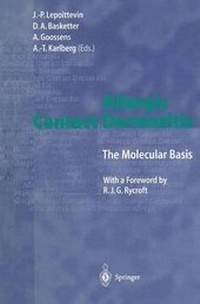
Allergic Contact Dermatitis
The Molecular Basis
Published on 9. October 1997
Book
Hardback
X, 186 pages
978-3-540-61833-1 (ISBN)
Description
Allergic Contact Dermatitis
presents all up-to-date chemical and physio-chemical concepts for the study and understanding of allergic contact dermatitis (ACD). The book covers all aspects of ACD - skin penetration and metabolism, identification of sensitizers and hapten-protein interaction, including new concepts of increasing importance such as molecular recognition and quantitative structure-activity relationships. In addition, comprehensive references are provided, making this the most complete available text-book for dermatologists.
Allergic Contact Dermatitis reaches an equilibrium between fundamental concepts and clinical applications and thus presents an essential guideline to dermatologists, allergologists, biochemists and toxicologists.
Allergic Contact Dermatitis reaches an equilibrium between fundamental concepts and clinical applications and thus presents an essential guideline to dermatologists, allergologists, biochemists and toxicologists.
More details
Language
English
Place of publication
Heidelberg
Germany
Publishing group
Springer Berlin
Target group
College/higher education
Professional and scholarly
Illustrations
7 s/w Tabellen
7 black & white tables, biography
Dimensions
Height: 23.5 cm
Width: 15.5 cm
Thickness: 19 mm
Weight
410 gr
ISBN-13
978-3-540-61833-1 (9783540618331)
DOI
10.1007/978-3-642-80331-4
Schweitzer Classification
Other editions
Additional editions
Jean-Pierre Lepoittevin | David A. Basketter | An Goossens
Allergic Contact Dermatitis
The Molecular Basis
E-Book
12/2012
Springer
€96.29
Available for download
Jean-Pierre Lepoittevin | David A. Basketter | An Goossens
Allergic Contact Dermatitis
The Molecular Basis
Book
12/2011
Springer
€106.99
Shipment within 7-9 days
Persons
Content
1. Introduction.- 2. Immunological Aspects.- 3. Chemical Basis.- 4. Isolation and Identification of Contact Allergens.- 5. Skin Metabolism.- 6. Hapten-Protein Interactions.- 7. Molecular Basis for the Recognition of Haptens by T Lymphocytes.- 8. Structure-Activity Relationships for Contact Hypersensitivity.- 9. The Practical Approach.