


Materiality and Organizing
Social Interaction in a Technological World
Published on 22. November 2012
Book
Paperback/Softback
380 pages
978-0-19-966406-1 (ISBN)
Description
Ask a person on the street whether new technologies bring about important social change and you are likely to hear a resounding "yes." But the answer is less definitive amongst academics who study technology and social practice. Scholarly writing has been heavily influenced by the ideology of technological determinism - the belief that some types or technologically driven social changes are inevitable and cannot be stopped. Rather than argue for or against notions of determinism, the authors in this book ask how the materiality (the arrangement of physical, digital, or rhetorical materials into particular forms that endure across differences in place and time) of technologies, ranging from computer-simulation tools and social media, to ranking devices and rumours, is actually implicated in the process of formal and informal organizing.
The book builds a new theoretical framework to consider the important socio-technical changes confronting people's everyday experiences in and outside of work. Leading scholars in the field contribute original chapters examining the complex interactions between technology and the social, between artefact and humans. The discussion spans multiple disciplines, including management, information systems, informatics, communication, sociology, and the history of technology, and opens up a new area of research regarding the relationship between materiality and organizing.
The book builds a new theoretical framework to consider the important socio-technical changes confronting people's everyday experiences in and outside of work. Leading scholars in the field contribute original chapters examining the complex interactions between technology and the social, between artefact and humans. The discussion spans multiple disciplines, including management, information systems, informatics, communication, sociology, and the history of technology, and opens up a new area of research regarding the relationship between materiality and organizing.
Reviews / Votes
Materiality and Organizing marks a long overdue turning point in the scholarly study of the human-technology relationship that now engulfs our lives. For too long, researchers have tended to treat technology as a dream conjured by agents and imbued with their projects. This brilliant sequence of essays restores and deepens the entire field of perception. It finally returns us to the facticity of technology as it persistently redefines the horizon of the possible. These tightly argued masterpieces reestablish technology as embodied and significant. Most importantly, they return us to materiality just in time. With each passing day, technology becomes both more abstracted from its physical manifestations and more ubiquitous, producing a dematerialized materiality. Only a relentless focus on this paradox will yield the intellectual tools that are required to participate in our own destinies. * Shoshana Zuboff, Charles Edward Wilson Professor, Harvard Business School * This volume is a much-needed exploration of the material aspects of the technologies that have reshaped our world. For two decades, a narrative framing technologies as social constructions has led to important advances in our understanding of their nature and impacts. Materiality and Organizing provides an important counterbalance to this approach in its exploration of the dimensions of materiality that constrain but also enable technologies to connect with and affect people, organizations, and society. This volume is required reading for scholars interested in technology, its development, and its impacts. Its insights into information technology are particularly significant. * Professor Marshall Scott Poole, University of Illinois Urbana-Champaign * For too long the materiality of social life has been ignored by sociologists and organization studies scholars. The role of materiality in social life is turning out to be one of the most interesting and difficult issues in the field. This multidisciplinary collection does not offer a single solution but offers the latest thoughts of scholars who try and take materiality seriously in their own research. The resulting volume is a deep and fascinating collection of essays. * Professor Trevor Pinch, Cornell University *More details
Language
English
Place of publication
Oxford
United Kingdom
Target group
College/higher education
Professional and scholarly
Dimensions
Height: 234 mm
Width: 156 mm
Thickness: 21 mm
Weight
576 gr
ISBN-13
978-0-19-966406-1 (9780199664061)
Copyright in bibliographic data and cover images is held by Nielsen Book Services Limited or by the publishers or by their respective licensors: all rights reserved.
Schweitzer Classification
Other editions
Additional editions
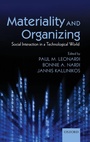
Paul M. Leonardi | Bonnie A. Nardi | Jannis Kallinikos
Materiality and Organizing
Social Interaction in a Technological World
Book
11/2012
Oxford University Press
€211.30
Shipment within 15-20 days
Persons
Paul M. Leonardi is the Pentair-Nugent Associate Professor in the Departments of Communication Studies and Industrial Engineering and Management Sciences at Northwestern University where he teaches courses on the management of innovation and organizational change in the School of Communication, the McCormick School of Engineering, and the Kellogg School of Management. His research focuses on how companies can design organizational structures and employ advanced information technologies to more effectively create and share knowledge. He is the author of Car Crashes Without Cars: Lessons about Simulation Technology and Organizational Change from Automotive Design (MIT Press, 2012).
Bonnie Nardi is a Professor in the Department of Informatics at the Donald Bren School of Information and Computer Sciences, the University of California, Irvine. An anthropologist, she has studied the uses of digital technologies in offices, schools, homes, libraries, hospitals, scientific laboratories, and virtual worlds. Her theoretical orientation is activity theory. She is the author of many scientific articles and books. Her latest books are My Life as a Night Elf Priest: An Anthropological Account of World of Warcraft (University of Michigan Press, 2010) and Ethnography and Virtual Worlds: A Handbook of Method (co-author, Princeton University Press, 2012).
Jannis Kallinikos is Professor and PhD programme Director in the Information Systems and Innovation Group, Department of Management at the London School of Economics. His research covers a wide range of topics on the interpenetration of technology with the administrative and institutional arrangements of contemporary societies. Recent books include The Consequences of Information: Institutional Implications of Technological Change (Edward Elgar, 2006), and Governing Through Technology: Information Artefacts and Social Practice (Palgrave, 2011).
Bonnie Nardi is a Professor in the Department of Informatics at the Donald Bren School of Information and Computer Sciences, the University of California, Irvine. An anthropologist, she has studied the uses of digital technologies in offices, schools, homes, libraries, hospitals, scientific laboratories, and virtual worlds. Her theoretical orientation is activity theory. She is the author of many scientific articles and books. Her latest books are My Life as a Night Elf Priest: An Anthropological Account of World of Warcraft (University of Michigan Press, 2010) and Ethnography and Virtual Worlds: A Handbook of Method (co-author, Princeton University Press, 2012).
Jannis Kallinikos is Professor and PhD programme Director in the Information Systems and Innovation Group, Department of Management at the London School of Economics. His research covers a wide range of topics on the interpenetration of technology with the administrative and institutional arrangements of contemporary societies. Recent books include The Consequences of Information: Institutional Implications of Technological Change (Edward Elgar, 2006), and Governing Through Technology: Information Artefacts and Social Practice (Palgrave, 2011).
Editor
, Pentair-Nugent Associate Professor in the Departments of Communication Studies and Industrial Engineering and Management Sciences at Northwestern University
Professor, Department of Informatics, the Donald Bren School of Information and Computer Sciences, the University of California, Irvine
Professor, London School of Economics
Content
I. SETTING THE STAGE ; 1. The Challenge of Materiality: Origins, Scope, and Prospects ; II. THEORIZING MATERIALITY ; 2. Materiality, Sociomateriality, and Socio-Technical Systems: What Do These Terms Mean? How Are They Different? Do We Need Them? ; 3. On Sociomateriality ; 4. Form, Function, and Matter: Crossing the Border of Materiality ; III. MATERIALITY AS PERFORMATIVITY ; 5. Ranking Devices: The Socio-Materiality of Ratings ; 6. Great Expectations: The Materiality of Commensurability in Social Media ; 7. Digital Materiality and the Emergence of an Evolutionary Science of the Artificial ; IV. MATERIALITY AS ASSEMBLAGE ; 8. Inverse Instrumentality: How Technologies Objectify Patients and Players ; 9. Space Matters, but How? Physical Space, Virtual Space, and Place ; 10. Socio-material Practices of Design Co-ordination Across a Large Construction Project ; V. MATERIALITY AS AFFORDANCE ; 11. Theorizing Information Technology as a Material Artifact in Information Systems Research ; 12. The Materiality of Technology: An Affordance Perspective ; 13. Pencils, Legos, and Guns: A Study of Artifacts Used in Architecture ; VI. MATERIALITY AS CONSEQUENCE ; 14. Materiality: What are the Consequences? ; 15. Why Matter Always Matters in (Organizational) Communication ; 16. The Materiality of Rumor ; VII. EPILOGUE ; 17. Matter Matters: Materiality in Philosophy, Physics, and Technology