

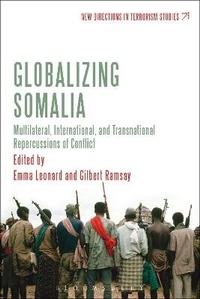
Globalizing Somalia
Multilateral, International and Transnational Repercussions of Conflict
Published on 5. December 2013
Book
Paperback/Softback
304 pages
978-1-78093-569-0 (ISBN)
Description
This collection of essays demonstrates how chronic state failure and the inability of the international community to provide a solution to the conflict in Somalia has had transnational repercussions.
Following the failed humanitarian mission in 1992-93, most countries refrained from any direct involvement in Somalia, but this changed in the 2000s with the growth of piracy and links to international terrorist organizations. The deterritorialization of the conflict quickly became apparent as it became transnational in nature. In part because of it lacked a government and was unable to work with the international community, Somalia came to be seen as a "testing-ground" by many international actors. Globalizing Somalia demonstrates how China, Japan, and the EU, among others, have all used the conflict in Somalia to project power, test the bounds of the national constitution, and test their own military capabilities.
Contributed by international scholars and experts, the work examines the impact of globalization on the internal and external dynamics of the conflict, arguing that it is no longer geographically contained. By bringing together the many actors and issues involved, the book fills a gap in the literature as one of the most complete works on the conflict in Somalia to date. It will be an essential text to any student interested in Somalia and the horn of Africa, as well as in terrorism, and conflict processes.
Following the failed humanitarian mission in 1992-93, most countries refrained from any direct involvement in Somalia, but this changed in the 2000s with the growth of piracy and links to international terrorist organizations. The deterritorialization of the conflict quickly became apparent as it became transnational in nature. In part because of it lacked a government and was unable to work with the international community, Somalia came to be seen as a "testing-ground" by many international actors. Globalizing Somalia demonstrates how China, Japan, and the EU, among others, have all used the conflict in Somalia to project power, test the bounds of the national constitution, and test their own military capabilities.
Contributed by international scholars and experts, the work examines the impact of globalization on the internal and external dynamics of the conflict, arguing that it is no longer geographically contained. By bringing together the many actors and issues involved, the book fills a gap in the literature as one of the most complete works on the conflict in Somalia to date. It will be an essential text to any student interested in Somalia and the horn of Africa, as well as in terrorism, and conflict processes.
Reviews / Votes
With extensive information and rich analyses, this book contributes a great deal to our understanding of how the Somali conflict has been transformed into a transnational issue with various forms of intervention by global and regional powers as well as international organizations. * Kidane Mengisteab, Professor of Political Science and African Studies, Pennsylvania State University, US and author of Anatomy of an African Tragedy and Foreign Policy Crisis in Post-Independence Eritrea (2005) *More details
Series
Language
English
Place of publication
London
United Kingdom
Publishing group
Bloomsbury Publishing PLC
Target group
College/higher education
Professional and scholarly
Dimensions
Height: 229 mm
Width: 152 mm
Weight
567 gr
ISBN-13
978-1-78093-569-0 (9781780935690)
DOI
CBID177533
Copyright in bibliographic data and cover images is held by Nielsen Book Services Limited or by the publishers or by their respective licensors: all rights reserved.
Schweitzer Classification
Other editions
Additional editions
Emma Leonard | Gilbert Ramsay
Globalizing Somalia
Multilateral, International and Transnational Repercussions of Conflict
E-Book
11/2013
1st Edition
Bloomsbury Academic
€40.49
Available for download
Emma Leonard | Gilbert Ramsay
Globalizing Somalia
Multilateral, International and Transnational Repercussions of Conflict
E-Book
11/2013
1st Edition
Bloomsbury Academic
€40.49
Available for download
Persons
Gilbert Ramsay works at the Centre for the Study of Terrorism and Political Violence at the University of St. Andrews, UK. An Arabic speaker, he has previously written reports on terrorism and the Internet for the United Nations and the European Union.
Emma Leonard was Assistant to the Dean of Development Studies at Mbarara University, Uganda. She earned a post-graduate degree in African Studies (MSc Hons) at Oxford University before joining the Center for the Study of Terrorism and Political Violence at the University of St Andrews, Scotland. She is now pursuing her doctoral research at The Pennsylvania State University, USA.
Emma Leonard was Assistant to the Dean of Development Studies at Mbarara University, Uganda. She earned a post-graduate degree in African Studies (MSc Hons) at Oxford University before joining the Center for the Study of Terrorism and Political Violence at the University of St Andrews, Scotland. She is now pursuing her doctoral research at The Pennsylvania State University, USA.
Content
Introduction
Emma Leonard & Gilbert Ramsay
SECTION ONE: THE FAILURE OF THE INTERNATIONAL
The United Nations, Peacekeeping, and the Globalization of the Conflict in Somalia
Kate Seaman
Contextual Disconnect: The Failure of the 'International Community' in Somalia
Karl Sandstrom
SECTION TWO: THE RISE OF THE TRANSNATIONAL
Is all Jihad Local? Transnational Contention and Political Violence in Somalia
Peter S. Henne
Involving Foreign Fighters in Somalia
David Malet, Bryan Priest, & Sarah Staggs
Somali Piracy and International Crime
Peter Lehr
SECTION THREE: THE NEW MULTIPOLAR POLITICS AS A RESPONSE TO TRANSNATIONAL DISORDER
Re-crossing the Mogadishu Line: U.S. Policy toward Somalia 1994-2012
Michael J. Boyle
Somalia-China Relations: China Claiming its Place as a Global Actor?
Monika Thakur
Japan's Aspirations as a Global Security Actor: the anti-piracy mission off Somalia and the dynamics of Great Power intervention
Yee-Kuang Heng
Opposing Interests? The Geopolitics of the Horn of Africa
Stig Jarle Hansen
The European Union Comprehensive Intervention in Somalia: Turning Ploughs into Swords?
Maria-Luisa Sanchez-Barrueco
SECTION FOUR: RE-IMAGINING INTERVENTION - MUST HISTORY REPEAT ITSELF IN SOMALIA?
Identity, Stability, and the Somali State: Indigenous Forms and External Intervention
Michael Walls & Steve Kibble
Conclusion
Gilbert Ramsay & Emma Leonard
Bibliography
Index
Emma Leonard & Gilbert Ramsay
SECTION ONE: THE FAILURE OF THE INTERNATIONAL
The United Nations, Peacekeeping, and the Globalization of the Conflict in Somalia
Kate Seaman
Contextual Disconnect: The Failure of the 'International Community' in Somalia
Karl Sandstrom
SECTION TWO: THE RISE OF THE TRANSNATIONAL
Is all Jihad Local? Transnational Contention and Political Violence in Somalia
Peter S. Henne
Involving Foreign Fighters in Somalia
David Malet, Bryan Priest, & Sarah Staggs
Somali Piracy and International Crime
Peter Lehr
SECTION THREE: THE NEW MULTIPOLAR POLITICS AS A RESPONSE TO TRANSNATIONAL DISORDER
Re-crossing the Mogadishu Line: U.S. Policy toward Somalia 1994-2012
Michael J. Boyle
Somalia-China Relations: China Claiming its Place as a Global Actor?
Monika Thakur
Japan's Aspirations as a Global Security Actor: the anti-piracy mission off Somalia and the dynamics of Great Power intervention
Yee-Kuang Heng
Opposing Interests? The Geopolitics of the Horn of Africa
Stig Jarle Hansen
The European Union Comprehensive Intervention in Somalia: Turning Ploughs into Swords?
Maria-Luisa Sanchez-Barrueco
SECTION FOUR: RE-IMAGINING INTERVENTION - MUST HISTORY REPEAT ITSELF IN SOMALIA?
Identity, Stability, and the Somali State: Indigenous Forms and External Intervention
Michael Walls & Steve Kibble
Conclusion
Gilbert Ramsay & Emma Leonard
Bibliography
Index