

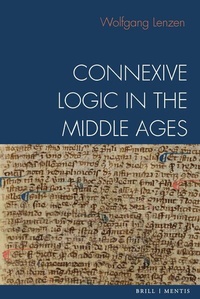
Connexive Logic in the Middle Ages
1st Edition
Published on 29. May 2026
Book
Hardback
XVIII, 409 pages
978-3-95743-357-2 (ISBN)
Description
Connexive logic is a rather new branch of modern logic, based on the idea that no proposition ever implies its own negation. This idea goes back to Aristotle, who put forward the thesis that one and the same consequent cannot be "necessitated" by the same antecedent affirmed and denied. Many medieval logicians discovered, however, that the connexive theses fail to hold in certain cases, namely when the antecedent is impossible, or when the consequent is necessary.
This book scrutinizes the theories of various medieval logicians such as Boethius, Abelard, Kilwardby, Burley, Buridan, Paul of Venice, Albert of Saxony, and the Pseudo-Scot, who endorsed a conception of conditionals as strict implications. This conception validates the "humble" version of the connexive principles, but invalidates their "hardcore" versions according to which, e.g., even the tautological disjunction 'p or not-p' is not implied by its own negation, i.e., by the self-contradictory conjunction 'p and not-p'.
More details
Edition
2026
Language
English
Place of publication
Netherlands
Publishing group
Brill | mentis
Target group
Professional and scholarly
Product notice
sewn/stitched
Cloth over boards
Illustrations
5
1 farbige Abbildung, 4 s/w Abbildungen
4 schwarz-weiße und 1 farbige Abbildungen
Dimensions
Height: 241 mm
Width: 160 mm
Thickness: 35 mm
Weight
882 gr
ISBN-13
978-3-95743-357-2 (9783957433572)
Schweitzer Classification
Person
Wolfgang Lenzen was born in 1946 in Essen. In 1981 he became full professor of philosophy at the University of Osnabrück, where he stayed until his retirement in 2011. He has published 15 books and around 150 articles in various fields of philosophy. His current research is focussed on the history of logic, espcially medieval logic.