

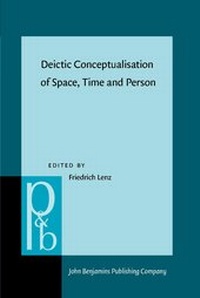
Deictic Conceptualisation of Space, Time and Person
Published on 17. April 2003
Book
Hardback
279 pages
978-90-272-5354-5 (ISBN)
Description
This volume is a collection of articles which present the results of investigations into the grammar, semantics and pragmatics of deictic expressions in several languages. Special emphasis is placed on contrastive studies that take cognitive and cultural context into account. Both the empirical and theoretical studies focus on the ways in which spatial, temporal, personal and textual entities are conceptualised and referred to. The cognitive approach proves to be a promising perspective combining aspects of perception, reasoning and linguistic expression to reveal what seems to be at the very heart of deictics.
Reviews / Votes
What has become obvious, is that research on deixis has grown out of its traditional focus on the nature of the referent (space, time, person) and is moving on to investigating the more subtle aspects of the process of referring itself. [...] all in all a very stimulating volume. -- Sonja Kleinke, Leipzig, in Anglia, Band 122:4 (2004)More details
Series
Language
English
Place of publication
Amsterdam
Netherlands
Target group
Professional and scholarly
Dimensions
Height: 225 mm
Width: 154 mm
Weight
530 gr
ISBN-13
978-90-272-5354-5 (9789027253545)
Copyright in bibliographic data and cover images is held by Nielsen Book Services Limited or by the publishers or by their respective licensors: all rights reserved.
Schweitzer Classification
Other editions
Additional editions
Friedrich Lenz
Deictic Conceptualisation of Space, Time and Person
E-Book
04/2003
1st Edition
John Benjamins Publishing Company
€136.99
Available for download
Person
Content
1. Contents; 2. Deictic conceptualisation of space, time and person: Introduction (by Lenz, Friedrich); 3. 1. 'Addressee effects' in demonstrative systems: The cases of Tiriyo and Brazilian Portuguese (by Meira, Sergio); 4. 2. Deictics in the conversational dyad: Findings in Spanish and some cross-linguistic outlines (by Jungbluth, Konstanze); 5. 3. Non-deictic uses of the deictic motion verbs kommen and gehen in German (by di Meola, Claudio); 6. 4. Origo, pointing, and conceptualization - what gestures reveal about the nature of the origo in face-to-face interaction (by Fricke, Ellen); 7. 5. Two ways of construing complex temporal structures (by Stutterheim, Christiane von); 8. 6. "Look here, what I am saying!": Speaker deixis and implicature as the basis of modality and future tense (by Fritz, Thomas A.); 9. 7. The 'subjective' effects of negation and past subjunctive on deontic modals: The case of German durfen and sollen (by Mortelmans, Tanja); 10. 8. Politeness distinctions in second person pronouns (by Helmbrecht, Johannes); 11. 9. Deictic use of demonstrative pronouns in the Rigveda (by Kupfer, Katharina); 12. 10. Towards a unified model of domain-bound reference (by Consten, Manfred); 13. 11. Deixis and speech situation revisited: The mechanism of perceived perception (by Hausendorf, Heiko); 14. Index