

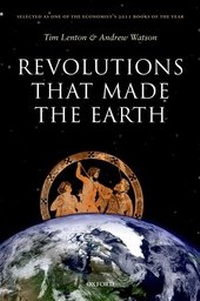
Revolutions that Made the Earth
Published on 11. April 2013
Book
Paperback/Softback
440 pages
978-0-19-967346-9 (ISBN)
Description
The Earth that sustains us today was born out of a few remarkable, near-catastrophic revolutions, started by biological innovations and marked by global environmental consequences. The revolutions have certain features in common, such as an increase in the complexity, energy utilization, and information processing capabilities of life. This book describes these revolutions, showing the fundamental interdependence of the evolution of life and its non-living environment. We would not exist unless these upheavals had led eventually to 'successful' outcomes - meaning that after each one, at length, a new stable world emerged.
The current planet-reshaping activities of our species may be the start of another great Earth system revolution, but there is no guarantee that this one will be successful. This book explains what a successful transition through it might look like, if we are wise enough to steer such a course.
This book places humanity in context as part of the Earth system, using a new scientific synthesis to illustrate our debt to the deep past and our potential for the future.
The current planet-reshaping activities of our species may be the start of another great Earth system revolution, but there is no guarantee that this one will be successful. This book explains what a successful transition through it might look like, if we are wise enough to steer such a course.
This book places humanity in context as part of the Earth system, using a new scientific synthesis to illustrate our debt to the deep past and our potential for the future.
Reviews / Votes
Lenton and Watson have written a remarkable and timely book which is both entertaining and impeccably researched from the beginning I felt both engaged and enlightened... With its academic rigour and, at the same time, its accessibility, the authors have clearly succeeded in their aim of writing scholarly popular science. As such, it should inspire us to learn from how the Earth system has evolved in the past and face up to the final question: Are we as yet sufficiently grown up to take responsibility for a whole planet? One thing is for sure: Over the next century we will find out. * Peter Horton, Chemistry World * Worth close study for anyone with more than a passing interest in the Earth sciences, from geology to climatology, and for anyone curious about why this planet is alive whilst all the other ones we know about are dead. * Mark Lynas * Lenton and Watson's thought-provoking book is the latest in a distinguished line of works that have altered our perception of the planet. * Wolfgang Lucht, Nature * This book is a stimulating read that involves its audience and challenges us to enlarge our awareness of many branches of human knowledge. It embraces the ethical question of how we can overcome our selfish genes to co-operate with our fellow human beings and recognise our symbiotic relationship with the Earth ecosystem that sustains us. * Susan Jappie, A World to Win * An exciting, timely, scholarly, and innovative book. * Tyler Volk, New York University, author of CO (2) Rising: The World's Greatest Environmental Challenge * [an] interesting and provocative read. * Meric Srokosz, Ocean Challenge *More details
Language
English
Place of publication
Oxford
United Kingdom
Illustrations
80 b/w illustrations
Dimensions
Height: 234 mm
Width: 157 mm
Thickness: 22 mm
Weight
762 gr
ISBN-13
978-0-19-967346-9 (9780199673469)
Copyright in bibliographic data and cover images is held by Nielsen Book Services Limited or by the publishers or by their respective licensors: all rights reserved.
Schweitzer Classification
Other editions
Additional editions
Tim Lenton Andrew Watson
Revolutions that Made the Earth
E-Book
01/2011
1st Edition
OUP Oxford
€31.29
Available for download
Tim Lenton | Andrew Watson
Revolutions that Made the Earth
Book
01/2011
Oxford University Press
€99.60
Shipment within 15-20 days
Persons
Tim Lenton is a Professor at the University of Exeter. His research focuses on understanding the behaviour of the Earth as a whole system, especially through the development and use of Earth system models. After gaining a BA in Natural Sciences at Cambridge University, he investigated what regulates the nutrient balance of the ocean and the oxygen content of the atmosphere as a PhD student of Andrew Watson. He also worked closely with James Lovelock developing the Gaia theory and trying to reconcile it with evolutionary theory. Moving to the Centre for Ecology and Hydrology in Edinburgh, he focused on understanding the feedbacks between the carbon cycle and the Earth's climate. Having returned to the University of East Anglia in 2004, his work identifying climate tipping points won the Times Higher Education Award for Research Projects of the Year 2008. He holds a number of other awards and fellowships.
Andrew Watson holds a Royal Society Research Professorship at the University of East Anglia. His career has spanned planetary and atmospheric sciences, oceanography, and climate, giving him a strong interest in the evolution of the Earth system as a whole. After obtaining a BSc in physics from Imperial College, he investigated the history of oxygen in Earth's atmosphere as a PhD student of James Lovelock. He worked on NASA's Pioneer Venus space mission at the University of Michigan. Returning to England and the marine research laboratories in Plymouth, he developed a new method of tracing large scale water movements. He became a professor at the University of East Anglia in 1996, was elected a Fellow of the Royal Society in 2003, and became a Royal Society Research Professor in 2009. He holds a number of other fellowships and awards.
Andrew Watson holds a Royal Society Research Professorship at the University of East Anglia. His career has spanned planetary and atmospheric sciences, oceanography, and climate, giving him a strong interest in the evolution of the Earth system as a whole. After obtaining a BSc in physics from Imperial College, he investigated the history of oxygen in Earth's atmosphere as a PhD student of James Lovelock. He worked on NASA's Pioneer Venus space mission at the University of Michigan. Returning to England and the marine research laboratories in Plymouth, he developed a new method of tracing large scale water movements. He became a professor at the University of East Anglia in 1996, was elected a Fellow of the Royal Society in 2003, and became a Royal Society Research Professor in 2009. He holds a number of other fellowships and awards.
Content
Preface ; PART I - INTRODUCTION ; 1. Origins ; 2. Carbon and oxygen ; 3. Russion dolls ; 4. The revolutions ; PART II - THEORY ; 5. The anthropic Earth ; 6. The critical steps ; 7. Playing Gaia ; PART III - THE OYGEN REVOLUTION ; 8. Photosynthesis ; 9. The trial of the oxygen poisoners ; 10. The Great Oxidation ; PART IV - THE COMPLEXITY REVOLUTION ; 11. Life gets an upgrade ; 12. When did eukaryotes evolve? ; 13. The not-so-boring billion ; 14. The Neoproterozoic ; PART V - INTERLUDE ; 15. Animals and oxygen ; 16. The grand recycling coalition ; 17. Rolls of the dice ; PART VI - A NEW REVOLUTION? ; 18. Climate wobbles ; 19. The origins of us ; 20. Review ; 21. Where next?