

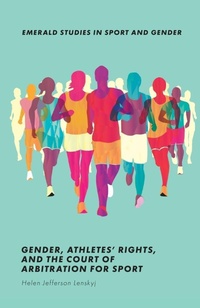
Gender, Athletes' Rights, and the Court of Arbitration for Sport
Published on 28. September 2018
Book
Paperback/Softback
263 pages
978-1-78754-240-2 (ISBN)
Description
Disputes over gender, doping, and eligibility in Olympic sport are widely covered in sport studies and in the mainstream media. Less well known are the functions of the Court of Arbitration for Sport (CAS), and the threat it poses to athletes' rights by depriving them of access to their own countries' court systems. CAS loosely follows the model of international arbitration tribunals. As in forced arbitration outside of sport, employees - in this case, high performance athletes - sign contracts agreeing to arbitration rather than litigation as the sole means of dispute resolution.
Promoting the concept of sport exceptionalism, the International Olympic Committee (IOC) justifies the power it exercises through CAS by claiming that sport must be autonomous and self-regulating, with disputes settled by specialist arbitrators. Arguments in support of this position point to lex sportiva (global sports law) as a valid legal principle in sport-related disputes, which, it is claimed, cannot be understood or resolved by non-specialists. Self-regulation works effectively to protect the Olympic industry brand by keeping disputes 'in the family'.
This critical analysis of CAS's history and functions demonstrates how athletes' rights are threatened by the forced arbitration process at CAS. In particular, CAS decisions involving female and gender-variant athletes, and racialized men and women, reflect numerous injustices. As well as the chronic problem of CAS's lack of independence, other issues examined here include confidentiality, lex sportiva, non-precedential awards, the closed list of specialist arbitrators, and, in doping cases, questions concerning strict liability and burden of proof.
Promoting the concept of sport exceptionalism, the International Olympic Committee (IOC) justifies the power it exercises through CAS by claiming that sport must be autonomous and self-regulating, with disputes settled by specialist arbitrators. Arguments in support of this position point to lex sportiva (global sports law) as a valid legal principle in sport-related disputes, which, it is claimed, cannot be understood or resolved by non-specialists. Self-regulation works effectively to protect the Olympic industry brand by keeping disputes 'in the family'.
This critical analysis of CAS's history and functions demonstrates how athletes' rights are threatened by the forced arbitration process at CAS. In particular, CAS decisions involving female and gender-variant athletes, and racialized men and women, reflect numerous injustices. As well as the chronic problem of CAS's lack of independence, other issues examined here include confidentiality, lex sportiva, non-precedential awards, the closed list of specialist arbitrators, and, in doping cases, questions concerning strict liability and burden of proof.
Reviews / Votes
'We've waited ten years for this book. Professor Lenskyj is the only person who could possibly have written it.' -- Dr David McArdle 'Drawing on the decisions of the Court of Arbitration for Sport and the Swiss Federal Tribunal between 1986 and 2018, as well as those of other courts, arbitration and disciplinary panels, and other sources, the author examines the history and functions of the Court of Arbitration for Sport as the place for a sport-specific and confidential dispute resolution process for Olympic and international athletes, particularly cases involving women and ethnic minorities. She considers how gender, race/ethnicity, and other social factors affect outcomes in Court of Arbitration for Sport cases. She explores general trends in alternative dispute resolution and debates about arbitration vs. litigation, as well as historical and contemporary developments in sports law, the influence of sport exceptionalism as a guiding principle, the problems of "stacked decks" and "repeat parties" in Court of Arbitration for Sport disputes, and the impacts of gender in these areas, then the "war against doping" and the strict liability principle, as well as the impact of gender and race/ethnicity on the outcomes of doping-related appeals, issues of gender policing and gender variance and testosterone-related controversies, and Court of Arbitration for Sport decisions on matters of doping and discipline.' -- Annotation (c)2018 * (protoview.com) * 'In Inside the Olympics Industry: Power, Politics, and Activism, Lenskyj suggested that the Olympic industry should be dismantled. The current volume reaches a similarly stark conclusion about the CAS, namely, reforms are inadequate and radical solutions are necessary. The incisive analysis in this volume, attributable to Lenskyj's research and the insights she has gained over the course of a long career studying power and sports, make Gender, Athletes' Rights, and the Court of Arbitration for Sport unfailingly thought provoking.' -- Evan C. Rothera, Sam Houston State University in Journal of Sport History, 2019 'I have no doubt that Gender, Athletes' Rights, and the Court of Arbitration for Sport is well worth reading from any other perspective than a lawyers' as well, but regardless of the perspective I do think it should be read from a critical standpoint. A good critique deserves to be seriously criticised.' -- Mikael Hansson, School of Law, University of Gothenburg 'Given the plethora of bold and interesting ideas Lenskyj raises, this book is a must read for anyone interested in human rights in sport.' -- Sarah Teetzel, University of ManitobaMore details
Series
Language
English
Place of publication
Bingley
United Kingdom
Target group
Professional and scholarly
Dimensions
Height: 198 mm
Width: 129 mm
Thickness: 13 mm
Weight
260 gr
ISBN-13
978-1-78754-240-2 (9781787542402)
Copyright in bibliographic data and cover images is held by Nielsen Book Services Limited or by the publishers or by their respective licensors: all rights reserved.
Schweitzer Classification
Other editions
Additional editions
Helen Jefferson Lenskyj
Gender, Athletes' Rights, and the Court of Arbitration for Sport
E-Book
09/2018
1st Edition
Emerald Publishing Limited
€39.49
Available for download
Person
Helen Jefferson Lenskyj is Professor Emerita at the University of Toronto. Helen began her career as a researcher and advocate for women and sport in 1980. Books on those issues include Out of Bounds: Women, Sport and Sexuality (1986), Out on the Field: Gender, Sport and Sexualities (2003), Gender Politics and the Olympic Industry (2013) and three monographs published by Sport Canada. Her recent publications on the Olympics include Inside the Olympic Industry: Power, Politics and Activism (2000), The Best Olympics Ever? Social Impacts of Sydney 2000 (2002), Olympic Industry Resistance (2008) and The Sochi 2014 Olympics: No More Rainbows (2014).
Content
Introduction Part I
Chapter 1. Sports Law and the Court of Arbitration for Sport
Chapter 2. CAS and Sport Exceptionalism
Part II
Chapter 3. The War on Doping
Chapter 4. Doping, Genes and Gender
Chapter 5. Conclusion
Chapter 1. Sports Law and the Court of Arbitration for Sport
Chapter 2. CAS and Sport Exceptionalism
Part II
Chapter 3. The War on Doping
Chapter 4. Doping, Genes and Gender
Chapter 5. Conclusion