

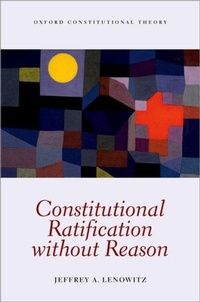
Constitutional Ratification without Reason
Published on 10. March 2022
Book
Hardback
400 pages
978-0-19-885234-6 (ISBN)
Description
This volume focuses on constitutional ratification, the procedure in which a draft constitution is submitted by its creators to the people or their representatives in an up or down vote determining implementation. Ratification is increasingly common and routinely recommended by experts. Nonetheless, it is neither neutral nor inevitable. Constitutions can be made without it and when it is used it has significant effects. This raises the central question of the book: should ratification be recommended? Put another way: is there a reason for treating the procedure as a default for the constitution-making process? Surprisingly, these questions are rarely asked. The procedure's worth is assumed, not demonstrated, while ratification is generally overlooked in the literature. In fact, this is the first sustained study of ratification.
To address these oversights, this book defines ratification and its types, explains the procedure's effects, conceptual origins, and history, and then concentrates on finding reasons for its use. Specifically, it builds up and analyzes the three most likely normative justifications. These urge the implementation of ratification because the procedure: enables the constituent power to make its constitution; fosters representation during constitution-making; or helps create a legitimate constitution.
Ultimately, these justifications are found wanting, leading to the conclusion that ratification lacks a convincing, context-independent justification. Thus, until new arguments are developed, experts should not give recommendations for ratification as a matter of course, practitioners should not reach for it uncritically, and-more generally-one should avoid the blanket application of concepts from democratic theory to extraordinary contexts such as constitution-making.
To address these oversights, this book defines ratification and its types, explains the procedure's effects, conceptual origins, and history, and then concentrates on finding reasons for its use. Specifically, it builds up and analyzes the three most likely normative justifications. These urge the implementation of ratification because the procedure: enables the constituent power to make its constitution; fosters representation during constitution-making; or helps create a legitimate constitution.
Ultimately, these justifications are found wanting, leading to the conclusion that ratification lacks a convincing, context-independent justification. Thus, until new arguments are developed, experts should not give recommendations for ratification as a matter of course, practitioners should not reach for it uncritically, and-more generally-one should avoid the blanket application of concepts from democratic theory to extraordinary contexts such as constitution-making.
Reviews / Votes
In his new book, Constitutional Ratification Without Reason, Jeffrey Lenowitz carefully addresses the fundamental normative questions related to the practice of constitutional ratification. His response to the basic question of whether ratification is normatively necessary for a constitutional system is refreshingly original and poses an impressive challenge to the dominant approaches in the field. Overall, the book presents a first-rate argument in every way, especially reflective of the value of Jeffrey's approach to political theory. * Jack Knight, Frederic Cleaveland Professor of Law and Political Science, Duke University * Constitutional Ratification Without Reason is one of the most illuminating books I've read in years about the deep conundra surrounding the notion of constitutional "legitimacy" in an age that valorizes "popular sovereignty." Lenowitz's skepticism especially about purported popular ratification of an already-drafted constitution is persuasive and should have great impact on both theoretical discussions and the actualities of constitutional formation. * Sanford Levinson, W. St. John Garwood and W. St. John Garwood, Jr. Centennial Chair and Professor of Government, University of Texas Law School *More details
Series
Language
English
Place of publication
Oxford
United Kingdom
Target group
College/higher education
Product notice
sewn/stitched
Cloth over boards
Dimensions
Height: 237 mm
Width: 164 mm
Thickness: 28 mm
Weight
785 gr
ISBN-13
978-0-19-885234-6 (9780198852346)
Copyright in bibliographic data and cover images is held by Nielsen Book Services Limited or by the publishers or by their respective licensors: all rights reserved.
Schweitzer Classification
Other editions
Additional editions
Jeffrey A. Lenowitz
Constitutional Ratification without Reason
E-Book
03/2022
1st Edition
OUP eBook
€67.49
Available for download
Jeffrey A. Lenowitz
Constitutional Ratification without Reason
E-Book
03/2022
1st Edition
OUP eBook
€67.49
Available for download
Person
Jeffrey A. Lenowitz is the Meyer and W. Walter Jaffe Assistant Professor of Politics at Brandeis University, where he researches and teaches political theory. He received his doctorate from the Department of Political Science at Columbia University and held a Prize Postdoctoral Research Fellowship at Nuffield College, University of Oxford. He is also a faculty member of the History of Ideas Program at Brandeis.
Content
1. Questioning Ratification
1: Basic concepts
2: Ratification
3: What kind of justification?
4: Why care about ratification?
5: Structure
2. Ratification Beyond (And Before) Constitutions
1: Agency law
2: Ratification in treaty law
3: Labor law & collective bargaining
4: Conclusions
3. The Invention of Constitutional Ratification
1: The Berkshire Constitutionalists
2: The Mechanicks' Union of New York City
3: Ratification by state conventions: Philadelphia
4: Ratification by Convention: Georgia
5: Conclusion
4. Making the Constituent Power Speak
1: The theory of constituent power
2: Finding constituent power justifications
3: Constituent power dispersed
4: Conclusion
5. The Unalienable Right of the Berkshire Constitutionalists
1: Historical context, theoretical context
2: Constituent power rooted in contractualism
3: Constitutional creation & constituent power
4: The Sleeping Sovereign & the Unique Site Justification
5: Conclusion
6. Ignorance and the Constituent Power
1: What kind of choice?
2: Condorcet's prediction
3: Ignorant framers
4: Information shortcuts
5: Educating the people
6: Conclusion
7. Representation Through Accountability
1: Representation justification
2: Ratification's potential role
3: Ratification as accountability mechanism
4: Objections
5: Conclusion
8. Legitimacy Types & Procedures
1: What is legitimacy?
2: Legitimate constitutions
3: Creating legitimacy
4: Pathways to constitutional legitimacy
5: Conclusions
9. Legitimation Device
1: Substantive legitimation
2: Procedural moral legitimation
3: Procedural sociological legitimation
4: Conclusion
10. Conclusion
1: Summary of findings
2: Lessons and questions
3: Context dependent reasons
1: Basic concepts
2: Ratification
3: What kind of justification?
4: Why care about ratification?
5: Structure
2. Ratification Beyond (And Before) Constitutions
1: Agency law
2: Ratification in treaty law
3: Labor law & collective bargaining
4: Conclusions
3. The Invention of Constitutional Ratification
1: The Berkshire Constitutionalists
2: The Mechanicks' Union of New York City
3: Ratification by state conventions: Philadelphia
4: Ratification by Convention: Georgia
5: Conclusion
4. Making the Constituent Power Speak
1: The theory of constituent power
2: Finding constituent power justifications
3: Constituent power dispersed
4: Conclusion
5. The Unalienable Right of the Berkshire Constitutionalists
1: Historical context, theoretical context
2: Constituent power rooted in contractualism
3: Constitutional creation & constituent power
4: The Sleeping Sovereign & the Unique Site Justification
5: Conclusion
6. Ignorance and the Constituent Power
1: What kind of choice?
2: Condorcet's prediction
3: Ignorant framers
4: Information shortcuts
5: Educating the people
6: Conclusion
7. Representation Through Accountability
1: Representation justification
2: Ratification's potential role
3: Ratification as accountability mechanism
4: Objections
5: Conclusion
8. Legitimacy Types & Procedures
1: What is legitimacy?
2: Legitimate constitutions
3: Creating legitimacy
4: Pathways to constitutional legitimacy
5: Conclusions
9. Legitimation Device
1: Substantive legitimation
2: Procedural moral legitimation
3: Procedural sociological legitimation
4: Conclusion
10. Conclusion
1: Summary of findings
2: Lessons and questions
3: Context dependent reasons