

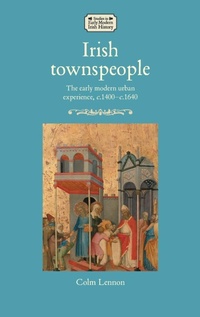
Irish townspeople
The early modern urban experience, c.1400-c.1640
Published on 12. May 2026
Book
Hardback
312 pages
978-1-5261-9342-1 (ISBN)
Description
Through a series of innovative perspectives, this book examines how early modern Irish townspeople experienced the urban world through a range of family and associational ties. Migrants inducted through town citizenship and marriage bonded more closely as sisters or brothers of confraternities and guilds, consolidating parish membership. Civic religion saw the integration of religion with town politics and councils, and monastic charity of the friars' hospitals preceded the era of modern municipal welfare. In circumstances of the alienation of the long-settled Catholic townspeople from the state's religious and political Reformation in the seventeenth century, they drew sustenance from the continuity of institutions such as colleges, fraternities and hospitals and forms of coexistence with Protestant fellow-citizens. -- .
More details
Series
Language
English
Place of publication
Manchester
United Kingdom
Dimensions
Height: 240 mm
Width: 161 mm
Thickness: 21 mm
Weight
634 gr
ISBN-13
978-1-5261-9342-1 (9781526193421)
Copyright in bibliographic data and cover images is held by Nielsen Book Services Limited or by the publishers or by their respective licensors: all rights reserved.
Schweitzer Classification
Other editions
Additional editions
E-Book
05/2026
Manchester University Press
€132.99
Available for download
Person
Colm Lennon is Emeritus Professor of History at Maynooth University. He is a member of the Royal Irish Academy -- .
Content
Introduction
1 Environment: buildings and boundaries, c.1400-c.1550
2 Integration: forging communal ties through marriage and migration, c.1400-c.1550
3 Association: the social kinship of religious confraternities, c.1400-c.1550
4 Civic religion: symbiosis of sacred and secular, c.1400-c.1550
5 Charity: from private mercy to municipal welfare, c.1500-c.1640
6 Recusancy and the defence of civic institutions, c.1550-c.1640
7 Urban culture and communal identity, c.1550-c.1640
Conclusion
Bibliography -- .
1 Environment: buildings and boundaries, c.1400-c.1550
2 Integration: forging communal ties through marriage and migration, c.1400-c.1550
3 Association: the social kinship of religious confraternities, c.1400-c.1550
4 Civic religion: symbiosis of sacred and secular, c.1400-c.1550
5 Charity: from private mercy to municipal welfare, c.1500-c.1640
6 Recusancy and the defence of civic institutions, c.1550-c.1640
7 Urban culture and communal identity, c.1550-c.1640
Conclusion
Bibliography -- .