

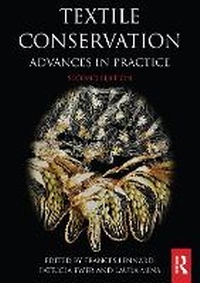
Textile Conservation
Advances in Practice
2nd Edition
Published on 7. March 2024
Book
Hardback
686 pages
978-1-032-41581-9 (ISBN)
Description
This second edition of Textile Conservation offers an up-to-date perspective on the role and practice of textile conservators, capturing the diversity of textile conservation work across the globe.
The volume considers key factors that are integral to effective conservation decision-making. It achieves this by focusing on four major factors that have influenced development in textile conservation practice over the past decades: the changing context, an evolution in the way conservators think about objects, the greater involvement of stakeholders, and technical development. Features of the new edition include:
Updated chapters that explain new techniques and recent developments in the field;
New and updated international case studies that demonstrate conservation decision-making in practice, including assessments of the conservation of objects in some of the world's major cultural institutions;
Full-colour illustrations that demonstrate conservation in practice.
Textile Conservation will be essential reading for conservators around the world. It will also be of great interest to academics and students engaged in the study of the conservation of textiles, as well as museum and heritage professionals.
The volume considers key factors that are integral to effective conservation decision-making. It achieves this by focusing on four major factors that have influenced development in textile conservation practice over the past decades: the changing context, an evolution in the way conservators think about objects, the greater involvement of stakeholders, and technical development. Features of the new edition include:
Updated chapters that explain new techniques and recent developments in the field;
New and updated international case studies that demonstrate conservation decision-making in practice, including assessments of the conservation of objects in some of the world's major cultural institutions;
Full-colour illustrations that demonstrate conservation in practice.
Textile Conservation will be essential reading for conservators around the world. It will also be of great interest to academics and students engaged in the study of the conservation of textiles, as well as museum and heritage professionals.
More details
Series
Edition
2nd edition
Language
English
Place of publication
London
United Kingdom
Publishing group
Taylor & Francis Ltd
Target group
College/higher education
Professional and scholarly
Postgraduate and Professional Reference
Product notice
sewn/stitched
Cloth over boards
Illustrations
223 farbige Abbildungen, 223 Farbfotos bzw. farbige Rasterbilder, 8 farbige Tabellen
8 Tables, color; 223 Halftones, color; 223 Illustrations, color
Dimensions
Height: 252 mm
Width: 177 mm
Thickness: 36 mm
Weight
1474 gr
ISBN-13
978-1-032-41581-9 (9781032415819)
Copyright in bibliographic data and cover images is held by Nielsen Book Services Limited or by the publishers or by their respective licensors: all rights reserved.
Schweitzer Classification
Other editions
Additional editions

Book
approx. 06/2026
2nd Edition
Routledge
€83.13
Not yet published
E-Book
03/2024
2nd Edition
Taylor & Francis
€68.49
Available for download
E-Book
03/2024
2nd Edition
Taylor & Francis
€68.49
Available for download
Previous edition
Book
03/2010
1st Edition
Butterworth-Heinemann
€160.94
Article exhausted; check for reprint
Persons
Frances Lennard worked as a textile conservator for 15 years, at the Textile Conservation Centre and in private practice with Fiona Hutton, before moving to the academic sphere and becoming the convenor of the postgraduate textile conservation programme at the University of Southampton and later at the University of Glasgow. Her research focused on conservation treatment and interdisciplinary practice; she is particularly interested in the treatment of woven tapestry, painted textiles and Pacific barkcloth. She became an Honorary Professorial Research Fellow at the University of Glasgow in 2021.
Patricia Ewer, the principal of Textile Objects Conservation, LLC, has over 35 years of international experience in treating textiles, as well as managing, developing and staffing conservation projects of all disciplines. She is a Fellow of the American Institute for Conservation, the organization she has been a member of since 1989. She is co-editor with Frances Lennard of the 2010 text Textile Conservation: Advances in Practice.
Laura Mina serves as Conservator of Textiles with the Smithsonian National Museum of African American History & Culture. Previous institutions include a joint appointment with Winterthur Museum and the University of Delaware, the Costume Institute at the Metropolitan Museum of Art and the Philadelphia Museum of Art. She received her BS in Performance Studies from Northwestern University and her MA in Fashion and Textile Studies: History, Theory, Museum Practice (conservation focus) from the Fashion Institute of Technology. She has led multiple workshops on the use of gels for textile treatments.
Patricia Ewer, the principal of Textile Objects Conservation, LLC, has over 35 years of international experience in treating textiles, as well as managing, developing and staffing conservation projects of all disciplines. She is a Fellow of the American Institute for Conservation, the organization she has been a member of since 1989. She is co-editor with Frances Lennard of the 2010 text Textile Conservation: Advances in Practice.
Laura Mina serves as Conservator of Textiles with the Smithsonian National Museum of African American History & Culture. Previous institutions include a joint appointment with Winterthur Museum and the University of Delaware, the Costume Institute at the Metropolitan Museum of Art and the Philadelphia Museum of Art. She received her BS in Performance Studies from Northwestern University and her MA in Fashion and Textile Studies: History, Theory, Museum Practice (conservation focus) from the Fashion Institute of Technology. She has led multiple workshops on the use of gels for textile treatments.
Content
1. Textile conservation within the cultural sector; 2. Treatment ethics and decision making; 3. Conservation and community partnerships; 4. Interventive conservation; 5. Preventive conservation; 6. Applied science in conservation; 7. Education of textile conservators; 8. Ongoing professional development.