

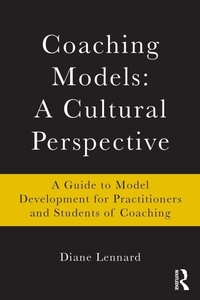
Coaching Models: A Cultural Perspective
A Guide to Model Development: for Practitioners and Students of Coaching
1st Edition
Published on 21. April 2010
Book
Paperback/Softback
140 pages
978-0-415-80214-7 (ISBN)
Description
"In addition to providing an extensive analysis of strategies for changing performance and the factors that can impact coaching effectiveness, this book offers what may be a unique value: instead of promoting one approach as the best, Dr. Lennard guides readers through a highly customized process of developing our own individualized coaching model. As a result of the book's thought-provoking activities, I strengthened my own sense of personal authenticity and saw new ways to coach and collaborate fully with employees who may have very different perspectives." - Tita Theodora Beal, Learning & Development, Pfizer, Inc.
"This is a wise book. The essential take-away is simple and profound. Develop, refine, and apply your own (as in ownership) personalized coaching model. Much is provided; nothing is imposed. Readers are invited to reflect on unique and defining experiences, strengths, values, perspectives and style and to begin creating their own 'work in progress.' Coaching Models will be a compelling read for experienced coaches and new coach practitioners alike." - Bethene LeMahieu, Ed.D.; Professional Coach and Conversation Conservationist
Coaching Models: A Cultural Perspective encourages and assists students and practitioners of business coaching to develop and apply their own coaching models. The entire field of coaching will benefit from having coaches who use their models to continually improve their practice.
The first part of this book presents the model development process by looking at the relationship among culture, beliefs, and behavior in the coaching context. It explains the importance of identifying cultural factors that influence the way coaches approach coaching interactions, and their coaching models.
The second section provides coaches with information and strategies for developing personalized coaching models, applying them to specific contexts, and reflecting on their interactions to refine their core coaching practices.
The third part describes the evolution of the author's own coaching model-the Performance Coaching Model-and illustrates how one coach incorporates unique perspectives and sets of skills, knowledge, and experience in her coaching practice.
"This is a wise book. The essential take-away is simple and profound. Develop, refine, and apply your own (as in ownership) personalized coaching model. Much is provided; nothing is imposed. Readers are invited to reflect on unique and defining experiences, strengths, values, perspectives and style and to begin creating their own 'work in progress.' Coaching Models will be a compelling read for experienced coaches and new coach practitioners alike." - Bethene LeMahieu, Ed.D.; Professional Coach and Conversation Conservationist
Coaching Models: A Cultural Perspective encourages and assists students and practitioners of business coaching to develop and apply their own coaching models. The entire field of coaching will benefit from having coaches who use their models to continually improve their practice.
The first part of this book presents the model development process by looking at the relationship among culture, beliefs, and behavior in the coaching context. It explains the importance of identifying cultural factors that influence the way coaches approach coaching interactions, and their coaching models.
The second section provides coaches with information and strategies for developing personalized coaching models, applying them to specific contexts, and reflecting on their interactions to refine their core coaching practices.
The third part describes the evolution of the author's own coaching model-the Performance Coaching Model-and illustrates how one coach incorporates unique perspectives and sets of skills, knowledge, and experience in her coaching practice.
More details
Language
English
Place of publication
London
United Kingdom
Publishing group
Taylor & Francis Ltd
Target group
College/higher education
Professional and scholarly
Postgraduate, Professional, and Undergraduate
Product notice
Paperback (UK-B)
Illustrations
10 s/w Abbildungen, 10 s/w Tabellen
10 Tables, black and white; 10 Illustrations, black and white
Dimensions
Height: 229 mm
Width: 152 mm
Thickness: 9 mm
Weight
234 gr
ISBN-13
978-0-415-80214-7 (9780415802147)
Copyright in bibliographic data and cover images is held by Nielsen Book Services Limited or by the publishers or by their respective licensors: all rights reserved.
Schweitzer Classification
Other editions
Additional editions
Diane Lennard
Coaching Models: A Cultural Perspective
A Guide to Model Development: for Practitioners and Students of Coaching
E-Book
02/2013
1st Edition
Routledge
€59.49
Available for download
Diane Lennard
Coaching Models: A Cultural Perspective
A Guide to Model Development: for Practitioners and Students of Coaching
E-Book
02/2013
1st Edition
Routledge
€59.49
Available for download

Diane Lennard
Coaching Models: A Cultural Perspective
A Guide to Model Development: for Practitioners and Students of Coaching
Book
04/2010
1st Edition
Routledge
€230.20
Shipment within 15-20 days
Person
Diane Lennard, Ph.D., is a coach and Clinical Associate Professor of Management Communication at New York University Stern School of Business. In her course, Foundations of Business Coaching, full-time and part-time MBAs, Executive MBAs, and other graduate students develop, apply, and present their own coaching models. In addition to coaching students, faculty, and administrators at NYU, she coaches business executives, consultants, and other professionals.
Content
Preface Part 1: The Foundation 1. Introduction to Coaching Model Development 2. Theoretical Foundation: Learning Theory for Coaches 3. Theory-Based Guidelines Part 2: The Coaching Model 4. Coaching Model Functions and Characteristics 5. Identification and Selection of Coaching Model Components Part 3: The Performance Coaching Model Example 6. How the Performance Coaching Model Evolved 7. How the Performance Coaching Model is Applied. References. Index