

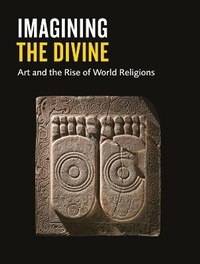
Imagining the Divine
Art and the Rise of World Religions
Published on 11. October 2017
Book
Paperback/Softback
200 pages
978-1-910807-18-7 (ISBN)
Description
Religion has always been a fundamental force for constructing identity, from antiquity to the contemporary world. The transformation of ancient cults into faith systems, which we recognise now as major world religions, took place in the first millennium AD, in the period we call 'Late Antiquity'. Our argument is that the creative impetus for both the emergence, and much of the visual distinctiveness of the world religions came in contexts of cultural encounter. Bridging the traditional divide between classical, Asian, Islamic and Western history, this exhibition and its accompanying catalogue highlights religious and artistic creativity at points of contact and cultural borders between late antique civilisations.
This catalogue features the creation of specific visual languages that belong to five major world religions: Christianity, Judaism, Buddhism, Hinduism and Islam. The imagery still used by these belief systems today is evidence for the development of distinct religious identities in Late Antiquity. Emblematic visual forms like the figure of Buddha and Christ, or Islamic aniconism, only evolved in dialogue with a variety of coexisting visualisations of the sacred. As late antique believers appropriated some competing models and rejected others, they created compelling and long-lived representations of faith, but also revealed their indebtedness to a multitude of contemporaneous religious ideas and images.
This catalogue features the creation of specific visual languages that belong to five major world religions: Christianity, Judaism, Buddhism, Hinduism and Islam. The imagery still used by these belief systems today is evidence for the development of distinct religious identities in Late Antiquity. Emblematic visual forms like the figure of Buddha and Christ, or Islamic aniconism, only evolved in dialogue with a variety of coexisting visualisations of the sacred. As late antique believers appropriated some competing models and rejected others, they created compelling and long-lived representations of faith, but also revealed their indebtedness to a multitude of contemporaneous religious ideas and images.
More details
Language
English
Place of publication
Oxford
United Kingdom
Illustrations
10 Illustrations, black and white; 200 Illustrations, color
Dimensions
Height: 280 mm
Width: 220 mm
Weight
1140 gr
ISBN-13
978-1-910807-18-7 (9781910807187)
Copyright in bibliographic data and cover images is held by Nielsen Book Services Limited or by the publishers or by their respective licensors: all rights reserved.
Schweitzer Classification
Persons
Content
Table of Contents: List of Contributors; Preface; Encounters; Religions in the Roman World; Gods in Combination; The Rise of the Image of Christ; Jewish Art; Scripture; Word as Image; Envisioning the Buddha; Amulets and Magic; Maidens and Mothers, Virgins and Lovers; Vishnu: The Enigmatic Image of a Deity; Sacred and Imperial Power; Iconoclasm; The Emergence of Islamic Art; Aniconism; Christianity in the British Isles; Sacred Space; Travelling Objects; Chronological Table; Map of the World (Britain to India) c.250 AD; Map of the World (Britain to India) c.850 AD; Index of Geographical Names; Index of Personal Names.