

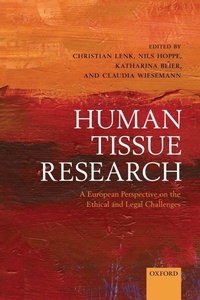
Human Tissue Research
A European perspective on the ethical and legal challenges
1st Edition
Published on 27. January 2011
Book
Hardback
216 pages
978-0-19-958755-1 (ISBN)
Description
The use of human tissue for medical research and scientific progress raises many ethical and legal challenges. The procurement, storage and transfer of human tissue for research purposes have posed significant questions over recent years, and a number of high profile scandals in the UK prompted the publication of the Madden Report on Post Mortem Practice and Procedures in Irish hospitals in 2006. Additionally, tissue-related research tends to be most promising if samples and information are shared across national borders, but the heterogeneity of current rules and guidelines within the member states of the European Union calls all the more for clarification.
This multi-authored interdisciplinary text, edited by four experienced researchers, explores many of the issues concerning biobank-related research and aims to provide answers to the most urgent questions by means of ethical, philosophical, and legal investigation. It provides a fascinating insight into a wide range of interlinking research perspectives and serves as a comprehensive reference to the state of play ethically and legally in Europe. It will be of value to medics and social scientists, human tissue researchers, and policy makers who have an interest in ethical and legal issues of human tissue research.
This multi-authored interdisciplinary text, edited by four experienced researchers, explores many of the issues concerning biobank-related research and aims to provide answers to the most urgent questions by means of ethical, philosophical, and legal investigation. It provides a fascinating insight into a wide range of interlinking research perspectives and serves as a comprehensive reference to the state of play ethically and legally in Europe. It will be of value to medics and social scientists, human tissue researchers, and policy makers who have an interest in ethical and legal issues of human tissue research.
More details
Language
English
Place of publication
Oxford
United Kingdom
Target group
College/higher education
Medics and social scientists, human tissue researchers, and policy makers.
Illustrations
1 black and white line drawing
Dimensions
Height: 260 mm
Width: 183 mm
Thickness: 16 mm
Weight
610 gr
ISBN-13
978-0-19-958755-1 (9780199587551)
Copyright in bibliographic data and cover images is held by Nielsen Book Services Limited or by the publishers or by their respective licensors: all rights reserved.
Schweitzer Classification
Persons
PD Dr Christian Lenk read philosophy, political science, and social anthropology at the University of Hamburg, Germany. From 2000 to 2002 he worked in two projects in the field of medical ethics and bioethics at the Universities of Marburg and Muenster, financed by the German Research Community (DFG). He received his doctoral degree for a study on the ethical issues of enhancement technologies in biomedicine at the University of Muenster in 2002. In 2002 he became a researcher and since 2004 has been assistant professor for medical ethics at the Department for Medical Ethics and History of Medicine at the University of Goettingen.
Nils Hoppe read law, with a specialisation in medical law and human rights, in Nottingham, Erlangen-Nuremberg, Goettingen and Hannover. He completed his doctorate in 2008 with a thesis on property rights in the life sciences. Nils held positions as a legal assistant in a large English law firm, legal counsel in a university hospital and as research fellow in medical ethics. He is now a senior research fellow in health law and ethics as well as co-director of the Centre for Ethics and Law in the Life Sciences (CELLS) at Leibniz Universitaet Hannover.
Katharina Beier majored in political science and German language and literature at the University of Greifswald in North-Eastern Germany. In February 2008 she finished her PhD "Between persistence and revision - The biomedical challenge to political liberalism " (Campus 2009). Since April 2008 she has been working as a research fellow and Project Officer for the Tiss.EU project at the Department of Medical Ethics and History in Goettingen (Germany). Her research interests comprise modern liberal theories, liberal biopolitics, questions of biomedical/genetic justice, utilitarianism as well as ethical and legal aspects of biobanks.
Claudia Wiesemann is a medical ethicist and head of the Department of Medical Ethics and History of Medicine at Goettingen University Medical School, Germany. She is also President of the German Academy of Ethics in Medicine, an academic society for Medical Ethics. In 1995, she completed her habilitation in medical history and medical ethics at the University of Erlangen-Nuernberg, Germany. Her dissertation in medical history at Muenster University, Germany, was published in 1991. She has completed all medical exams in Muenster University, Germany, in 1985 and has worked as resident from 1986 to 1988. Claudia Wiesemann has coordinated several European research projects, e.g., on the ethics of tissue research and on information and documentation networks in ethics in medicine and biotechnology. Her research focuses on the ethics of research with humans, reproductive medicine and the family. She serves as an editorial board member of several journals in the field of medical humanities.
Nils Hoppe read law, with a specialisation in medical law and human rights, in Nottingham, Erlangen-Nuremberg, Goettingen and Hannover. He completed his doctorate in 2008 with a thesis on property rights in the life sciences. Nils held positions as a legal assistant in a large English law firm, legal counsel in a university hospital and as research fellow in medical ethics. He is now a senior research fellow in health law and ethics as well as co-director of the Centre for Ethics and Law in the Life Sciences (CELLS) at Leibniz Universitaet Hannover.
Katharina Beier majored in political science and German language and literature at the University of Greifswald in North-Eastern Germany. In February 2008 she finished her PhD "Between persistence and revision - The biomedical challenge to political liberalism " (Campus 2009). Since April 2008 she has been working as a research fellow and Project Officer for the Tiss.EU project at the Department of Medical Ethics and History in Goettingen (Germany). Her research interests comprise modern liberal theories, liberal biopolitics, questions of biomedical/genetic justice, utilitarianism as well as ethical and legal aspects of biobanks.
Claudia Wiesemann is a medical ethicist and head of the Department of Medical Ethics and History of Medicine at Goettingen University Medical School, Germany. She is also President of the German Academy of Ethics in Medicine, an academic society for Medical Ethics. In 1995, she completed her habilitation in medical history and medical ethics at the University of Erlangen-Nuernberg, Germany. Her dissertation in medical history at Muenster University, Germany, was published in 1991. She has completed all medical exams in Muenster University, Germany, in 1985 and has worked as resident from 1986 to 1988. Claudia Wiesemann has coordinated several European research projects, e.g., on the ethics of tissue research and on information and documentation networks in ethics in medicine and biotechnology. Her research focuses on the ethics of research with humans, reproductive medicine and the family. She serves as an editorial board member of several journals in the field of medical humanities.
Editor
, Privatdozent (Ethics & Theory of Medicine), Coordinator of the Tiss.EU Project, Department for Medical Ethics and History of Medicine, University of Goettingen, Germany
, Senior Research Fellow in Health Law and Bioethics, Leibniz Universitaet, Hannover, Germany
, Research Fellow and Project Officer for the Tiss.EU Project, Department for Medical Ethics and History of Medicine, University of Goettingen, Germany
, Department for Medical Ethics and History of Medicine, University of Goettingen, Germany
Content
1 - KEY CONCEPTS OF THE ETHICAL DEBATE; 2 - THE LEGAL REGULATION OF HUMAN TISSUE RESEARCH; 3 - PRACTICES - DISCIPLINARY PERSPECTIVES