

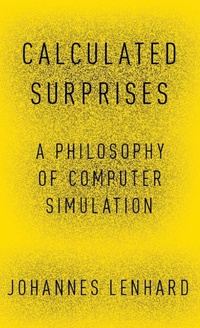
Calculated Surprises
A Philosophy of Computer Simulation
Published on 11. April 2019
Book
Hardback
272 pages
978-0-19-087328-8 (ISBN)
Description
If all philosophy starts with wondering, then Calculated Surprises starts with wondering about how computers are changing the face and inner workings of science. In this book, Lenhard concentrates on the ways in which computers and simulation are transforming the established conception of mathematical modeling. His core thesis is that simulation modeling constitutes a new mode of mathematical modeling that rearranges and inverts key features of the established conception. Although most of these new key features--such as experimentation, exploration, or epistemic opacity--have their precursors, the new ways in which they are being combined is generating a distinctive style of scientific reasoning. Lenhard also documents how simulation is affecting fundamental concepts of solution, understanding, and validation. He feeds these transformations back into philosophy of science, thereby opening up new perspectives on longstanding oppositions.
By combining historical investigations with practical aspects, Calculated Surprises is accessible for a broad audience of readers. Numerous case studies covering a wide range of simulation techniques are balanced with broad reflections on science and technology.
Initially, what computers are good at is calculating with a speed and accuracy far beyond human capabilities. Lenhard goes further and investigates the emerging characteristics of computer-based modeling, showing how this simple observation is creating a number of surprising challenges for the methodology and epistemology of science. These calculated surprises will attract both philosophers and scientific practitioners who are interested in reflecting on recent developments in science and technology.
By combining historical investigations with practical aspects, Calculated Surprises is accessible for a broad audience of readers. Numerous case studies covering a wide range of simulation techniques are balanced with broad reflections on science and technology.
Initially, what computers are good at is calculating with a speed and accuracy far beyond human capabilities. Lenhard goes further and investigates the emerging characteristics of computer-based modeling, showing how this simple observation is creating a number of surprising challenges for the methodology and epistemology of science. These calculated surprises will attract both philosophers and scientific practitioners who are interested in reflecting on recent developments in science and technology.
Reviews / Votes
...this book is recommended as a clearly organized portrait, including many examples of computer simulation, and valuable for its vision of the future transformation of science into technoscience. ...Recommended * CHOICE * Lenhard has done a wonderful job connecting contemporary debates with the historical backdrop of computer simulations. On occasion, he surprises me with intriguing new examples and cases taken from the history of science and technology that have until now eluded my attention. * Juan M. Duran, Delft University of Technology, Delft, The Netherlands, Metascience *More details
Series
Language
English
Place of publication
New York
United States
Dimensions
Height: 222 mm
Width: 145 mm
Thickness: 18 mm
Weight
472 gr
ISBN-13
978-0-19-087328-8 (9780190873288)
Copyright in bibliographic data and cover images is held by Nielsen Book Services Limited or by the publishers or by their respective licensors: all rights reserved.
Schweitzer Classification
Other editions
Additional editions
E-Book
02/2019
1st Edition
OUP eBook
€46.99
Available for download
E-Book
02/2019
1st Edition
OUP eBook
€36.99
Available for download
Person
Johannes Lenhard is Lecturer of Philosophy and senior researcher at the Department of Philosophy and the Insititute for Interdisciplinary Research at Bielefeld University. He received his doctoral degree in mathematics from the University of Frankfurt and has a long track record of research in philosophy and history of computational methods in science and engineering.
Content
- Introduction
- Section I: A New Type of Mathematical Modeling
- Chapter 1: Experiment and Artificiality
- Chapter 2: Visualization and Interaction
- Chapter 3: Plasticity
- Chapter 4: Epistemic Opacity
- Chapter 5: A New Type of Mathematical Modeling
- Section II: Conceptual Transformations
- Chapter 6: Solution or Imitation?
- Chapter 7:Validation, Holism, and the Limits of Analysis
- Section III: Conclusion and Outlook
- Chapter 8: Novelty and Reality
- Bibliography