

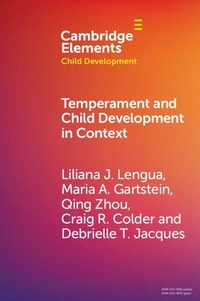
Temperament and Child Development in Context
Published on 28. November 2024
Book
Paperback/Softback
98 pages
978-1-009-52185-7 (ISBN)
Description
Children's temperament is a central individual characteristic that has significant implications, directly and indirectly, for their social, emotional, behavioral, cognitive, and health outcomes, through its evocative and moderating effects on other social and contextual influences. Accounting for these contextual influences is critical to articulating the role of temperament in children's development. This Element defines temperament and describes its roots in neurobiological systems as well as its relevance to children's developmental outcomes, with a focus on understanding the influence of temperament in children's social and environmental contexts. It covers key developmental periods, situating the contribution of temperament to children's development in complex and changing processes and contexts from infancy through adolescence. The Element concludes by underscoring the value of integrating contextual, relational, and dynamic systems approaches and pointing to future directions in temperament research and application.
More details
Series
Language
English
Place of publication
Cambridge
United Kingdom
Product notice
Paperback (trade)
Illustrations
Worked examples or Exercises
Dimensions
Height: 229 mm
Width: 152 mm
Thickness: 6 mm
Weight
156 gr
ISBN-13
978-1-009-52185-7 (9781009521857)
Copyright in bibliographic data and cover images is held by Nielsen Book Services Limited or by the publishers or by their respective licensors: all rights reserved.
Schweitzer Classification
Other editions
Additional editions
Liliana J. Lengua | Maria A. Gartstein | Qing Zhou
Temperament and Child Development in Context
Book
11/2024
Cambridge University Press
€75.30
Shipment within 15-20 days
Persons
Content
1. Introduction; 2. Definition and biological basis of temperament; 3. Temperament, developmental processes, and outcomes; 4. Social, cultural, and contextual influences on temperament development; 5. Developmental periods, contexts, and outcomes; 6. Contextual, relational, and dynamic systems theories; 7. Clinical and translational implications for child temperament; 8. Future directions in research and practice; 9. Conclusions; References.