

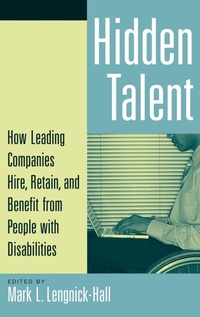
Hidden Talent
How Leading Companies Hire, Retain, and Benefit from People with Disabilities
Published on 1. April 2007
Book
Hardback
168 pages
978-0-275-99289-7 (ISBN)
Description
Despite the passage of the Americans with Disabilities Act in 1990, many forms of discrimination against people with disabilities are still practiced, denying opportunity for employees, as well as the employers who might hire and support them. Based on a multi-year research project by a team of experts in human resource management, economics, and communications, Hidden Talent showcases the innovative practices of organizations that are actively hiring, training, and retaining people with disabilities-and thriving as a result. The authors reveal the roots of disability discrimination and demonstrate the benefits, to employers and employees alike, of investing in disabled workers, featuring in-depth case examples. Additional resources, including an overview of the ADA, information on tax and legal incentives, and listing of related publications, organizations, and websites, will make this book essential for anyone researching, managing, or experiencing the dynamics of disability in the workplace.
The Americans with Disabilities Act was signed into law in 1990 to protect and assist over 20 million people with disabilities. Though its mandates for business are far-reaching, many forms of discrimination are still practiced, denying opportunity for employees and potential employees with disabilites, as well as the companies that might hire and support them. Meanwhile, as many analysts argue, we are heading toward a high-skill labor shortage, with a largely untapped resource ready to fill the gap.
Based on a multi-year research project by a team of experts in human resource management, economics, and communications, Hidden Talent showcases the innovative practices of organizations that are actively hiring, training, and retaining people with disabilities-and thriving as a result. The authors reveal the roots of disability discrimination, and demonstrate the benefits, to employers and employees alike, of investing in disabled workers, featuring in-depth case examples. Additional resources, including an overview of the ADA, information on tax and legal incentives, and a listing of related publications, organizations, and websites, will make this book essential for anyone researching, managing, or experiencing the dynamics of disability in the workplace.
The Americans with Disabilities Act was signed into law in 1990 to protect and assist over 20 million people with disabilities. Though its mandates for business are far-reaching, many forms of discrimination are still practiced, denying opportunity for employees and potential employees with disabilites, as well as the companies that might hire and support them. Meanwhile, as many analysts argue, we are heading toward a high-skill labor shortage, with a largely untapped resource ready to fill the gap.
Based on a multi-year research project by a team of experts in human resource management, economics, and communications, Hidden Talent showcases the innovative practices of organizations that are actively hiring, training, and retaining people with disabilities-and thriving as a result. The authors reveal the roots of disability discrimination, and demonstrate the benefits, to employers and employees alike, of investing in disabled workers, featuring in-depth case examples. Additional resources, including an overview of the ADA, information on tax and legal incentives, and a listing of related publications, organizations, and websites, will make this book essential for anyone researching, managing, or experiencing the dynamics of disability in the workplace.
Reviews / Votes
"Lengnick-Hall has edited a highly readable and informative book that attempts to persuade readers of the benefits of hiring people with disabilities. Although employers may be hesitant to hire disabled persons for various reasons, Lengnick-Hall and his academic and research colleagues dispel myths surrounding disabled employees, citing examples of companies that were proactive in hiring the disabled and thrived as a result. The seven case studies included in the text, each one its own chapter, read like a conversation, with practical advice and lessons learned provided at the end. Further resources include a section on tax incentives for employers and a basic introduction to the Americans with Disabilities Act (1990). Although brief, the seven case studies, along with the research discussed in the book, successfully highlight the message that hiring people with disabilities puts companies at a competitive advantage. Any individual interested in learning about this topic, and particularly managers in the early stages of changing organizational culture for purposes of being more disability-friendly, would gain from reading this book....Recommended. General readers; all levels of undergraduate students; and practitioners." - Choice "Editor Lengnick-Hall compiles new essays and case studies (not previously published) about how companies have benefited from the hiring and retaining of people with disabilities. The pieces include suggestions on how to create organizational cultures and climates that are disability-friendly. Unlike in many books that present strategies for people entering the workforce with disabilities, these contributors (mostly academics) focus on companies that are leaders in hiring, retaining, and valuing employees with disabilities, illustrating principles that can improve any organization that is committed to a diverse workforce....Helpful appendixes include a list of federal tax incentives for hiring people with disabilities, a list of government agencies and business-sponsored organizations that help in the hiring of people with disabilities, and an overview of the Americans with Disabilities Act of 1990. The distinct research and presentations make this volume suitable for most public and academic libraries." - Library Journal "The Rehabilitation Act of 1978 and Americans with Disabilities Act of 1990 were bold first steps in ensuring the 20 million considered disabled in the US would be treated equitably, but unemployment of the disabled has remained at about 25 to 30 percent from their enactment to the present. This leaves a significant number of people who are well-trained and ready to work. This collection of 12 articles and case studies shows how successful companies such as Hewlett-Packard, Dow Chemical Company, Microsoft and Marriott International have found a significant business case for hiring people with disabilities and creating a disability-friendly culture and climate. Along with these exemplars contributors describe why employers do not hire the disabled and how they learn about the high quality of work and loyalty of such employees and other incentives that go straight to the bottom line, such as tax incentives currently available." - Reference & Research Book NewsMore details
Language
English
Place of publication
United States
Publishing group
Bloomsbury Publishing Plc
Target group
Professional and scholarly
Dimensions
Height: 240 mm
Width: 161 mm
Thickness: 14 mm
Weight
426 gr
ISBN-13
978-0-275-99289-7 (9780275992897)
Copyright in bibliographic data and cover images is held by Nielsen Book Services Limited or by the publishers or by their respective licensors: all rights reserved.
Schweitzer Classification
Other editions
Additional editions
Mark L. Lengnick-Hall
Hidden Talent
How Leading Companies Hire, Retain, and Benefit from People with Disabilities
E-Book
04/2007
1st Edition
Praeger Publishers Inc
€65.99
Available for download
Person
Mark L. Lengnick-Hall is Professor of Management in the College of Business at the University of Texas, San Antonio. His research and teaching interests include the employment of people with disabilities, human resource management in the knowledge economy, and implementing information technology in organizations. He is coauthor of Human Resource Management in the Knowledge Economy, Compensation Decision Making, and Interactive Human Resource Management and Strategic Planning (Quorum, 1990), and his articles have been published in a wide array of journals, including Academy of Management Review, Personnel Psychology, HR Magazine, Journal of Organizational Behavior, and the Wall Street Journal.
Content
Preface
Robert R. Hull
Introduction
Mark L. Lengnick-Hall
Section One The Problem and the Opportunity: People with Disabilities Need Jobs and Employers Need Workers
Chapter 1 Where Will Businesses Find the Workers They Need in the Future?
Jodi Messer Pelkowski
Chapter 2 Why Employers Don't Hire People with Disabilities
Mark L. Lengnick-Hall and Philip Gaunt
Section Two Solutions: What Some Leading Companies Are Doing to Hire and Retain People with Disabilities
Chapter 3 Hewlett-Packard
Philip Gaunt
Chapter 4 Dow Chemical Company
Robert R. Hull
Chapter 5 SunTrust Banks
Nancy Bereman and Stephanie J. Hargrave
Chapter 6 A&F Wood Products
Philip Gaunt
Chapter 7 Giant Eagle Inc.
Nancy Bereman and Stephanie J. Hargrave
Chapter 8 Microsoft
Mark L. Lengnick-Hall
Chapter 9 Marriott International
Robert R. Hull
Section Three Lessons Learned about Hiring and Retaining People with Disabilities
Chapter 10 The Business Case for Hiring People with Disabilities
Mark L. Lengnick-Hall
Chapter 11 Creating a Disability-Friendly Organizational Culture and Climate
Mark L. Lengnick-Hall
Chapter 12 Conclusion
Mark L. Lengnick-Hall
Appendixes
Appendix 1 Tax Incentives for Hiring People with Disabilities
Robert R. Hull
Appendix 2 Resources for Hiring People with Disabilities
Robert R. Hull
Appendix 3 The Cerebral Palsy Research Foundation
Robert R. Hull
Appendix 4 The Americans with Disabilities Act (1990)
Mark L. Lengnick-Hall
Notes
Index
About the Editor and Contributors
Robert R. Hull
Introduction
Mark L. Lengnick-Hall
Section One The Problem and the Opportunity: People with Disabilities Need Jobs and Employers Need Workers
Chapter 1 Where Will Businesses Find the Workers They Need in the Future?
Jodi Messer Pelkowski
Chapter 2 Why Employers Don't Hire People with Disabilities
Mark L. Lengnick-Hall and Philip Gaunt
Section Two Solutions: What Some Leading Companies Are Doing to Hire and Retain People with Disabilities
Chapter 3 Hewlett-Packard
Philip Gaunt
Chapter 4 Dow Chemical Company
Robert R. Hull
Chapter 5 SunTrust Banks
Nancy Bereman and Stephanie J. Hargrave
Chapter 6 A&F Wood Products
Philip Gaunt
Chapter 7 Giant Eagle Inc.
Nancy Bereman and Stephanie J. Hargrave
Chapter 8 Microsoft
Mark L. Lengnick-Hall
Chapter 9 Marriott International
Robert R. Hull
Section Three Lessons Learned about Hiring and Retaining People with Disabilities
Chapter 10 The Business Case for Hiring People with Disabilities
Mark L. Lengnick-Hall
Chapter 11 Creating a Disability-Friendly Organizational Culture and Climate
Mark L. Lengnick-Hall
Chapter 12 Conclusion
Mark L. Lengnick-Hall
Appendixes
Appendix 1 Tax Incentives for Hiring People with Disabilities
Robert R. Hull
Appendix 2 Resources for Hiring People with Disabilities
Robert R. Hull
Appendix 3 The Cerebral Palsy Research Foundation
Robert R. Hull
Appendix 4 The Americans with Disabilities Act (1990)
Mark L. Lengnick-Hall
Notes
Index
About the Editor and Contributors