

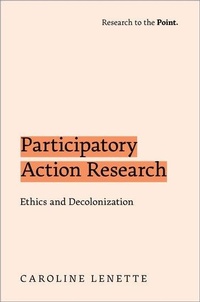
Participatory Action Research
Ethics and Decolonization
Published on 13. July 2022
Book
Paperback/Softback
160 pages
978-0-19-764496-6 (ISBN)
Description
Participatory Action Research (PAR) privileges the involvement of participants as co-researchers to generate new knowledge and act on findings to effect social change. In PAR projects, academic researchers collaborate closely with co-researchers, working from the idea that these individuals, especially those who are usually marginalized from institutions, can be engaged in meaningful research activities to achieve social justice outcomes in addition to answering research questions. When deployed ethically in collaboration with co-researchers, PAR's participatory element facilitates a 'bottom-up' approach where knowledge is co-created through grassroots or community-based activities.
This book goes beyond a PAR 'how to' manual on the methodology. Rather it synthesizes key learnings in contemporary research, with a distinct focus on the challenging aspects of undertaking PAR in practice and strategies to address these. It provides a clear and user-friendly collection of practical and contextual examples and presents key pointers on the implications of PAR methods, their strengths and weaknesses, and strategies for the field. These examples will be useful for critical class discussions, as well as to anticipate fieldwork pitfalls and pre-empt challenges through collaborative approaches.
This book goes beyond a PAR 'how to' manual on the methodology. Rather it synthesizes key learnings in contemporary research, with a distinct focus on the challenging aspects of undertaking PAR in practice and strategies to address these. It provides a clear and user-friendly collection of practical and contextual examples and presents key pointers on the implications of PAR methods, their strengths and weaknesses, and strategies for the field. These examples will be useful for critical class discussions, as well as to anticipate fieldwork pitfalls and pre-empt challenges through collaborative approaches.
Reviews / Votes
Every now and then, a book comes along which is full of such sheer practical wisdom, determination and meticulous scholarship that it takes your breath away and has you shouting sentences aloud in affirmation. * Professor Alison Phipps, UNESCO Chair for Refugee Integration through Languages and the Arts, University of Glasgow * An unflinching exploration of the joys and messy challenges of engaging in participatory action research that will compel novice and more seasoned researchers alike to critically assess both their practices and their promises. * Associate Professor Susan Cox, University of British Columbia. * This accessible book engages with often opaque elements of participatory research. Through highly accessible writing and reflective vignettes, it encourages us to reflect on how to decolonize and sensitize collective research practice. It should be on all research methods course lists! * Professor Sara Kindon, Te Herenga Waka, Victoria University of Wellington *More details
Series
Language
English
Place of publication
New York
United States
Target group
College/higher education
Dimensions
Height: 254 mm
Width: 177 mm
Thickness: 12 mm
Weight
297 gr
ISBN-13
978-0-19-764496-6 (9780197644966)
Copyright in bibliographic data and cover images is held by Nielsen Book Services Limited or by the publishers or by their respective licensors: all rights reserved.
Schweitzer Classification
Other editions
Additional editions
Book
06/2022
Oxford University Press Inc
€103.99
Shipment within 15-20 days
E-Book
05/2022
OUP eBook
€22.49
Available for download
E-Book
05/2022
OUP eBook
€22.49
Available for download
Person
Caroline Lenette is Associate Professor in the School of Social Sciences and Deputy Director of the Big Anxiety Research Centre at the University of New South Wales (UNSW) Sydney. She is a leading interdisciplinary scholar on participatory, trauma-informed and community-engaged research, and knowledge co-production.
Content
Preface
Acknowledgments
Chapter 1: What is Participatory Action Research? Contemporary Methodological Considerations
Chapter 2: Why decolonize? Participatory Action Research's Origins, Decolonial Research, and Intersectionality
Chapter 3: What does participation entail? Challenges to Genuine Participation in Participatory Action Research
Chapter 4: How do we engage in co-research? Co-Production and Mess
Chapter 5: Participatory Action Research is Ethical, Right? Ethics in Practice and Institutional Ethics
Chapter 6: What of Gender Equality? Feminist Participatory Action Research and Gender Diversity
Chapter 7: How do we influence policy? Challenges to Knowledge Translation
References
Index
Acknowledgments
Chapter 1: What is Participatory Action Research? Contemporary Methodological Considerations
Chapter 2: Why decolonize? Participatory Action Research's Origins, Decolonial Research, and Intersectionality
Chapter 3: What does participation entail? Challenges to Genuine Participation in Participatory Action Research
Chapter 4: How do we engage in co-research? Co-Production and Mess
Chapter 5: Participatory Action Research is Ethical, Right? Ethics in Practice and Institutional Ethics
Chapter 6: What of Gender Equality? Feminist Participatory Action Research and Gender Diversity
Chapter 7: How do we influence policy? Challenges to Knowledge Translation
References
Index