

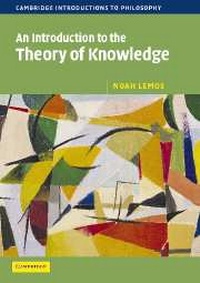
An Introduction to the Theory of Knowledge
Published on 15. February 2007
Book
Paperback/Softback
239 pages
978-0-521-60309-6 (ISBN)
Description
Epistemology or the theory of knowledge is one of the cornerstones of analytic philosophy, and this book provides a clear and accessible introduction to the subject. It discusses some of the main theories of justification, including foundationalism, coherentism, reliabilism, and virtue epistemology. Other topics include the Gettier problem, internalism and externalism, skepticism, the problem of epistemic circularity, the problem of the criterion, a priori knowledge, and naturalized epistemology. Intended primarily for students taking a first class in epistemology, this lucid and well-written text would also provide an excellent introduction for anyone interested in knowing more about this important area of philosophy.
More details
Series
Language
English
Place of publication
Cambridge
United Kingdom
Target group
College/higher education
Professional and scholarly
Product notice
Paperback (trade)
Dimensions
Height: 247 mm
Width: 174 mm
Thickness: 15 mm
Weight
500 gr
ISBN-13
978-0-521-60309-6 (9780521603096)
Copyright in bibliographic data and cover images is held by Nielsen Book Services Limited or by the publishers or by their respective licensors: all rights reserved.
Schweitzer Classification
Other editions
New editions
Noah Lemos
An Introduction to the Theory of Knowledge
Book
11/2020
2nd Edition
Cambridge University Press
€44.00
Shipment within 15-20 days
Additional editions
Noah Lemos
An Introduction to the Theory of Knowledge
E-Book
03/2007
Cambridge University Press
€32.49
Available for download
Person
Noah Lemos is Professor of Philosophy at the College of William and Mary, Virginia. He is author of Intrinsic Value (1994) and Common Sense (2004).
Content
1. Knowledge, truth and justification; 2. The traditional analysis and the Gettier Problem; 3. Foundationalism; 4. The coherence theory of justification; 5. Reliabilism and virtue epistemology; 6. Internalism, externalism and epistemic circularity; 7. Skepticism; 8. The problem of the criterion; 9. The a priori; 10. Naturalized epistemology.