

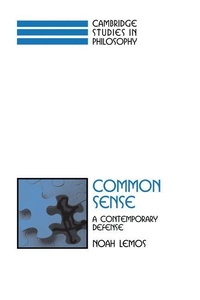
Common Sense
A Contemporary Defense
Published on 10. June 2010
Book
Paperback/Softback
212 pages
978-0-521-14345-5 (ISBN)
Description
In this 2004 book, Noah Lemos presents a strong defense of the common sense tradition, the view that we may take as data for philosophical inquiry many of the things we ordinarily think we know. He discusses the main features of that tradition as expounded by Thomas Reid, G. E. Moore and Roderick Chisholm. For a long time common sense philosophers have been subject to two main objections: that they fail to give any non-circular argument for the reliability of memory and perception; and that they pick out instances of knowledge without knowing a criterion for knowledge. Lemos defends the appeal to what we ordinarily think we know in both epistemology and ethics and thus rejects the charge that common sense is dogmatic, unphilosophical or question-begging. Written in a clear and engaging style, this book will appeal to students and philosophers in epistemology and ethics.
Reviews / Votes
"...Academic libraries wanting a solid philosophy collection should acquire this book." CHOICE May 2005 "clear and straightfoward" - Amy M. Schmitter, University of AlbertaMore details
Series
Language
English
Place of publication
Cambridge
United Kingdom
Target group
College/higher education
Professional and scholarly
Product notice
Paperback (trade)
Illustrations
Worked examples or Exercises
Dimensions
Height: 229 mm
Width: 152 mm
Thickness: 13 mm
Weight
352 gr
ISBN-13
978-0-521-14345-5 (9780521143455)
Copyright in bibliographic data and cover images is held by Nielsen Book Services Limited or by the publishers or by their respective licensors: all rights reserved.
Schweitzer Classification
Other editions
Additional editions
E-Book
07/2006
1st Edition
Cambridge University Press
€26.49
Available for download
Book
08/2004
Cambridge University Press
€122.40
Shipment within 15-20 days
Person
Content
Acknowledgements; Preface; 1. The common sense tradition; 2. Common sense and reliability I; 3. Common sense and reliability II; 4. Reid, reliability, and Reid's wrong turn; 5. Moore, skepticism, and the external world; 6. Chisholm, particularism, and methodism; 7. Common sense and a priori epistemology; 8. Particularism, ethical skepticism, and moral philosophy; Conclusion; Selected bibliography; Index.