

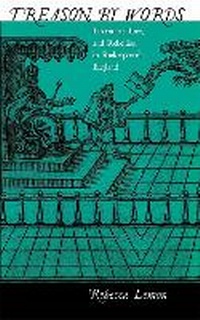
Treason by Words
Literature, Law, and Rebellion in Shakespeare's England
Published on 5. May 2006
Book
Hardback
256 pages
978-0-8014-4428-9 (ISBN)
Description
Under the Tudor monarchy, English law expanded to include the category of "treason by words." Rebecca Lemon investigates this remarkable phrase both as a legal charge and as a cultural event. English citizens, she shows, expressed competing notions of treason in opposition to the growing absolutism of the monarchy. Lemon explores the complex participation of texts by John Donne, Ben Jonson, and William Shakespeare in the legal and political controversies marking the Earl of Essex's 1601 rebellion and the 1605 Gunpowder Plot. Lemon suggests that the articulation of diverse ideas about treason within literary and polemical texts produced increasingly fractured conceptions of the crime of treason itself. Further, literary texts, in representing issues familiar from political polemic, helped to foster more free, less ideologically rigid, responses to the crisis of treason. As a result, such works of imagination bolstered an emerging discourse on subjects' rights. Treason by Words offers an original theory of the role of dissent and rebellion during a period of burgeoning sovereign power.
Reviews / Votes
It may be that, as the republican theorists of Ancient Rome and Early Modern England understood, tyranny does not consist in an overly rigid enforcement of the law, but on the replacement of the objective laws of logic by arbitrary laws such as those of the marketplace, individual whim, or mere fiction. When this happens, rhetoric becomes a legal matter, certain kinds of statement become criminal, and the notion of 'treason by words' gains new currency. Treason by Words examines the consequences of such a development. Its analysis is incisive and its warnings timely.(Times Literary Supplement) Lemon points out that the arguments in favor of Richard II's deposition that Hayward puts into the mouth of the Archbishop of Canterbury echo the arguments for Elizabeth's deposition. Lemon indicates how the controversy surrounding Haywards's subsequent prosecution produced competing definitions of treason and sovereignty. Lemon's book provides valuable New Historical leverage on how early modern English writers dealt with the problem of treason and tyranny, a problem becoming familiar again.
(Renaissance Quarterly)
More details
Language
English
Place of publication
Ithaca
United States
Target group
College/higher education
Professional and scholarly
Product notice
Paper over boards
Dimensions
Height: 229 mm
Width: 152 mm
Thickness: 24 mm
Weight
907 gr
ISBN-13
978-0-8014-4428-9 (9780801444289)
Copyright in bibliographic data and cover images is held by Nielsen Book Services Limited or by the publishers or by their respective licensors: all rights reserved.
Schweitzer Classification
Other editions
Additional editions
E-Book
02/2011
1st Edition
Cornell University Press
€162.99
Available for download
Person
Rebecca Lemon is Associate Professor of English at the University of Southern California.