

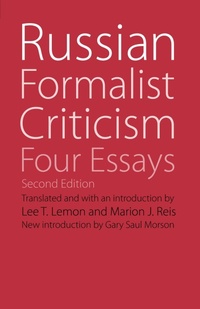
Russian Formalist Criticism
Four Essays, Second Edition
Published on 1. July 2012
Book
Paperback/Softback
172 pages
978-0-8032-3998-2 (ISBN)
Description
The Russian formalists emerged from the Russian Revolution with ideas about the independence of literature. They enjoyed that independence until Stalin shut them down. By then, however, they had produced essays that remain among the best defenses ever written for both literature and its theory.
Included here are four essays representing key points in the formalists' short history. Victor Shklovsky's pioneering "Art as Technique" (1917) defines the literary as a way to make us see familiar things as if for the first time. His 1921 essay on Tristram Shandy makes that eccentric novel the centerpiece for a theory of narrative. A section from Boris Tomashevsky's "Thematics" (1925) inventories the elements of stories. In "The Theory of the 'Formal Method'" (1927), Boris Eichenbaum defends Russian Formalism against various attacks. An able champion, he describes Formalism's evolution, notes its major figures and works, clears away decayed axioms, and rescues literature from "primitive historicism" and other dangers.
These essays set a course for literary studies that led to Prague structuralism, French semiotics, and postmodern poetics. Russian Formalist Criticism has been honored as a Choice Outstanding Academic Book of the Year by the American Library Association.
Included here are four essays representing key points in the formalists' short history. Victor Shklovsky's pioneering "Art as Technique" (1917) defines the literary as a way to make us see familiar things as if for the first time. His 1921 essay on Tristram Shandy makes that eccentric novel the centerpiece for a theory of narrative. A section from Boris Tomashevsky's "Thematics" (1925) inventories the elements of stories. In "The Theory of the 'Formal Method'" (1927), Boris Eichenbaum defends Russian Formalism against various attacks. An able champion, he describes Formalism's evolution, notes its major figures and works, clears away decayed axioms, and rescues literature from "primitive historicism" and other dangers.
These essays set a course for literary studies that led to Prague structuralism, French semiotics, and postmodern poetics. Russian Formalist Criticism has been honored as a Choice Outstanding Academic Book of the Year by the American Library Association.
Reviews / Votes
"Some of the most important literary theory of this century."-College EnglishMore details
Series
Edition
Secondtion edition
Language
English
Place of publication
Lincoln
United States
Target group
College/higher education
Product notice
Paperback (trade)
Dimensions
Height: 224 mm
Width: 141 mm
Thickness: 13 mm
Weight
237 gr
ISBN-13
978-0-8032-3998-2 (9780803239982)
Copyright in bibliographic data and cover images is held by Nielsen Book Services Limited or by the publishers or by their respective licensors: all rights reserved.
Schweitzer Classification
Other editions
Previous edition
Book
12/1965
University of Nebraska Press
€34.84
Shipment within 10-20 days
Persons
Lee T. Lemon is an emeritus professor of English at the University of Nebraska-Lincoln and the author of several books, including Portraits of the Artist in Contemporary Fiction and Approaches to Literature: A Guide to Thinking and Writing. Marion J. Reis was affiliated with the Oak Park and River Forest High School in Oak Park, Illinois. Gary Saul Morson is the author of numerous books, including The Words of Others: From Quotations to Culture and "Anna Karenina" in Our Time: Seeing More Wisely.
Content
Introduction by Gary Saul MorsonIntroductionVICTOR SHKLOVSKY Art as Technique Sterne's Tristram Shandy: Stylistic CommentaryBORIS TOMASHEVSKY ThematicsBORIS EICHENBAUM The Theory of the "Formal Method"Index