

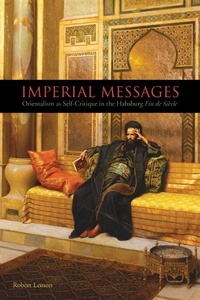
Imperial Messages
Orientalism as Self-Critique in the Habsburg Fin de Siecle
Will be published approx. on 1. June 2011
Book
Hardback
184 pages
978-1-57113-500-1 (ISBN)
Description
Orientalism as self-critique rather than hegemonic discourse in works by Hofmannsthal, Musil, and Kafka.
In recent years a debate has arisen on the applicability of postcolonial theory to the Austro-Hungarian Empire. Some have argued that Austria-Hungary's lack of overseas territories renders the concepts of colonialism and postcolonialism irrelevant, while others have cited the quasi-colonial attitudes of the Viennese elite towards the various "subject peoples" of the empire as a point of comparison. Imperial Messages applies postcolonial theory to works of orientalist fiction by Hugo von Hofmannsthal, Robert Musil, and Franz Kafka, all subjects of the empire, challenging Edward Said's notion that orientalism invariably acts in the ideological service of European colonialism.It argues that these Habsburg authors employ oriental motifs not to promulgate Western hegemony, but to engage in self-reflection and self-critique, including critique of the foundational concepts of orientalist discourse itself.By providing detailed textual analyses of canonical works of Austrian Modernism, including Hofmannsthal's "Tale of the 672nd Night," Musil's Young Toerless, and Kafka's "In the Penal Colony," the book not only offers new postcolonial readings of these Austrian works, but also shows how they question the conventional postcolonial and post-Saidian view of orientalism as a purely hegemonic discourse.
Robert Lemon is Associate Professor of German at the University of Oklahoma.
In recent years a debate has arisen on the applicability of postcolonial theory to the Austro-Hungarian Empire. Some have argued that Austria-Hungary's lack of overseas territories renders the concepts of colonialism and postcolonialism irrelevant, while others have cited the quasi-colonial attitudes of the Viennese elite towards the various "subject peoples" of the empire as a point of comparison. Imperial Messages applies postcolonial theory to works of orientalist fiction by Hugo von Hofmannsthal, Robert Musil, and Franz Kafka, all subjects of the empire, challenging Edward Said's notion that orientalism invariably acts in the ideological service of European colonialism.It argues that these Habsburg authors employ oriental motifs not to promulgate Western hegemony, but to engage in self-reflection and self-critique, including critique of the foundational concepts of orientalist discourse itself.By providing detailed textual analyses of canonical works of Austrian Modernism, including Hofmannsthal's "Tale of the 672nd Night," Musil's Young Toerless, and Kafka's "In the Penal Colony," the book not only offers new postcolonial readings of these Austrian works, but also shows how they question the conventional postcolonial and post-Saidian view of orientalism as a purely hegemonic discourse.
Robert Lemon is Associate Professor of German at the University of Oklahoma.
Reviews / Votes
With his book Robert Lemon delivers a valuable contribution to the topic of orientalism in German-language literature of the late nineteenth and early twentieth centuries. Lemon's work fills a gap in current scholarship, which for the most part has been lacking any focused treatment of orientalism in the context of Austro-Hungarian literature. * GERMAN STUDIES REVIEW * With the formula 'Orientalism as Self-Critique' Robert Lemon has found a theoretical figure that is extremely fruitful in, on the one hand, approaching modernist Austrian literature, and, on the other, problematizing [and critically extending] Said's Orientalism. . . The metadiscourse that comes to light through a careful reading can be understood as an invitation to further historical differentiation. * MUSIL-FORUM * [E]nters much discussed and contested territory, yet manages to offer a fresh perspective. * MODERN LANGUAGE REVIEW * [H]ighly engaging and thought provoking. . . . [A]n important addition to our understanding of postcolonial theory in the context of Austria-Hungary and highly relevant for students working in this field. * FOCUS ON GERMAN STUDIES * In [the] phrase 'orientalism as self-critique,' the book's ambitious subtitle promises a theoretical contribution to the debates on Orientalism of recent decades - and the book certainly delivers. . . . Readers do not usually associate Kafka with the Austrian/Habsburg/Viennese cultural blossoming of the turn of the twentieth century. . . . However, by emphasizing Kafka's Austro-Hungarian identity and the importance of empire . . . in several important stories, Lemon sheds new light on Kafka and his relationship to Orientalism. * JOURNAL OF AUSTRIAN STUDIES * Lemon . . . makes some new and telling points, especially when he discerns classical allusions . . . . [He] convincingly questions attempts at simple identification (e.g. of the jackals in 'Schakale und Araber' with Jews). * JOURNAL OF EUROPEAN STUDIES * [A] clear, smartly argued, and perceptive book. * GERMAN QUARTERLY *More details
Series
Language
English
Place of publication
Columbia, MD
United States
Publishing group
Boydell & Brewer Ltd
Target group
Professional and scholarly
Product notice
Cloth over boards
Illustrations
3 s/w Abbildungen
3 b/w illus.
Dimensions
Height: 236 mm
Width: 159 mm
Thickness: 20 mm
Weight
411 gr
ISBN-13
978-1-57113-500-1 (9781571135001)
Copyright in bibliographic data and cover images is held by Nielsen Book Services Limited or by the publishers or by their respective licensors: all rights reserved.
Schweitzer Classification
Other editions
Additional editions
E-Book
06/2011
1st Edition
De Gruyter
€48.99
Available for download
Person
Content
Introduction
Empiricist Empires: Hofmannsthal's Domestic Orientalism
Empirical Mysticism and Imperial Mystique: Orientalism inMusil's Die Verwirrungen des Zoeglings Toerless
The Sovereign Subject under Siege: Ethnology andEthnocentrism in Kafka's "Description of a Struggle,"Jackals und Arabs," and "In the Penal Colony"
The Contingent Continent: Kafka's China in "Beim Bauder chinesischen Mauer" and "Ein altes Blatt"
Conclusion
Works Cited
Empiricist Empires: Hofmannsthal's Domestic Orientalism
Empirical Mysticism and Imperial Mystique: Orientalism inMusil's Die Verwirrungen des Zoeglings Toerless
The Sovereign Subject under Siege: Ethnology andEthnocentrism in Kafka's "Description of a Struggle,"Jackals und Arabs," and "In the Penal Colony"
The Contingent Continent: Kafka's China in "Beim Bauder chinesischen Mauer" and "Ein altes Blatt"
Conclusion
Works Cited