

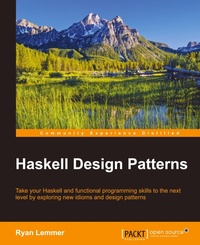
Haskell Design Patterns
Take your Haskell and functional programming skills to the next level by exploring new idioms and design patterns
Published on 6. November 2015
Book
Paperback/Softback
166 pages
978-1-78398-872-3 (ISBN)
Description
Take your Haskell and functional programming skills to the next level by exploring new idioms and design patterns
Key Features
Explore Haskell on a higher level through idioms and patterns
Get an in-depth look into the three strongholds of Haskell: higher-order functions, the Type system, and Lazy evaluation
Expand your understanding of Haskell and functional programming, one line of executable code at a time
Book DescriptionDesign patterns and idioms can widen our perspective by
showing us where to look, what to look at, and ultimately
how to see what we are looking at. At their best, patterns
are a shorthand method of communicating better ways
to code (writing less, more maintainable, and more
efficient code)
This book starts with Haskell 98 and through the lens of
patterns and idioms investigates the key advances and
programming styles that together make "modern Haskell".
Your journey begins with the three pillars of Haskell.
Then you'll experience the problem with Lazy I/O, together
with a solution. You'll also trace the hierarchy formed
by Functor, Applicative, Arrow, and Monad. Next you'll
explore how Fold and Map are generalized by Foldable
and Traversable, which in turn is unified in a broader
context by functional Lenses. You'll delve more deeply into
the Type system, which will prepare you for an overview
of Generic programming. In conclusion you go to the
edge of Haskell by investigating the Kind system and
how this relates to Dependently-typed programmingWhat you will learn
Understand the relationship between the "Gang of Four" OOP Design Patterns and Haskell.
Try out three ways of Streaming I/O: imperative, Lazy, and Iteratee based.
Explore the pervasive pattern of Composition: from function composition through to high-level composition with Lenses.
Synthesize Functor, Applicative, Arrow and Monad in a single conceptual framework.
Follow the grand arc of Fold and Map on lists all the way to their culmination in Lenses and Generic Programming.
Get a taste of Type-level programming in Haskell and how this relates to dependently-typed programming.
Retrace the evolution, one key language extension at a time, of the Haskell Type and Kind systems.
Place the elements of modern Haskell in a historical framework.
Who this book is forIf you're a Haskell programmer with a firm grasp of the basics and ready to move more deeply into modern idiomatic Haskell programming, then this book is for you.
Key Features
Explore Haskell on a higher level through idioms and patterns
Get an in-depth look into the three strongholds of Haskell: higher-order functions, the Type system, and Lazy evaluation
Expand your understanding of Haskell and functional programming, one line of executable code at a time
Book DescriptionDesign patterns and idioms can widen our perspective by
showing us where to look, what to look at, and ultimately
how to see what we are looking at. At their best, patterns
are a shorthand method of communicating better ways
to code (writing less, more maintainable, and more
efficient code)
This book starts with Haskell 98 and through the lens of
patterns and idioms investigates the key advances and
programming styles that together make "modern Haskell".
Your journey begins with the three pillars of Haskell.
Then you'll experience the problem with Lazy I/O, together
with a solution. You'll also trace the hierarchy formed
by Functor, Applicative, Arrow, and Monad. Next you'll
explore how Fold and Map are generalized by Foldable
and Traversable, which in turn is unified in a broader
context by functional Lenses. You'll delve more deeply into
the Type system, which will prepare you for an overview
of Generic programming. In conclusion you go to the
edge of Haskell by investigating the Kind system and
how this relates to Dependently-typed programmingWhat you will learn
Understand the relationship between the "Gang of Four" OOP Design Patterns and Haskell.
Try out three ways of Streaming I/O: imperative, Lazy, and Iteratee based.
Explore the pervasive pattern of Composition: from function composition through to high-level composition with Lenses.
Synthesize Functor, Applicative, Arrow and Monad in a single conceptual framework.
Follow the grand arc of Fold and Map on lists all the way to their culmination in Lenses and Generic Programming.
Get a taste of Type-level programming in Haskell and how this relates to dependently-typed programming.
Retrace the evolution, one key language extension at a time, of the Haskell Type and Kind systems.
Place the elements of modern Haskell in a historical framework.
Who this book is forIf you're a Haskell programmer with a firm grasp of the basics and ready to move more deeply into modern idiomatic Haskell programming, then this book is for you.
More details
Language
English
Place of publication
Birmingham
United Kingdom
Target group
Professional and scholarly
US School Grade: College Graduate Student
Dimensions
Height: 235 mm
Width: 191 mm
Thickness: 10 mm
Weight
323 gr
ISBN-13
978-1-78398-872-3 (9781783988723)
Copyright in bibliographic data and cover images is held by Nielsen Book Services Limited or by the publishers or by their respective licensors: all rights reserved.
Schweitzer Classification
Other editions
Additional editions
Ryan Lemmer
Haskell Design Patterns
Take your Haskell and functional programming skills to the next level by exploring new idioms and design patterns
E-Book
01/2025
Packt Publishing
€26.49
Available for download
Person
Ryan Lemmer is software maker, coach, and strategic advisor based in Cape Town. With a background in mathematics and computer science and 20 years of developing software in the trenches, Ryan remains inspired and humbled by the process of creating and evolving software. Ryan is a polyglot programmer, who prefers to think in Haskell. He loves to learn and facilitate learning for others.
Content
Table of Contents
Functional Patterns: the Building Blocks
Patterns for I/O
Patterns for Composition
Patterns of Folding and Traversing
Patterns of Type Abstraction
Patterns of Generic Programming
Patterns of Kind Abstraction
Functional Patterns: the Building Blocks
Patterns for I/O
Patterns for Composition
Patterns of Folding and Traversing
Patterns of Type Abstraction
Patterns of Generic Programming
Patterns of Kind Abstraction