

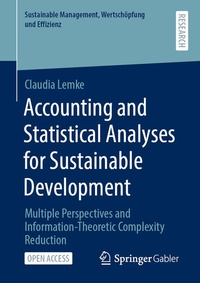
Accounting and Statistical Analyses for Sustainable Development
Multiple Perspectives and Information-Theoretic Complexity Reduction
1st Edition
Published on 31. March 2021
Book
Paperback/Softback
296 pages
978-3-658-33245-7 (ISBN)
Description
In this Open Access publication Claudia Lemke develops a comprehensive Multi-Level Sustainable Development Index (MLSDI) that is applicable to micro, meso, and macro objects by conducting methodological and empirical research. Multi-level comparability is crucial because the Sustainable Development Goals (SDGs) at macro level can only be achieved if micro and meso objects contribute. The author shows that a novel information-theoretic algorithm outperforms established multivariate statistical weighting methods such as the principal component analysis (PCA). Overcoming further methodological shortcomings of previous sustainable development indices, the MLSDI avoids misled managerial and political decision making.
More details
Product info
Paperback
Series
Edition
1st ed. 2021
Language
English
Place of publication
Wiesbaden
Germany
Publishing group
Springer Fachmedien Wiesbaden GmbH
Target group
Professional and scholarly
Illustrations
52 s/w Abbildungen
52 Illustrations, black and white; CCLXIII, 31 p. 52 illus.
Dimensions
Height: 210 mm
Width: 148 mm
Thickness: 17 mm
Weight
386 gr
ISBN-13
978-3-658-33245-7 (9783658332457)
DOI
10.1007/978-3-658-33246-4
Schweitzer Classification
Person
Dr. Claudia Lemke holds a doctorate degree in Sustainability Accounting and Management Control from the Technische Universität Berlin. She worked several years as a Senior Research Associate in the field of sustainability science and corporate sustainability. She is now employed as a Supply Chain Sustainability Manager and is responsible for driving sustainability in the FMCG industry.
Content
Introduction.- Conceptual framework of sustainable development.- Measuring and assessing contributions to sustainable development.- Methodology.- Empirical fndings.- Discussion and conclusion