

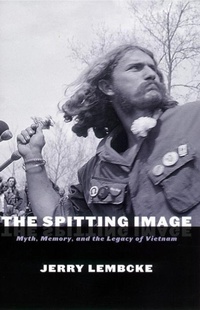
The Spitting Image
Myth, Memory, and the Legacy of Vietnam
Published on 1. May 2000
Book
Paperback/Softback
217 pages
978-0-8147-5147-3 (ISBN)
Description
How the startling image of an anti-war protested spitting on a uniformed veteran misrepresented the narrative of Vietnam War political debate
One of the most resilient images of the Vietnam era is that of the anti-war protester - often a woman - spitting on the uniformed veteran just off the plane. The lingering potency of this icon was evident during the Gulf War, when war supporters invoked it to discredit their opposition.
In this startling book, Jerry Lembcke demonstrates that not a single incident of this sort has been convincingly documented. Rather, the anti-war Left saw in veterans a natural ally, and the relationship between anti-war forces and most veterans was defined by mutual support. Indeed one soldier wrote angrily to Vice President Spiro Agnew that the only Americans who seemed concerned about the soldier's welfare were the anti-war activists.
While the veterans were sometimes made to feel uncomfortable about their service, this sense of unease was, Lembcke argues, more often rooted in the political practices of the Right. Tracing a range of conflicts in the twentieth century, the book illustrates how regimes engaged in unpopular conflicts often vilify their domestic opponents for "stabbing the boys in the back."
Concluding with an account of the powerful role played by Hollywood in cementing the myth of the betrayed veteran through such films as Coming Home, Taxi Driver, and Rambo, Jerry Lembcke's book stands as one of the most important, original, and controversial works of cultural history in recent years.
One of the most resilient images of the Vietnam era is that of the anti-war protester - often a woman - spitting on the uniformed veteran just off the plane. The lingering potency of this icon was evident during the Gulf War, when war supporters invoked it to discredit their opposition.
In this startling book, Jerry Lembcke demonstrates that not a single incident of this sort has been convincingly documented. Rather, the anti-war Left saw in veterans a natural ally, and the relationship between anti-war forces and most veterans was defined by mutual support. Indeed one soldier wrote angrily to Vice President Spiro Agnew that the only Americans who seemed concerned about the soldier's welfare were the anti-war activists.
While the veterans were sometimes made to feel uncomfortable about their service, this sense of unease was, Lembcke argues, more often rooted in the political practices of the Right. Tracing a range of conflicts in the twentieth century, the book illustrates how regimes engaged in unpopular conflicts often vilify their domestic opponents for "stabbing the boys in the back."
Concluding with an account of the powerful role played by Hollywood in cementing the myth of the betrayed veteran through such films as Coming Home, Taxi Driver, and Rambo, Jerry Lembcke's book stands as one of the most important, original, and controversial works of cultural history in recent years.
Reviews / Votes
"Well-argued and documented" (Berkshire Eagle) "The image is ingrained: A Vietnam veteran, arriving home from the war, gets off a plane only to be greeted by an angry mob of antiwar protesters yelling, 'Murderer!' and 'Baby killer!' Then out of the crowd comes someone who spits in the veteran's face. The only problem, according to Jerry Lembcke, is that no such incident ever has been documented. It is instead, says Lembcke, a kind of urban myth that reflects our lingering national confusion over the war." (Los Angeles Times) "The best history I have seen on the impact of the war on Americans, both then and now." - David Dellinger "The myth of the spat-upon veteran is not only bad history, but it has been instrumental in selling the American public on bad policy." - Maurice Isserman (Chicago Tribune) "Lembcke builds a compelling case against collective memory by demonstrating that remembrances of Vietnam were almost at direct odds with circumstantial evidence." (San Francisco Chronicle)More details
Edition
Revised edition
Language
English
Place of publication
New York
United States
Target group
College/higher education
Professional and scholarly
Product notice
Paperback (trade)
Dimensions
Height: 223 mm
Width: 147 mm
Thickness: 15 mm
Weight
336 gr
ISBN-13
978-0-8147-5147-3 (9780814751473)
Copyright in bibliographic data and cover images is held by Nielsen Book Services Limited or by the publishers or by their respective licensors: all rights reserved.
Schweitzer Classification
Other editions
Additional editions
E-Book
05/2000
New York University Press
€27.49
Available for download
E-Book
05/2000
New York University Press
€142.99
Available for download
Person
Jerry Lembcke grew up in Northwest Iowa. He was drafted in 1968 and served as a Chaplain's Assistant in Vietnam. He is the author of eight books including The Spitting Image, CNN's Tailwind Tail, and Hanoi Jane. His opinion pieces have appeared in The New York Times, Boston Globe, and The Chronicle of Higher Education. He is presently Associate Professor of Sociology, Emeritus, at Holy Cross College and Distinguished Lecturer for the Organization of American Historians.