

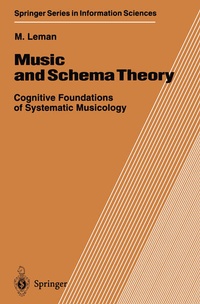
Music and Schema Theory
Cognitive Foundations of Systematic Musicology
Published on 15. December 2011
Book
Paperback/Softback
XIII, 234 pages
978-3-642-85215-2 (ISBN)
Description
Music is an important domain of application for schema theory. The perceptual structures for pitch and timbre have been mapped via schemata, with results that have contributed to a better understanding of music perception. Yet we still need to know how a schema comes into existence, or how it functions in a particular perception task. This book provides a foundation for the understanding of the emergence and functionality of schemata by means of computer-based simulations of tone center perception. It is about how memory structures self-organize and how they use contextual information to guide perception.
More details
Series
Edition
Softcover reprint of the original 1st ed. 1995
Language
English
Place of publication
Berlin
Germany
Publishing group
Springer Berlin
Target group
Professional and scholarly
Research
Illustrations
XIII, 234 p.
Dimensions
Height: 235 mm
Width: 155 mm
Thickness: 15 mm
Weight
394 gr
ISBN-13
978-3-642-85215-2 (9783642852152)
DOI
10.1007/978-3-642-85213-8
Schweitzer Classification
Other editions
Additional editions
Book
08/1995
Springer
€85.55
Article exhausted; check different version
Content
1. Introduction.- 2. Tone Semantics.- 2.1 The Problem of Tone Semantics.- 2.2 Historical Background.- 2.3 Consonance Theory.- 2.4 Cognitive Structuralism.- 2.5 The Static vs. Dynamic Approach.- 2.6 Conclusion.- 3. Pitch as an Emerging Percept.- 3.1 The Two-Component Theory of Révész.- 3.2 Attribute Theory Reconsidered.- 3.3 The Shepard-Tone.- 3.4 Paradoxes of Pitch Perception.- 3.5 The Shepard-Illusion.- 3.6 Ambiguous Stimuli.- 3.7 Conclusion.- 4. Defining the Framework.- 4.1 The Computer Model.- 4.2 Representational Categories.- 4.3 Conclusion.- 5. Auditory Models of Pitch Perception.- 5.1 The Missing Fundamental.- 5.2 Auditory Models.- 5.3 SAM: A Simple Model.- 5.4 TAM: A Place Model.- 5.5 VAM: A Place-Time Model 53.- 5.6 Conclusion.- 6. Schema and Learning.- 6.1 Gestalt Perception.- 6.2 Tone Semantics and Self-Organization.- 6.3 SOM: The Self-Organizing Map.- 6.4 Architecture.- 6.5 Dynamics.- 6.6 Implementation.- 6.7 Conclusion.- 7. Learning Images-out-of-Time.- 7.1 SAMSOM.- 7.2 TAMSOM.- 7.3 VAMSOM.- 7.4 Conclusion.- 8. Learning Images-in-Time.- 8.1 Temporal Constraints in Tonality Perception.- 8.2 Tone Images-in-Time.- 8.3 Tone Context Images.- 8.4 Determination of the Integration Period.- 8.5 TAMSOM.- 8.6 VAMSOM.- 8.7 Conclusion.- 9. Schema and Control.- 9.1 Schema-Based Dynamics.- 9.2 TCAD: Tone Center Attraction Dynamics.- 9.3 TCAD - Stable States.- 9.4 TCAD - Recognition.- 9.5 TCAD - Interpretation.- 9.6 The TCAD Model.- 9.7 TCAD - At Work.- 9.8 Conclusion.- 10. Evaluation of the Tone Center Recognition Model.- 10.1 Overview of Other Models.- 10.2 TCAD-Based Tone Center Analysis.- 10.3 The Evaluation Method.- 10.4 Bartók - Through the Keys.- 10.5 Brahms - Sextet No. 2.- 10.6 Chopin - Prélude No. 20.- 10.7 The Effect of Phrase - Re-evaluationof Through the Keys.- 10.8 Conclusion.- 11. Rhythm and Timbre Imagery.- 11.1 Models of Rhythm Perception.- 11.2 VRAM: A Rhythm Analysis Model.- 11.3 The Analysis of Timbre.- 11.4 Conclusion.- 12. Epistemological Foundations.- 12.1 Epistemological Relevance.- 12.2 Neurophysiological Foundations.- 12.3 Modular Organization.- 12.4 Relevance for a Theory of Meaning.- 12.5 Music Semantics and Meaning Formation.- 12.6 Epistemological Principles.- 12.7 Conclusion.- 13. Cognitive Foundations of Systematic Musicology.- 13.1 Cognitive Musicology, AI and Music, and Systematic Musicology.- 13.2 Historical-Scientific Background.- 13.3 New Developments in the 1960s.- 13.4 A Discipline of Musical Imagery.- 13.5 A Psycho-morphological Account of Musical Imagery.- 13.6 Interdisciplinary Foundations.- 13.7 General Conclusion.- A. Orchestra Score in CSOUND.- A.l The Orchestra File.- A. 2 The Score File.- B. Physiological Foundations of the Auditory Periphery.- B.1 The Ear.- B.2 The Neuron.- B.3 Coding.- B. 4 The Brain Stem and Cortex.- C. Normalization and Similarity Measures.- C. l Similarity Measures.- C.2 Towards a Psychoacoustic-Based Similarity Measure.- References.