

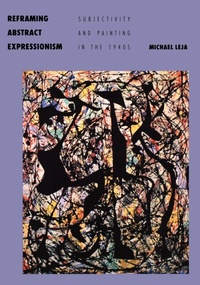
Reframing Abstract Expressionism
Subjectivity and Painting in the 1940s
Will be published approx. on 1. April 1997
Book
Paperback/Softback
400 pages
978-0-300-07082-8 (ISBN)
Description
In the wake of World War II, the paintings of Jackson Pollock, Mark Rothko, Barnett Newman, Willem de Kooning, and other New York School artists participated in a culture-wide initiative to reimagine the self. At a time when widely held beliefs about human nature and the human condition were coming to seem to many commentators increasingly outdated and inadequate, Abstract Expressionism gave compelling visual form to a new subjectivity-a new experience and idea of self.
In this original and wide-ranging study, Michael Leja argues that the interest of these artists in tapping "primitive" and unconscious components of self aligns them with many contemporary essayists, Hollywood filmmakers, journalists, and popular philosophers who were turning, like the artists, to psychology, anthropology, and philosophy in the effort to reformulate individual identity. Taking Pollock's paintings and their reception as a case study, Leja shows that critics located in Pollock's abstract forms a web of metaphors-including spatial entrapment, conflicted production, energy flow, gendered opposition, and unconsciousness-that situated the paintings in mainstream cultural discourses on the individual's sense of self and identity. In this interpretative frame, the cultural and ideological character of the art is illuminated. According to Leja, Abstract Expressionism effectively enacted and represented the new, conflicted, layered subjectivity, a feature that helps to account for the support and interest it garnered from cultural and political institutions alike.
In this original and wide-ranging study, Michael Leja argues that the interest of these artists in tapping "primitive" and unconscious components of self aligns them with many contemporary essayists, Hollywood filmmakers, journalists, and popular philosophers who were turning, like the artists, to psychology, anthropology, and philosophy in the effort to reformulate individual identity. Taking Pollock's paintings and their reception as a case study, Leja shows that critics located in Pollock's abstract forms a web of metaphors-including spatial entrapment, conflicted production, energy flow, gendered opposition, and unconsciousness-that situated the paintings in mainstream cultural discourses on the individual's sense of self and identity. In this interpretative frame, the cultural and ideological character of the art is illuminated. According to Leja, Abstract Expressionism effectively enacted and represented the new, conflicted, layered subjectivity, a feature that helps to account for the support and interest it garnered from cultural and political institutions alike.
More details
Language
English
Place of publication
United States
Target group
College/higher education
Product notice
Paperback (trade)
Illustrations
92 b-w illus.
Dimensions
Height: 255 mm
Width: 177 mm
Thickness: 27 mm
Weight
1022 gr
ISBN-13
978-0-300-07082-8 (9780300070828)
Copyright in bibliographic data and cover images is held by Nielsen Book Services Limited or by the publishers or by their respective licensors: all rights reserved.
Schweitzer Classification