

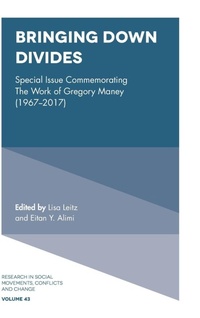
Bringing Down Divides
Special Issue Commemorating the Work of Gregory Maney (1967 - 2017)
Published on 7. October 2019
Book
Hardback
280 pages
978-1-78769-406-4 (ISBN)
Description
The 43rd Volume of Research in Social Movements, Conflicts and Change continues the series' tradition of publishing peer reviewed chapters, which advance our understanding of peace, political contention, and social change, by offering new ways to research and theorize attempts to challenge divides. Dedicated to the memory of Gregory M. Maney, Bringing Down Divides engages with and continues Maney's work on international conflicts, peace and justice movements, and community-based research.
The volume is organized around three types of divides:
Attributional divides, meaning the quality or feature of people around which resources, rights, and powers are distributed unequally, such as race, gender, and ethno-nationality.
Ideological divides which encompass the systems of meaning, ideas, and beliefs that split and polarize people, such as conservative vs. progressive and antiwar vs. pro-war.
Epistemological divides, namely the types, productions, and usages of knowledge over which conflicts occur, such as the academic-activist divide.
The contributions to each of these sections focus on a variety of global issues, including the changing nature of political murals in Northern Ireland; armed actors' responses to civilian demands in Colombian peace territories; boundary-blurring in Turkey's leftwing-Islamist movement; and community-based action research. This makes Bringing Down Divides essential reading for those working and researching within the social movement field.
The volume is organized around three types of divides:
Attributional divides, meaning the quality or feature of people around which resources, rights, and powers are distributed unequally, such as race, gender, and ethno-nationality.
Ideological divides which encompass the systems of meaning, ideas, and beliefs that split and polarize people, such as conservative vs. progressive and antiwar vs. pro-war.
Epistemological divides, namely the types, productions, and usages of knowledge over which conflicts occur, such as the academic-activist divide.
The contributions to each of these sections focus on a variety of global issues, including the changing nature of political murals in Northern Ireland; armed actors' responses to civilian demands in Colombian peace territories; boundary-blurring in Turkey's leftwing-Islamist movement; and community-based action research. This makes Bringing Down Divides essential reading for those working and researching within the social movement field.
More details
Series
Language
English
Place of publication
Bingley
United Kingdom
Target group
Professional and scholarly
Dimensions
Height: 235 mm
Width: 157 mm
Thickness: 20 mm
Weight
563 gr
ISBN-13
978-1-78769-406-4 (9781787694064)
Copyright in bibliographic data and cover images is held by Nielsen Book Services Limited or by the publishers or by their respective licensors: all rights reserved.
Schweitzer Classification
Other editions
Additional editions
Lisa Leitz | Eitan Y. Alimi
Bringing Down Divides
Special Issue Commemorating the Work of Gregory Maney (1967 - 2017)
E-Book
10/2019
1st Edition
Emerald Publishing Limited
€104.99
Available for download
Persons
Lisa Leitz is the Delp-Wilkinson Professor of Peace Studies at Chapman University. She is the Series Editor of RSMCC and the author of Fighting for Peace: Veterans and Military Families in the Anti-Iraq War Movement (2014).
Eitan Y. Alimi is Associate Professor of Sociology at the Hebrew University, Jerusalem. He has published in numerous reputable journals and co-authored two books: The Dynamics of Radicalization (2015) and Popular Contention, Regime, and Transition (2016).
Eitan Y. Alimi is Associate Professor of Sociology at the Hebrew University, Jerusalem. He has published in numerous reputable journals and co-authored two books: The Dynamics of Radicalization (2015) and Popular Contention, Regime, and Transition (2016).
Content
Introduction: Thinking about Divides; Lisa Leitz & Eitan AlimiSection I: Attributional Divides
Chapter 1. (Lead Chapter) Paramilitary Public Symbolic Displays in Northern Ireland: A Content and Geospatial Analysis; Gregory M. Maney, Lee A. Smithey & Joshua Satre
Chapter 2. Endeavoring to Change History: Palestinian-led Transnational Coalitions in the Occupied West Bank; Michelle Gawerc
Chapter 3. 'As We Come Marching': Framing Amplification and Transformation Through Songs and Poetry; William F. Danaher and Trisha L. Crawshaw
Section II: Ideological Divides
Chapter 4. (Lead Chapter) Religion, Ideology, and Support for Nonviolent Revolutionary Struggles: A Comparison of Catholic Leaders in Argentina, Chile, and El Salvador in the 1970s-1980s; Sharon Erickson Nepstad
Chapter 5. Boundary Blurring as Collective Identity Formation? The Case of the Left-Wing Islamists in Turkey; Mustafa Yavas
Chapter 6. Armed Actors' Responses to Civilian Demands in Three Colombian Peace Territories; Cecile Mouly, Esperanza Hernandez Delgado and Maria Belen Garrido
Chapter 7. The Benefits of Organizational Diversity: Resource Exchange and Collaboration among Women's Groups in New Delhi, India; Vera Heuer
Section III: Epistemological Divides
Chapter 8. (Lead Chapter) Social Movement Research With Whom: Potential Contributions of Community-based Research Methods; Charlotte Ryan and Gregory Squires
Chapter 9. Engaged Academics as Activist Professionals: Privilege and Humility in Addressing Knowledge Divides; Pamela Oliver
Afterword: Challenging divisions and harnessing hope in the scholarly life of Gregory Maney; Patrick G. Coy and Lynne M. Woehrle
Chapter 1. (Lead Chapter) Paramilitary Public Symbolic Displays in Northern Ireland: A Content and Geospatial Analysis; Gregory M. Maney, Lee A. Smithey & Joshua Satre
Chapter 2. Endeavoring to Change History: Palestinian-led Transnational Coalitions in the Occupied West Bank; Michelle Gawerc
Chapter 3. 'As We Come Marching': Framing Amplification and Transformation Through Songs and Poetry; William F. Danaher and Trisha L. Crawshaw
Section II: Ideological Divides
Chapter 4. (Lead Chapter) Religion, Ideology, and Support for Nonviolent Revolutionary Struggles: A Comparison of Catholic Leaders in Argentina, Chile, and El Salvador in the 1970s-1980s; Sharon Erickson Nepstad
Chapter 5. Boundary Blurring as Collective Identity Formation? The Case of the Left-Wing Islamists in Turkey; Mustafa Yavas
Chapter 6. Armed Actors' Responses to Civilian Demands in Three Colombian Peace Territories; Cecile Mouly, Esperanza Hernandez Delgado and Maria Belen Garrido
Chapter 7. The Benefits of Organizational Diversity: Resource Exchange and Collaboration among Women's Groups in New Delhi, India; Vera Heuer
Section III: Epistemological Divides
Chapter 8. (Lead Chapter) Social Movement Research With Whom: Potential Contributions of Community-based Research Methods; Charlotte Ryan and Gregory Squires
Chapter 9. Engaged Academics as Activist Professionals: Privilege and Humility in Addressing Knowledge Divides; Pamela Oliver
Afterword: Challenging divisions and harnessing hope in the scholarly life of Gregory Maney; Patrick G. Coy and Lynne M. Woehrle