

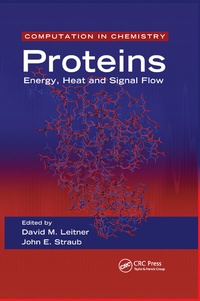
Proteins
Energy, Heat and Signal Flow
1st Edition
Published on 18. October 2019
Book
Paperback/Softback
415 pages
978-0-367-38514-9 (ISBN)
Description
Computational modeling can provide a wealth of insight into how energy flow in proteins mediates protein function. Computational methods can also address fundamental questions related to molecular signaling and energy flow in proteins. Proteins: Energy, Heat and Signal Flow presents state-of-the-art computational strategies for studying energy redistribution, signaling, and heat transport in proteins and other molecular machines.
The first of four sections of the book address the transport of energy in molecular motors, which function through a combination of chemically driven large-scale conformational changes and charge transport. Focusing on vibrational energy flow in proteins and nanostructures, the next two sections discuss approaches based on molecular dynamics simulations and harmonic analysis. By exploring the flow of free energy in proteins, the last section examines the conformational changes involved in allosteric transitions and the role of coupled protein-solvent dynamics in conformational changes. It also presents computational approaches developed to locate pathways between protein structures.
The integrated presentation of this comprehensive, up-to-date volume emphasizes the interrelations between disparate computational approaches that have contributed to our understanding of energy flow in proteins and its role in protein function. By defining the forefront of research in this area, the book delineates the current challenges and opportunities in developing novel methods and applications for the evolving study of energy flow in molecular machines and nanomaterials.
The first of four sections of the book address the transport of energy in molecular motors, which function through a combination of chemically driven large-scale conformational changes and charge transport. Focusing on vibrational energy flow in proteins and nanostructures, the next two sections discuss approaches based on molecular dynamics simulations and harmonic analysis. By exploring the flow of free energy in proteins, the last section examines the conformational changes involved in allosteric transitions and the role of coupled protein-solvent dynamics in conformational changes. It also presents computational approaches developed to locate pathways between protein structures.
The integrated presentation of this comprehensive, up-to-date volume emphasizes the interrelations between disparate computational approaches that have contributed to our understanding of energy flow in proteins and its role in protein function. By defining the forefront of research in this area, the book delineates the current challenges and opportunities in developing novel methods and applications for the evolving study of energy flow in molecular machines and nanomaterials.
More details
Language
English
Place of publication
London
United Kingdom
Publishing group
Taylor & Francis Ltd
Target group
Professional and scholarly
Professional Practice & Development
Dimensions
Height: 234 mm
Width: 156 mm
Weight
453 gr
ISBN-13
978-0-367-38514-9 (9780367385149)
Copyright in bibliographic data and cover images is held by Nielsen Book Services Limited or by the publishers or by their respective licensors: all rights reserved.
Schweitzer Classification
Other editions
Additional editions
E-Book
09/2009
CRC Press
€89.99
Available for download
E-Book
09/2009
1st Edition
CRC Press
€89.99
Available for download
Book
09/2009
1st Edition
CRC Press
€282.53
Article not available at the moment
Persons
David M. Leitner is a Professor of Chemistry at the University of Nevada in Reno.
John E. Straub is a Professor of Chemistry at Boston University in Boston, Massachusetts.
John E. Straub is a Professor of Chemistry at Boston University in Boston, Massachusetts.
Content
Energy Transduction in Molecular Motors. Vibrational Energy Flow in Proteins: Molecular Dynamics-Based Methods. Vibrational Energy Flow in Proteins and Nanostructures: Normal Mode-Based Methods. Conformational Transitions and Reaction Path Searches in Proteins. Index.