

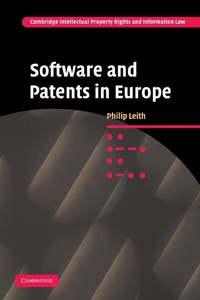
Software and Patents in Europe
1st Edition
Published on 30. June 2011
Book
Paperback/Softback
214 pages
978-0-521-32962-0 (ISBN)
Description
The computer program exclusion from Article 52 of the European Patent Convention (EPC) proved impossible to uphold as industry moved over to digital technology, and the Boards of Appeal of the European Patent Organisation (EPO) felt emboldened to circumvent the EPC in Vicom by creating the legal fiction of 'technical effect'. This 'engineer's solution' emphasised that protection should be available for a device, a situation which has led to software and business methods being protected throughout Europe when the form of application, rather than the substance, is acceptable. Since the Article 52 exclusion has effectively vanished, this text examines what makes examination of software invention difficult and what leads to such energetic opposition to protecting inventive activity in the software field. Leith advocates a more programming-centric approach, which recognises that software examination requires different strategies from that of other technical fields.
More details
Series
Language
English
Place of publication
Cambridge
United Kingdom
Target group
Professional and scholarly
Product notice
Paperback (trade)
Illustrations
Worked examples or Exercises
Dimensions
Height: 229 mm
Width: 152 mm
Thickness: 12 mm
Weight
318 gr
ISBN-13
978-0-521-32962-0 (9780521329620)
Copyright in bibliographic data and cover images is held by Nielsen Book Services Limited or by the publishers or by their respective licensors: all rights reserved.
Schweitzer Classification
Other editions
Additional editions
Philip Leith
Software and Patents in Europe
E-Book
01/2008
1st Edition
Cambridge University Press
€38.49
Available for download
Philip Leith | Leith
Software & Patents in Europe
Book
2007
Cambridge University Press
€147.90
Shipment within 15-20 days
Person
Content
Introduction; 1. Software as machine; 2. Software as software; 3. Policy arguments; 4. Software patent examination; 5. Holding the line: algorithms, business methods and other computing ogres; 6. The third way: between patent and copyright?; 7. Conclusion: dealing with and harmonising 'radical' technologies.