

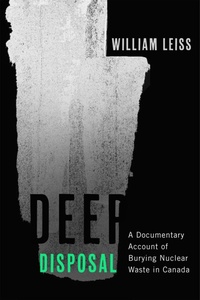
Deep Disposal
A Documentary Account of Burying Nuclear Waste in Canada
Published on 10. September 2024
Book
Paperback/Softback
234 pages
978-0-2280-2282-4 (ISBN)
Description
Canada is one of many countries around the world that use nuclear reactors to generate electrical power, in part to reduce our carbon footprint. Yet this energy produces hazardous, long-lived waste that emits dangerous radioactivity for tens of thousands of years.
Nuclear waste, stored temporarily for decades, must be safely disposed of so it will not pose a serious threat to human health and the environment. This means placing it in locations deep underground in granite, sedimentary rock, or clay. Canada's ideal location is somewhere on the Canadian Shield, the 2.5-billion-year-old crystalline rock that undergirds much of the country. Beginning in 2010 some twenty-two communities, most in Ontario, volunteered to host the repository. In Deep Disposal William Leiss explains the challenges that have arisen in the evaluation of potential sites over the last decade.
High-level nuclear waste is the most hazardous byproduct of an energy source that is incredibly useful and increasingly in demand. Finding the ideal place to store it permanently is an urgent policy crisis facing our country. Deep Disposal reveals the nature of this crisis and how we might overcome it.
Nuclear waste, stored temporarily for decades, must be safely disposed of so it will not pose a serious threat to human health and the environment. This means placing it in locations deep underground in granite, sedimentary rock, or clay. Canada's ideal location is somewhere on the Canadian Shield, the 2.5-billion-year-old crystalline rock that undergirds much of the country. Beginning in 2010 some twenty-two communities, most in Ontario, volunteered to host the repository. In Deep Disposal William Leiss explains the challenges that have arisen in the evaluation of potential sites over the last decade.
High-level nuclear waste is the most hazardous byproduct of an energy source that is incredibly useful and increasingly in demand. Finding the ideal place to store it permanently is an urgent policy crisis facing our country. Deep Disposal reveals the nature of this crisis and how we might overcome it.
Reviews / Votes
"In light of climate change and the imperative to find new energy sources that are not carbon-based, this is a story of great consequence for the future of Canada and other nations. Leiss understands the technical issues exceedingly well and demonstrates a rare and valuable capacity to bring the narrative to life for non-specialists." Michael Kraft, University of Wisconsin-Green Bay"Deep Disposal addresses academics and industry professionals while appealing to a broader, more environmentally conscious crowd. Leiss ... thoroughly explains his technical subject, from how pressurized heavy water reactors work to how nuclear stigma alters public perception of risk. It all amounts to a thoughtful compendium on a task as colossal as it is necessary for Canada to reach net-zero emissions by 2050." Literary Review of Canada
"An essential read for policymakers, environmentalists, and anyone interested in the intersection of science, public policy, and Indigenous rights, Leiss' detailed account of Canada's nuclear waste saga offers valuable lessons for other nations grappling with similar challenges. By placing First Nations and public policy issues at the forefront, the book not only critiques past failures but also charts a path towards a more inclusive and sustainable future. In sum, Deep Disposal is both a sobering reminder of the complexities of nuclear waste management and a hopeful vision for resolving them through collaboration and informed debate. It is a testament to Leiss' ability to navigate one of the most pressing public policy issues of our time with clarity, depth, and compassion." Medicine, Conflict and Survival
More details
Language
English
Place of publication
Montreal
Canada
Target group
Professional and scholarly
Illustrations
7 tables, 3 maps, 1 diagram
Dimensions
Height: 227 mm
Width: 150 mm
Thickness: 16 mm
Weight
354 gr
ISBN-13
978-0-2280-2282-4 (9780228022824)
Copyright in bibliographic data and cover images is held by Nielsen Book Services Limited or by the publishers or by their respective licensors: all rights reserved.
Schweitzer Classification
Other editions
Additional editions

E-Book
09/2024
1st Edition
McGill-Queen's University Press
€72.99
Available for download
E-Book
09/2024
1st Edition
McGill-Queen's University Press
€72.99
Available for download
Person
William Leiss is professor emeritus in the School of Policy Studies at Queen's University and author of several books on climate issues, most recently Canada and Climate Change.