

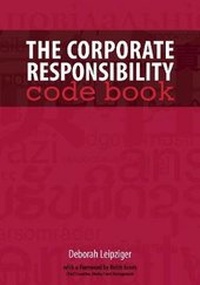
The Corporate Responsibility Code Book
1st Edition
Published on 1. November 2003
Book
Hardback
512 pages
978-1-874719-78-6 (ISBN)
Description
There is no single code or standard, no panacea that will lead to corporate responsibility (CR). Yet, now, more than ever before, corporations are waking up to the fact that they must adopt codes and implement standards to satisfy the growing demands of an ever-wider and ever-less-trustful spectrum of stakeholders. So, where do companies start?
Information overload is nowhere more apparent than in the field of CR. There are millions of pages and web pages written on codes and standards, but most of it is spin: organisations punting to sell their code or standard. The reality is that CR is an emerging field, a new terrain for which maps are much needed, but often imprecise. Each company is different, each with its own challenges, corporate culture, unique set of stakeholders, and management systems. Corporate responsibility is a journey for which, today, there is no single map but a multitude of codes and standards that can be combined in new ways for different journeys. In her many lectures around the world, CSR consultant Deborah Leipziger has been asked the same question over and over again: "What are the best standards for companies seeking to be socially responsible?" Over the course of more than a decade, she has analysed hundreds of codes of conduct and standards to answer that question. This indispensable resource is the result.
The Corporate Responsibility Code Book is a guide for companies trying to understand the landscape of corporate responsibility and searching for their own, unique route towards satisfying diverse stakeholders. There is no one-size-fits-all approach. A company may face quite different challenges if it operates in more than part of the world. And yet stakeholders, especially consumers and investors, are keen for some degree of comparability with which they can evaluate corporate performance. There are countervailing forces at work within corporate responsibility: on the one hand is the need for convergence in order to simplify the large numbers of codes and standards; and, on the other hand, the need to foster diversity and innovation.
Many of the best codes of conduct and standards are not well known while some CR instruments that are well disseminated are not terribly effective. Some comprehensive codes of conduct achieve nothing, while other quite vague codes of conduct become well embedded into the organisation and foster innovation and change. The book explains some of the best CR instruments available, and distils their most valuable elements.
The goal of the book is to help companies select, develop and implement social and environmental codes of conduct. It demonstrates how the world's leading companies are implementing global codes of conduct, including the United Nations Global Compact, the OECD Guidelines for Multinational Enterprises, Social Accountability 8000 (SA 8000) and AccountAbility 1000 (AA 1000). The codes in this book cover a wide range of issues, including human rights, labour rights, environmental management, corruption and corporate governance. The book also includes how-to (or process) codes focusing on reporting, stakeholder engagement and assurance.
This book is based on interviews with the standard-setters, the implementers of standards, academics, activists and other key stakeholders from around the world; and in many cases includes the full text of the code profiled. Each of the standards and codes described has been shared with the promulgators of the instrument to ensure that the information is as up to date as possible.
The Corporate Responsibility Code Book will be an invaluable tool for companies developing their own code, but will also be a key tool for companies with a strong track record in CR, seeking to understand the interrelationships among codes and standards to create their own corporate vision. It will be the key reference text on corporate codes of conduct for many years to come.
Information overload is nowhere more apparent than in the field of CR. There are millions of pages and web pages written on codes and standards, but most of it is spin: organisations punting to sell their code or standard. The reality is that CR is an emerging field, a new terrain for which maps are much needed, but often imprecise. Each company is different, each with its own challenges, corporate culture, unique set of stakeholders, and management systems. Corporate responsibility is a journey for which, today, there is no single map but a multitude of codes and standards that can be combined in new ways for different journeys. In her many lectures around the world, CSR consultant Deborah Leipziger has been asked the same question over and over again: "What are the best standards for companies seeking to be socially responsible?" Over the course of more than a decade, she has analysed hundreds of codes of conduct and standards to answer that question. This indispensable resource is the result.
The Corporate Responsibility Code Book is a guide for companies trying to understand the landscape of corporate responsibility and searching for their own, unique route towards satisfying diverse stakeholders. There is no one-size-fits-all approach. A company may face quite different challenges if it operates in more than part of the world. And yet stakeholders, especially consumers and investors, are keen for some degree of comparability with which they can evaluate corporate performance. There are countervailing forces at work within corporate responsibility: on the one hand is the need for convergence in order to simplify the large numbers of codes and standards; and, on the other hand, the need to foster diversity and innovation.
Many of the best codes of conduct and standards are not well known while some CR instruments that are well disseminated are not terribly effective. Some comprehensive codes of conduct achieve nothing, while other quite vague codes of conduct become well embedded into the organisation and foster innovation and change. The book explains some of the best CR instruments available, and distils their most valuable elements.
The goal of the book is to help companies select, develop and implement social and environmental codes of conduct. It demonstrates how the world's leading companies are implementing global codes of conduct, including the United Nations Global Compact, the OECD Guidelines for Multinational Enterprises, Social Accountability 8000 (SA 8000) and AccountAbility 1000 (AA 1000). The codes in this book cover a wide range of issues, including human rights, labour rights, environmental management, corruption and corporate governance. The book also includes how-to (or process) codes focusing on reporting, stakeholder engagement and assurance.
This book is based on interviews with the standard-setters, the implementers of standards, academics, activists and other key stakeholders from around the world; and in many cases includes the full text of the code profiled. Each of the standards and codes described has been shared with the promulgators of the instrument to ensure that the information is as up to date as possible.
The Corporate Responsibility Code Book will be an invaluable tool for companies developing their own code, but will also be a key tool for companies with a strong track record in CR, seeking to understand the interrelationships among codes and standards to create their own corporate vision. It will be the key reference text on corporate codes of conduct for many years to come.
Reviews / Votes
Occasionally, a book comes along and you know this is going to used again and again ... What can one say about this book? Nothing really: it is simply a great book of reference and will save us all buckets full of work. * <i>Social and Environmental Accounting</i> 1 (2004) * ... indispensable for anyone seeking to grasp the complex landscape of the multitudinous tools that measure corporate social responsibility. The Corporate Responsibility Code Book is not a light read, neither in the sense of its physical heft nor in terms of the import of its contents. The book weighs so much because it reprints the complete texts of 32 of the most important corporate social responsibility (CSR) principles, codes, norms, and standards. For those who work in the CSR field, having those texts in one place is reason enough to buy the book. * <i>Ethical Corporation</i>, 16 April 2004 * This is a guide for companies trying to understand the landscape of corporate responsibility and managing their way through the jungle of sustainability, human rights and CSR standards. The most useful part of the book is the summary, description and text of the most relevant codes of conducts, standards and norms that exist to guide sustainable corporate behaviour. A key reference book for all corporate responsibility professionals. * <i>Sustainability Radar</i>, December 2003 * Corporate Responsibility has become a minefield of issues, with a wide range of stakeholders, all of whom need to be satisfied. Tracking these and the many Code options and guides that are available is a time consuming and, sometimes, frustrating exercise. Deborah Leipziger's book is a welcome relief for those who are desperate for a "one stop shop" reference to provide the basic information of adherence and compliance in the field * <i>Eagle Bulletin</i>, May 2004 * This is a valuable and timely book for a growing number of people in many sectors who need to engage with these principles, standards and codes, but who need guidance on which ones to concentrate on. * <i>The Corporate Citizen</i> 4.1 (2004) *More details
Language
English
Place of publication
Saltaire
United Kingdom
Publishing group
Taylor & Francis Ltd
Target group
College/higher education
Professional and scholarly
Dimensions
Height: 235 mm
Width: 156 mm
Weight
1030 gr
ISBN-13
978-1-874719-78-6 (9781874719786)
Copyright in bibliographic data and cover images is held by Nielsen Book Services Limited or by the publishers or by their respective licensors: all rights reserved.
Schweitzer Classification
Other editions
New editions
Deborah Leipziger
The Corporate Responsibility Code Book - Second edition
Book
07/2010
2nd Edition
Greenleaf Publishing
€104.17
Article exhausted; check for reprint
Person
DEBORAH LEIPZIGER is a consultant in the field of corporate social responsibility, and advises companies on the development and implementation of codes of conduct and standards. Her clients include the UN's Global Compact and Social Accountability International.
Content
Foreword
Keith Jones, Chief Executive, Morley Fund Management
Introduction
Executive summary of corporate responsibility initiatives
1. Values, principles, norms, codes and standards
Part 1: Global initiatives
2. The OECD Guidelines for Multinational Enterprises
3. The Global Sullivan Principles of Social Responsibility
4. The UN Global Compact
Part 2: Human rights
5. The Universal Declaration of Human Rights
6. The Voluntary Principles on Security and Human Rights
7. The Norms on the Responsibilities of Transnational Corporations and Other Business Enterprises with Regard to Human Rights
Part 3: Labour rights
8. International Labour Organisation: Tripartite Declaration of Principles concerning Multinational Enterprises and Social Policy
9. Social Accountability 8000
10. Fair Labor Association: Workplace Code of Conduct
11. Ethical Trading Initiative: Base Code
12. Clean Clothes Campaign: Model Code
13. Other major initiatives in the clothing industry
Part 4: From environment to sustainability
14. The Rio Declaration on Environment and Development
15. The CERES Principles
16. The Natural Step
Part 5: Combating corruption
17. The OECD Convention on Combating Bribery of Foreign Public Officials in International Business Transactions
18. The Business Principles for Countering Bribery
Part 6: Corporate governance
19. The OECD Principles of Corporate Governance
Part 7: Company codes of conduct
20. Shell's Business Principles
21. Johnson & Johnson's "Credo"
Part 8: Framework, sectoral and regional agreements
22. Framework agreements
23. Sectoral and regional agreements
Part 9: Implementation
24. AccountAbility 1000 Framework
25. AccountAbility 1000 Assurance Standard
26. The Global Reporting Initiative
27. ISO 14001
28. The "Sustainability: Integrated Guidelines for Management" (SIGMA) Project
Part 10: Visions for the future
29. An emerging consensus
Keith Jones, Chief Executive, Morley Fund Management
Introduction
Executive summary of corporate responsibility initiatives
1. Values, principles, norms, codes and standards
Part 1: Global initiatives
2. The OECD Guidelines for Multinational Enterprises
3. The Global Sullivan Principles of Social Responsibility
4. The UN Global Compact
Part 2: Human rights
5. The Universal Declaration of Human Rights
6. The Voluntary Principles on Security and Human Rights
7. The Norms on the Responsibilities of Transnational Corporations and Other Business Enterprises with Regard to Human Rights
Part 3: Labour rights
8. International Labour Organisation: Tripartite Declaration of Principles concerning Multinational Enterprises and Social Policy
9. Social Accountability 8000
10. Fair Labor Association: Workplace Code of Conduct
11. Ethical Trading Initiative: Base Code
12. Clean Clothes Campaign: Model Code
13. Other major initiatives in the clothing industry
Part 4: From environment to sustainability
14. The Rio Declaration on Environment and Development
15. The CERES Principles
16. The Natural Step
Part 5: Combating corruption
17. The OECD Convention on Combating Bribery of Foreign Public Officials in International Business Transactions
18. The Business Principles for Countering Bribery
Part 6: Corporate governance
19. The OECD Principles of Corporate Governance
Part 7: Company codes of conduct
20. Shell's Business Principles
21. Johnson & Johnson's "Credo"
Part 8: Framework, sectoral and regional agreements
22. Framework agreements
23. Sectoral and regional agreements
Part 9: Implementation
24. AccountAbility 1000 Framework
25. AccountAbility 1000 Assurance Standard
26. The Global Reporting Initiative
27. ISO 14001
28. The "Sustainability: Integrated Guidelines for Management" (SIGMA) Project
Part 10: Visions for the future
29. An emerging consensus